
Eighteen cells, a 16-bit ADC, ±3 mV, bidirectional daisy chain, ASIL-D—the specifications of Chinese BMS AFEs no longer look like reduced-feature alternatives. That makes the question sharper: if the data sheets are comparable, why are traction-battery BOMs still reluctant to switch?
A BMS AFE is not an ordinary sampling IC. It operates beside a battery pack at hundreds of volts while determining whether a cell is overvoltage, a sense wire is open, or communications have failed. ADC accuracy is the résumé it presents to an automaker. Diagnostic coverage, communications reliability, functional-safety documentation, and full-pack software integration are the employment test.
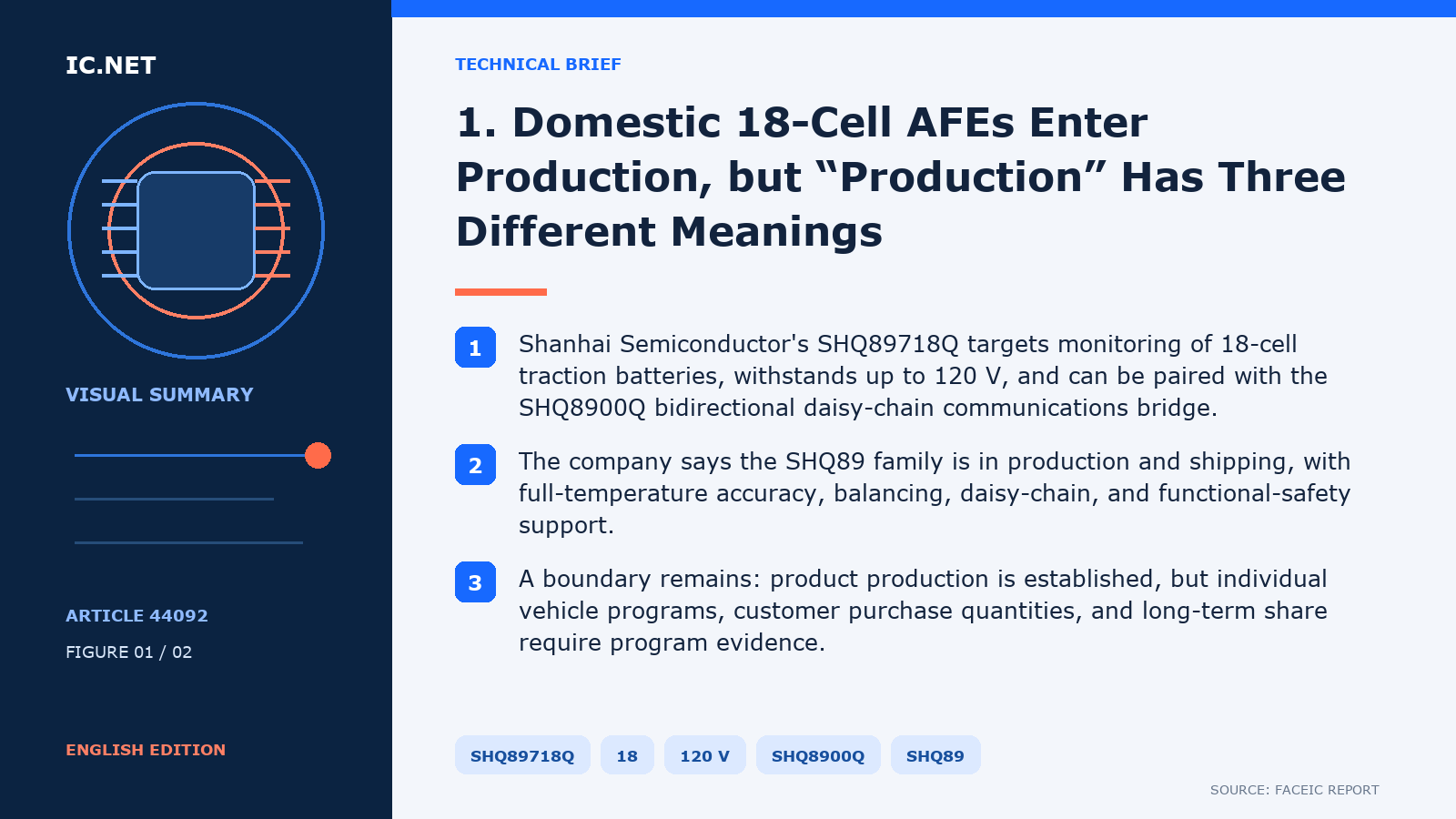
1. Domestic 18-Cell AFEs Enter Production, but “Production” Has Three Different Meanings
A clearer domestic 18-cell product matrix is emerging. BYD Semiconductor's BF891X family includes BF8915A-1, BF8915B-1, and BF8916A across 16 and 18 channels. The company says the family has been in production since 2021 and exceeded 100 million cumulative shipments by July 2026. That proves BF891X has scale; it is a cumulative figure for the complete family, not 100 million units of one 18-channel device.
Shanhai Semiconductor's SHQ89718Q targets monitoring of 18-cell traction batteries, withstands up to 120 V, and can be paired with the SHQ8900Q bidirectional daisy-chain communications bridge. The company says the SHQ89 family is in production and shipping, with full-temperature accuracy, balancing, daisy-chain, and functional-safety support. A boundary remains: product production is established, but individual vehicle programs, customer purchase quantities, and long-term share require program evidence.
3PEAK's 2026 selection guide lists TPB79818Q, TPB79828Q, and TPB7717Q as Production. The first two are 18-channel automotive AFEs supporting 90 V input, ±3 mV accuracy, and UART/daisy-chain communications; TPB79828Q also integrates current sensing. TPB7717Q bridges the AFE and MCU. Yet the company's BMS application page still says Coming Soon, and public information names no customer or SOP. The accurate description is that the products are in the production catalog while evidence of volume vehicle installation remains incomplete.
GigaDevice GD30BM1018RWTR-I also supports 18 cells, 99 V, 2 mV TME, and a 1 Mbps bidirectional daisy chain, but the manufacturer positions it for energy storage. Eighteen-cell monitoring capability does not make it a production automotive traction-battery part. Mixing storage devices, automotive devices, and installed vehicle parts into one domestic production list may look impressive but creates procurement risk.
2. Two 16-Bit ADCs May Not Measure the Same Battery Pack
ADC resolution is the easiest AFE parameter to compare and the easiest to misunderstand. Sixteen bits describes theoretical quantization, not cell-voltage accuracy across temperature, lifetime, and a noisy environment. The stronger comparison is total measurement error, or TME, and whether it includes reference drift, gain error, solder stress, humidity, temperature drift, and aging.
ADI ADBMS1818 supports 18 cells with maximum TME of 3 mV, measures every cell in 290 μs, and provides a 1 Mbps bidirectional isoSPI interface. NXP MC33774 also covers 18 channels; its higher-specification version emphasizes total error no greater than 1.5 mV across temperature, voltage, and lifetime. Mature competition has moved from ADC bit count to how far measurement can drift after ten years.
Synchronization matters too. Battery current changes rapidly under acceleration, regenerative braking, and fast charging. If 18 channels are scanned slowly in sequence, the first and eighteenth readings may not represent the same instant. Fully parallel ADCs, grouped synchronization, and fast scanning involve different tradeoffs. Engineering teams need channel-to-channel timing skew, filter delay, noise, and total pack acquisition time—not a marketing label of simultaneous sampling.
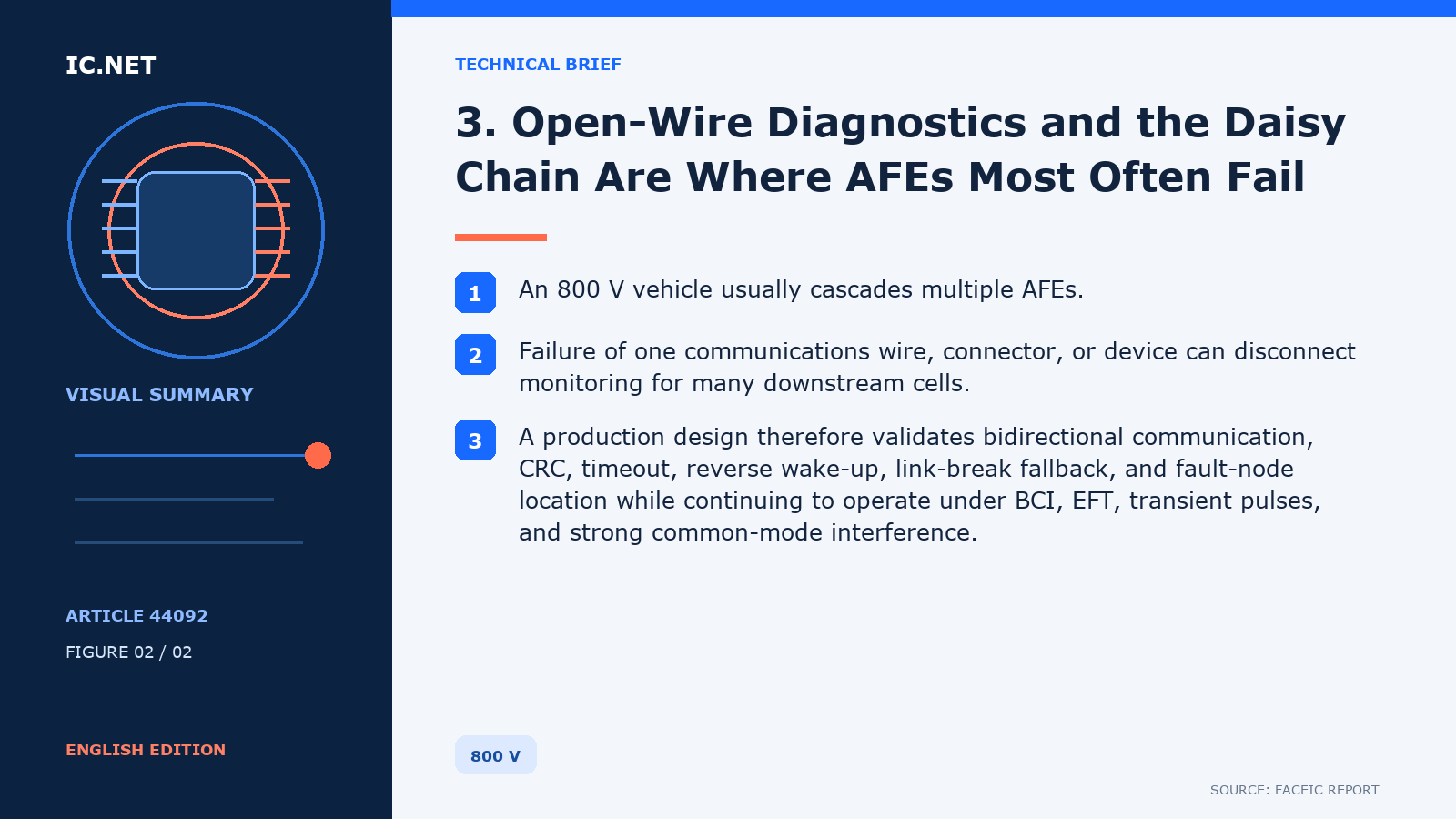
3. Open-Wire Diagnostics and the Daisy Chain Are Where AFEs Most Often Fail
An 800 V vehicle usually cascades multiple AFEs. Failure of one communications wire, connector, or device can disconnect monitoring for many downstream cells. A production design therefore validates bidirectional communication, CRC, timeout, reverse wake-up, link-break fallback, and fault-node location while continuing to operate under BCI, EFT, transient pulses, and strong common-mode interference.
Open-wire diagnostics are more than checking whether one channel has voltage. The system needs paths for an open sense wire, abnormal busbar connection, adjacent-channel short, stuck ADC, drifting reference, clock fault, balancing-switch fault, and failed temperature channel. Those diagnostics cannot create excessive false positives; a driver will not be more tolerant of an unexpected traction-battery warning merely because the IC is domestic.
This is why ASIL functional-safety documentation is valuable. Certification of an ASIL-D development process does not automatically give every product a complete Safety Manual, FMEDA, FIT data, fault-reaction times, and safety-mechanism description. Automakers and Tier 1s need those materials for system safety analysis, fault injection, and diagnostic-coverage calculations. Without them, attractive IC parameters are difficult to turn into responsibility that can be signed off in production documents.
4. Why an AFE Change Also Creates Work for the MCU, Isolation Link, and Pack Software
An AFE never appears alone. A high-voltage BMS also includes a communications bridge, isolation devices, a BMS MCU, balancing resistors and MOSFETs, isolated power, pack-current and total-voltage monitoring, insulation monitoring, contactor drivers, and CAN. Replacing the AFE may change registers, command timing, CRC, wake-up, sampling cadence, fault codes, and balancing strategy.
MCU drivers must then migrate, low-level diagnostics may need rewriting, timestamps for SOC, SOH, and SOP algorithms need recalibration, and HIL, EMC, thermal, and full-pack fault-injection tests must run again. Pin-to-pin compatibility reduces PCB modification; it does not establish software compatibility or reusable safety mechanisms.
A more realistic domestic-adoption path treats the AFE and communications bridge as a chipset for a new vehicle platform or second-source program. First validate full-temperature TME, synchronized acquisition, and balancing thermal effects; then test open-wire, busbar, communications faults, and EMC; and finally move through HIL, full-pack, and small-fleet validation. Saving tens of yuan on the chip without counting software migration, qualification, inventory transition, and fallback can turn into tens of weeks of program delay.
The appearance of 18-cell BMS AFEs on domestic production lists shows that supply has crossed the existence threshold. The outcome is not decided by whether ADC accuracy says ±1 mV or ±3 mV, but whether the device detects faults throughout its lifetime, protects communications, provides complete safety documentation, and allows the full BMS software stack to run stably.
Matching a data sheet starts the contest. Accumulated field data establishes real production.
Disclaimer: This article analyzes public information and does not constitute investment, procurement, or part recommendations. Product status and program adoption are subject to the latest manufacturer and customer validation results.