
Current sensing in EV chargers and energy storage: evaluating Southchip alongside Allegro and TI
Holiday road trips make charging speed and waiting time visible to drivers. Inside an EV charger, current measurement provides the feedback that lets the control system adjust power and recognize abnormal operation. Power converters in energy-storage cabinets need similar information.
Chinese supplier Southchip has introduced products for this function. Comparing its published specifications with those from Allegro and Texas Instruments helps engineering and sourcing teams separate a viable design candidate from a replacement that would require substantial changes to the equipment.
Two Southchip routes place the conductor in different locations
Southchip's 2026 interim report describes the launch of the SCS81XX integrated current-sensor family and SCS910X linear Hall sensors. Their first distinction is where the measured current flows.
SCS8100 integrates the primary current path into its package. Current flows through an internal conductor, a Hall structure senses the resulting field, and the device produces a corresponding output voltage. Southchip lists SCS8100SWAR-FB5050 with a ±50A range, 2MHz bandwidth, 200µΩ internal conductor resistance and SOW10 package. This integrated approach provides a compact option for measurement on a circuit board.
SCS9101 measures magnetic field directly. Its bandwidth is 1MHz and its sensitivity is specified in mV/Gs. Converting that field measurement into current requires an external conductor, magnetic circuit and defined sensor position. Its magnetic sensitivity therefore cannot be compared directly with SCS8100's current sensitivity, and the chip alone does not establish the complete assembly's current range.
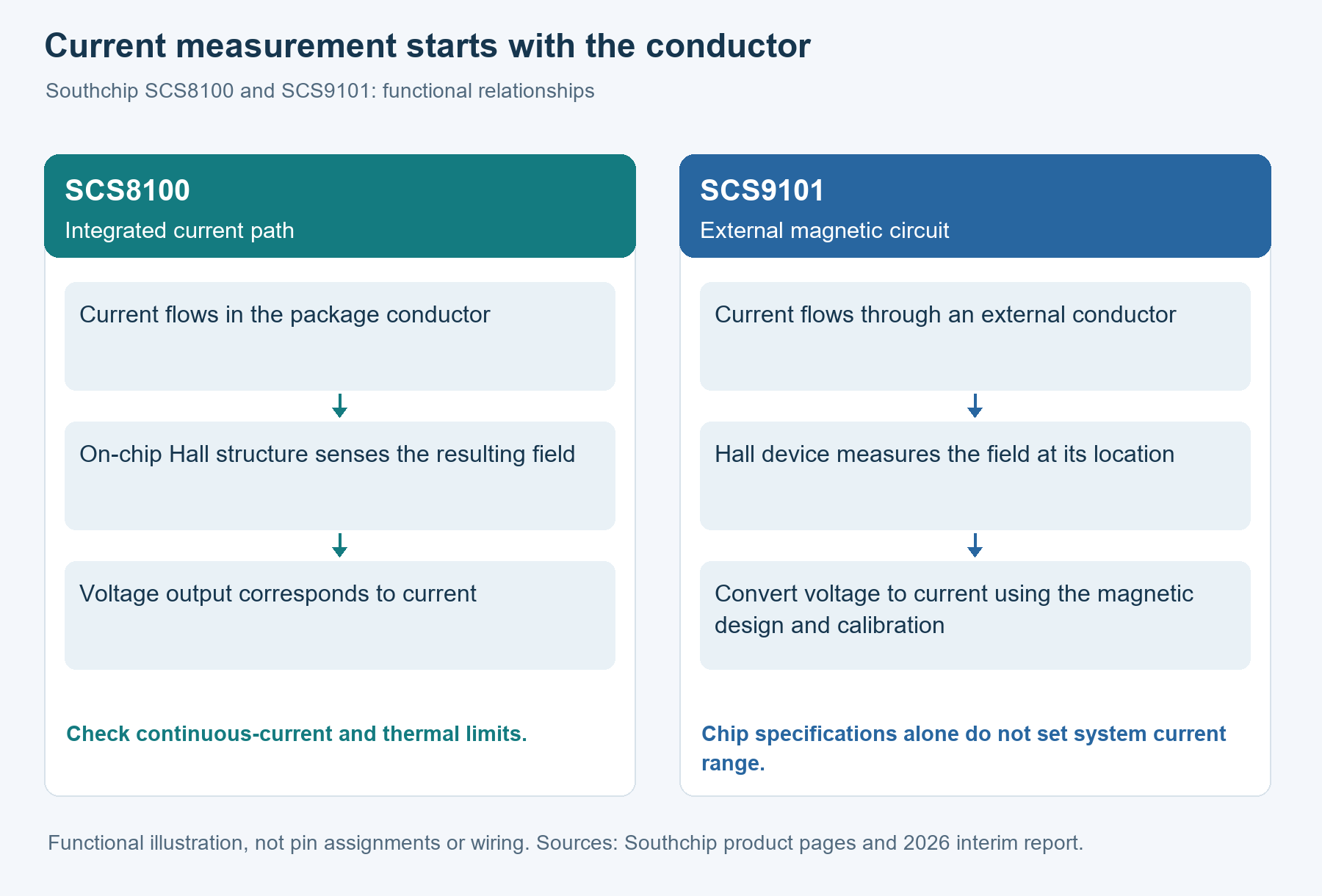
Figure 1. Measurement relationships based on Southchip product material. This is a functional explanation, not a pinout or wiring diagram.
Southchip offers both an integrated current path and a sensor for an external magnetic circuit. Board-level sampling in a charging module and busbar measurement in storage equipment can start from different candidates. Range, layout space and cooling also vary between measurement points within the same machine. Evaluation is therefore most useful at each measurement location, rather than treating one part as a solution for the entire charger or cabinet.
Accuracy figures depend on how the specification is defined
Allegro announced ACS37017 in February 2026 with a typical sensitivity error of ±0.55% over temperature and lifetime and a bandwidth of 750kHz. Southchip's SCS8100 page specifies a maximum sensitivity error below 2% over temperature and lifetime.
Typical and maximum values do not establish a common performance ranking. A typical value describes representative behavior, while a maximum specifies a boundary. Engineers need the complete conditions before using either in the same error budget.
TI's TMCS1123 datasheet, revised in May 2026, adds another distinction. It specifies maximum sensitivity error below 1.4% without system calibration and below 0.9% after a single room-temperature calibration, both including temperature and lifetime effects. Calibration can improve the specified result, but it adds production-test work.
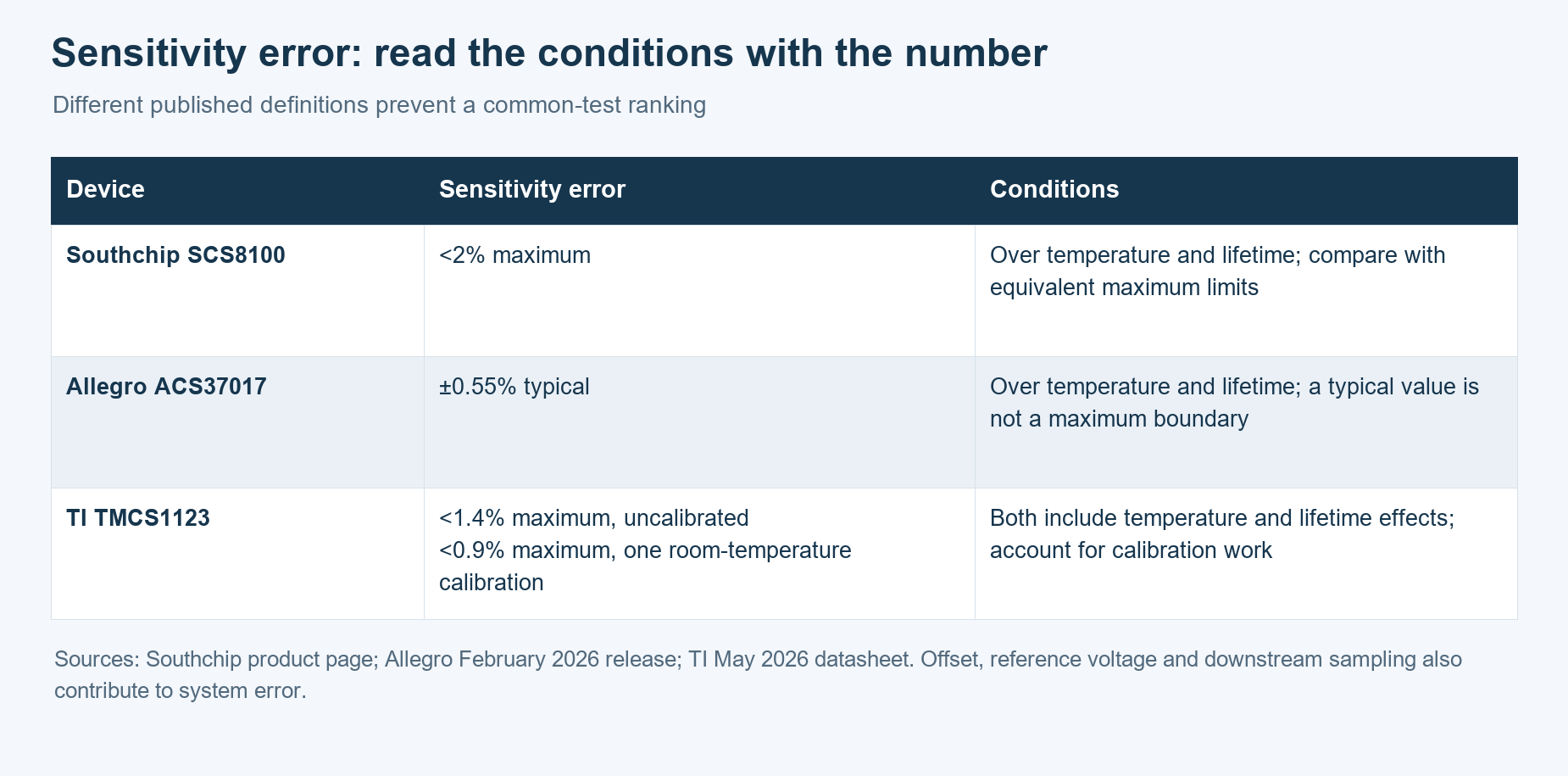
Figure 2. Published sensitivity-error specifications. Their different conditions prevent a common-test performance ranking.
Sensitivity error describes the proportional relationship between input current and output voltage. Offset, downstream sampling and reference-voltage behavior also affect the final reading. At low current, offset can account for a particularly large relative error. A sensor's sensitivity specification is only part of the equipment's current-measurement accuracy.
A practical comparison fixes the current points and temperatures, then records offset, gain and total error separately. Comparing a calibrated output with an uncalibrated one does not isolate device performance. Reproducible supplier test conditions can save time during validation.
Higher current brings thermal and isolation constraints
An integrated conductor removes the need for an external magnetic circuit but still dissipates heat. Using the 200µΩ value listed for SCS8100, a current of 50A produces approximately 0.5W of resistive loss in the conductor alone. That calculation identifies a heat source; it does not establish continuous 50A operation at every board temperature.
A curve in TI's updated datasheet shows permitted continuous current decreasing as ambient temperature rises. It applies to a specified evaluation board or equivalent PCB without airflow. Different copper thickness or cooling arrangements change the thermal conditions.
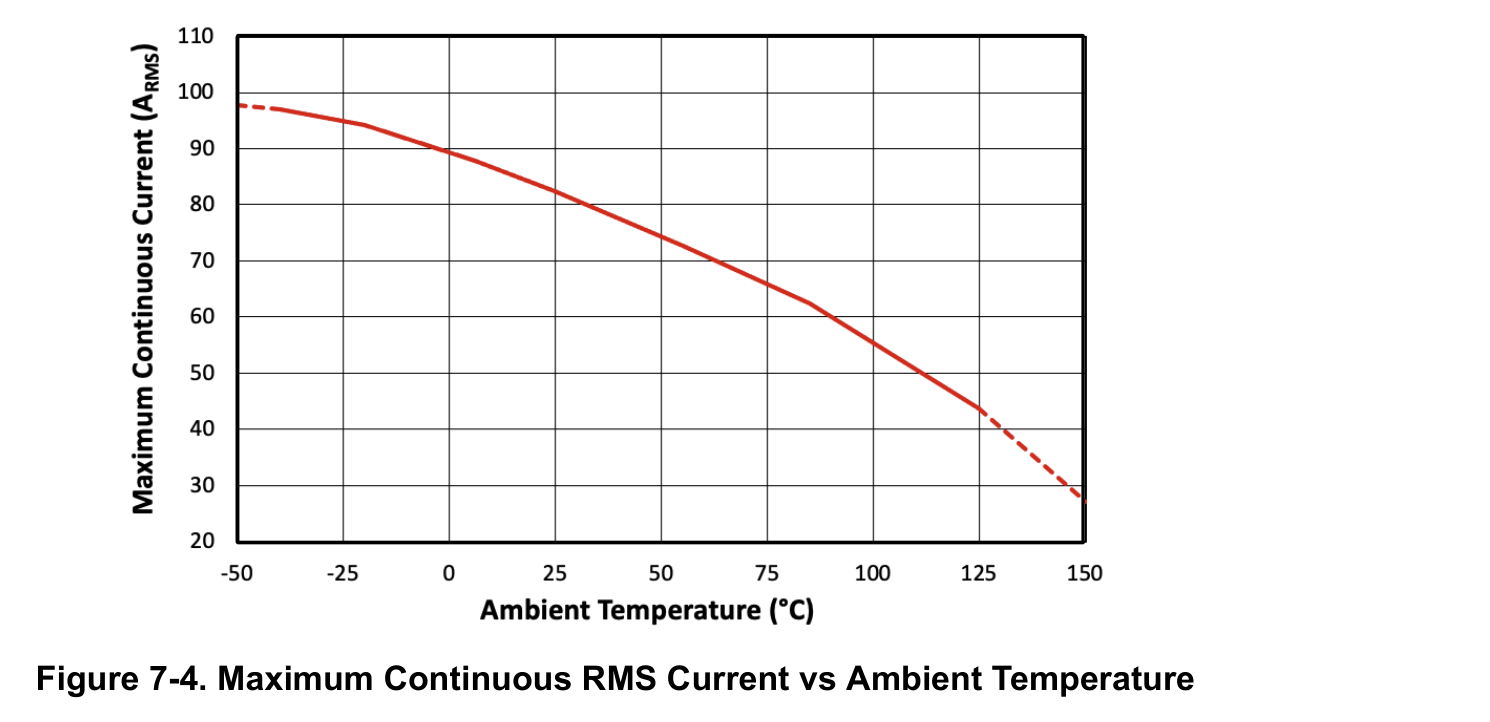
Figure 3. Original Figure 7-4 from TI's May 2026 TMCS1123 datasheet. Ambient temperature is plotted against maximum continuous RMS current for the specified evaluation board or equivalent PCB with no airflow. Copyright Texas Instruments.
Isolation ratings also have distinct meanings. ACS37017's published 5000VRMS withstand rating and 565VRMS reinforced-isolation working voltage describe different conditions. The withstand figure does not establish continuous operation at that voltage. Measurement range, continuous current capability and isolation working voltage need separate checks.
Speed requires similar care. SCS8100's 2MHz bandwidth describes signal-following capability. Interrupting a fault also involves detection, decision-making and driver shutdown. Required control bandwidth, output noise and total protection delay should be evaluated together.
A storage system that combines high-current operation with light-load monitoring needs tests near zero current. A design intended to capture fast faults needs sensor output and actual shutdown waveforms on the same time axis. Different measurement points can therefore favor different devices.
Replacement cost depends on how much the system must change
Southchip now provides specific products that can enter an engineering comparison: SCS8100 for an integrated current path, and SCS9101 as part of a design with an external magnetic circuit. Allegro ACS37017 emphasizes low-drift accuracy, while TI TMCS1123 documents calibration benefits and application conditions.
These choices affect development effort. SCS8100 uses SOW10, while ACS37017 uses SOICW-16. A substitution needs checks of pads, pin functions, cooling and isolation distances. An external magnetic circuit adds mechanical tolerances and mounting consistency. Similar functions justify evaluation without establishing a direct board-level replacement.
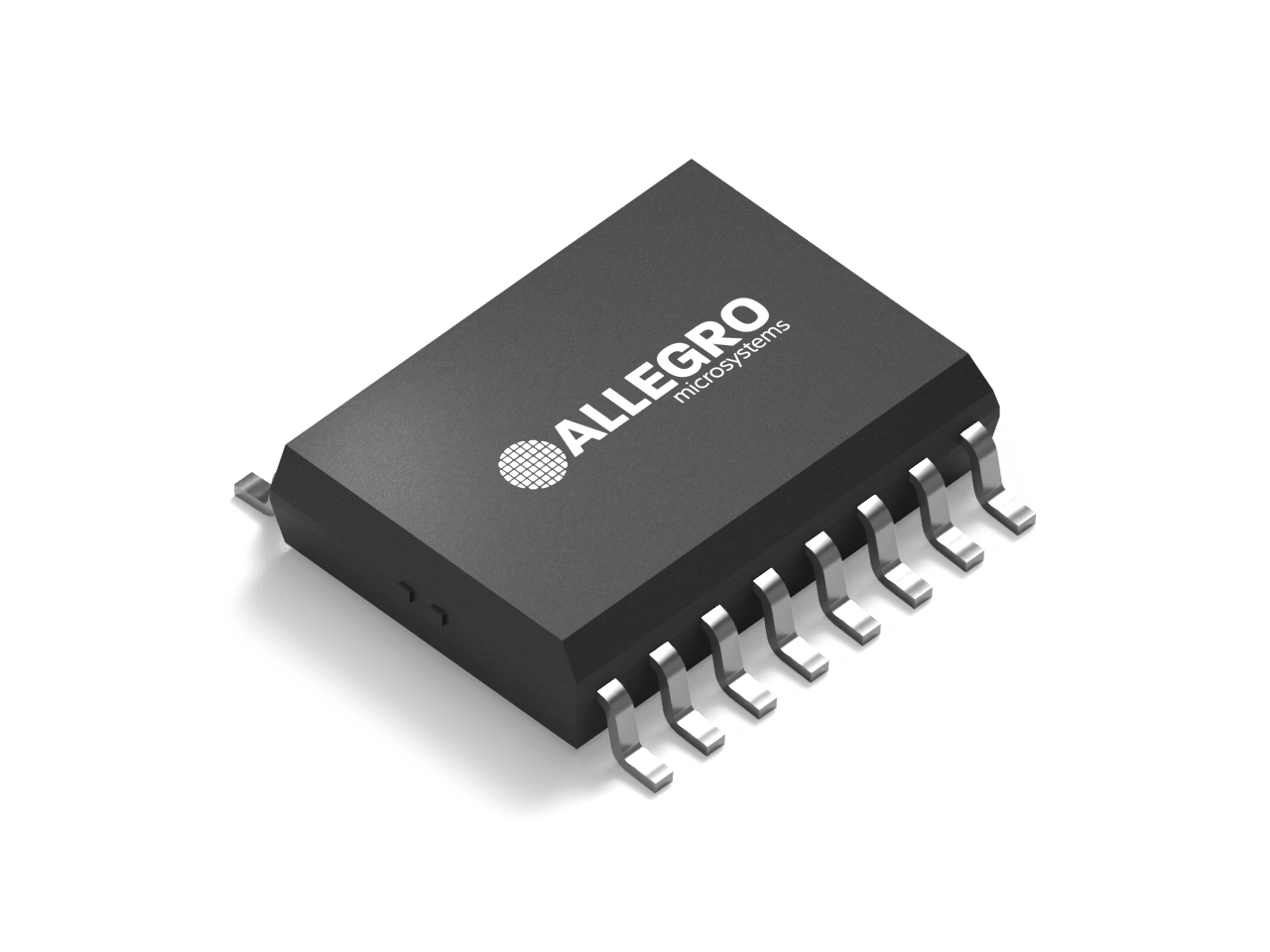
Figure 4. SOICW-16 package rendering used on Allegro's ACS37017 product page. It identifies package form and is not a photograph of a device's ordering-code marking.
TI's May revision also added guidance on overcurrent-threshold stability, addressing the possibility that rapid voltage changes disturb the protection output. Validation should therefore extend beyond steady current points to temperature rise, switching transients and false protection triggers.
Supply maturity needs its own assessment. Allegro's ACS37017 launch offered engineering-sample requests, and Southchip's interim report described product introduction. Current lead times, batch consistency and customer production-validation records require further confirmation.
Costs should be compared across the complete implementation. An external magnetic circuit adds magnetic structures, assembly and calibration. An integrated solution still requires board layout, thermal design and production testing. A lower chip price can be offset by added process steps, and requalification takes time in established equipment. The public information reviewed does not support a common total-cost ranking of the three suppliers.
Teams developing new chargers or storage converters can include these Chinese current sensors in design evaluation. For existing production equipment, the decision also includes board changes, calibration and revalidation. A completed substitution must measure reliably, support dependable protection and sustain deliveries in the target system.
Information reviewed through September 22, 2026. This analysis uses published vendor material and does not include testing under common conditions. Selection requires the complete datasheet and equipment-level validation.