
Chinese LDOs for portable devices: balancing standby current and analog performance
A portable instrument needs a battery that lasts and readings that remain stable. Its low-dropout regulator, or LDO, contributes to both. During long sleep periods, the regulator's own consumption draws from the battery. During measurement, supply ripple and noise can affect sensitive analog circuits.
Recent products from Chinese suppliers give international engineering and sourcing teams specific options to examine. LINEARIN's LTP753H, announced in July 2026, specifies typical no-load quiescent current of 0.5μA. ETEK's updated ET559XX documentation describes a 500mA regulator with noise measurements under stated conditions. Their different priorities illustrate how Chinese LDO offerings fit different supply rails in portable equipment.
Ripple rejection and output noise describe different problems
An LDO often follows a battery or switching supply and provides the voltage required by a sensor or analog-to-digital converter. Power-supply rejection ratio, or PSRR, describes its ability to attenuate disturbances arriving at the input. Output noise describes noise generated within the regulator itself.
PSRR needs a frequency as well as a value in decibels. A result at 1kHz does not establish performance around an upstream converter's switching frequency. Integrated output noise, usually stated in μVrms, also needs its integration bandwidth, output voltage and test conditions.
A multimeter reading can confirm the basic output voltage while missing fluctuations that matter to a weak-signal measurement. Identifying whether the dominant disturbance comes from the upstream supply or the LDO helps determine which specification deserves attention.
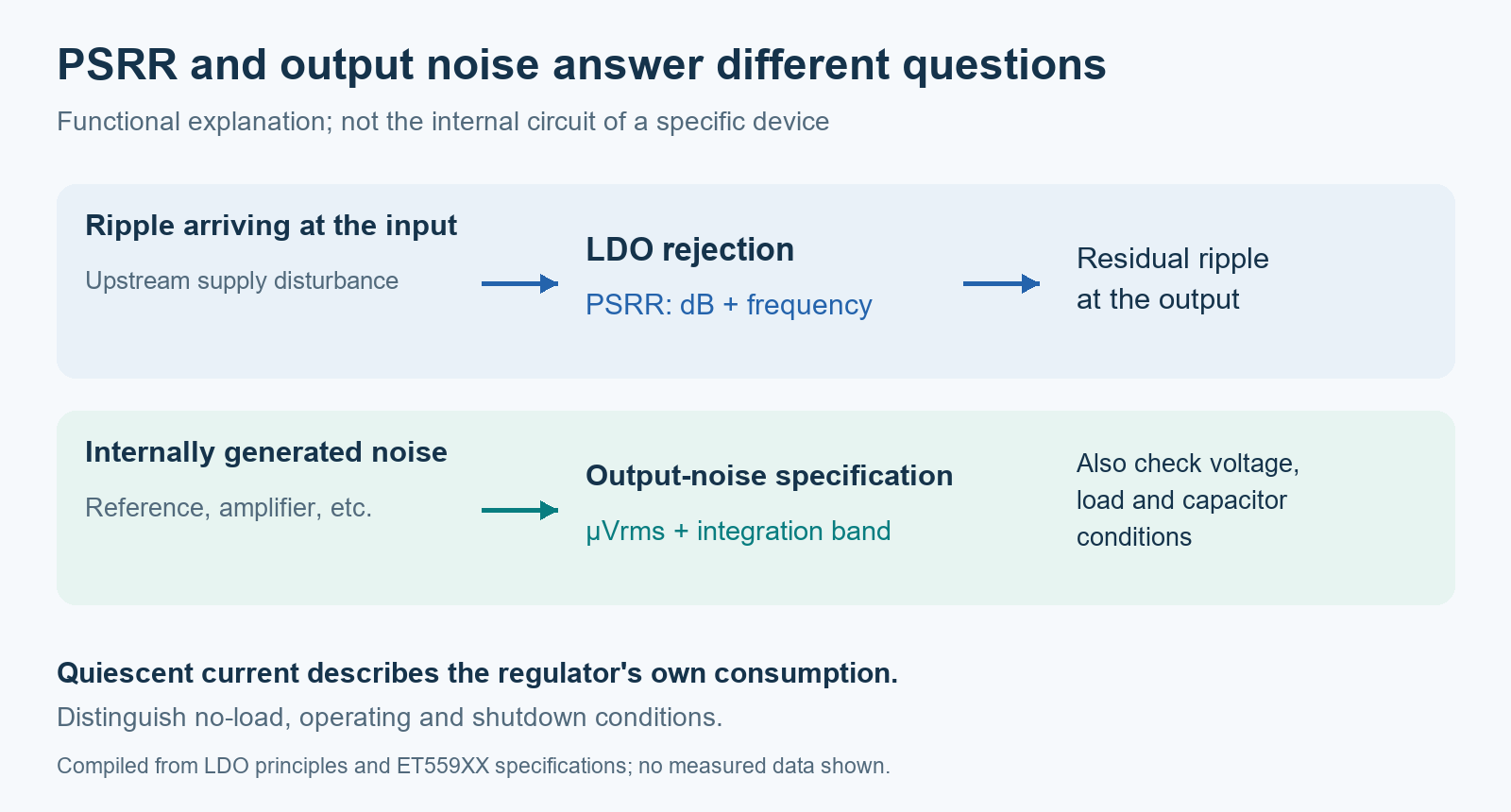
Figure 1. PSRR and output noise address different sources of disturbance. This functional explanation is not an internal circuit diagram of a particular product.
LINEARIN targets consumption below one microamp during standby
LINEARIN announced the LTP753H family on July 30, 2026. Its launch material lists 400mA output capability and typical no-load quiescent current of 0.5μA. For a wireless sensor that sleeps for long periods and samples intermittently, the regulator continues drawing current while the load is inactive.
The input range is 1.5V to 8.0V. Fixed-output variants cover 1.2V to 5.0V, with the ordering code chosen for the required voltage. Packages include SOT23-3L, SOT23-5L, SOT89-3L and DFN1×1-4L. The SOT23-5L and DFN1×1-4L versions support enable control.
The announcement gives a dropout voltage of 180mV at a 3.3V output and 100mA load. That load condition matters when determining the voltage margin between input and output: it is not a dropout specification at the family's full 400mA capability.
LINEARIN also quotes PSRR of 60dB at 1kHz. The launch announcement does not state an integrated output-noise value. It provides a clear basis for evaluating standby consumption; a sensitive analog supply would also need noise data for the selected version.
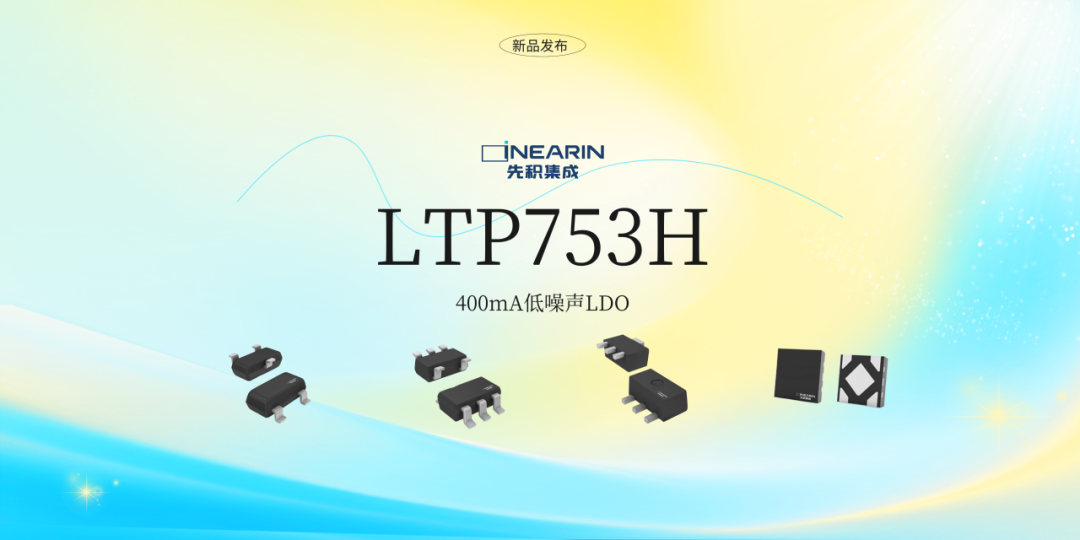
Figure 2. Original LINEARIN product artwork from its July 30, 2026 announcement, showing the LTP753H family and package options. The Chinese captions identify a new-product release and a "400mA low-noise LDO." Manufacturer artwork, branding and captions are preserved; this is not a product photograph.
ETEK documents noise and transient behavior at 500mA
ETEK's ET559XX datasheet Rev1.2.b records a revision date of April 24, 2026, including updated characteristic curves. The family supports loads up to 500mA, an input range of 1.9V to 6.5V, and DFN4 (1mm×1mm) or SOT23-5 packages. The listed applications include portable instruments.
The datasheet gives typical output noise of 45μVrms at a 3.3V output, integrated from 10Hz to 100kHz, with a 100mA load, 1μF output capacitor and temperature of 25°C. Its 85dB PSRR figure at 1kHz uses a 30mA load, a 1μF output capacitor and 25°C. Even these two specifications use different load conditions.
Typical operating quiescent current is 60μA. Compared with LINEARIN's 0.5μA no-load figure, this reflects a different design emphasis and operating condition. Battery-life assessment still depends on the time spent sampling and sleeping. For a rail supplying active analog circuitry, noise, ripple rejection and response to load changes need to be considered alongside regulator consumption.
The ET55933 curves show output response as the load switches between 1mA and 500mA. External components contribute to that response: the datasheet recommends effective output capacitance of 1μF to 4.7μF and specifies an ESR range. Board-area calculations therefore need to include the surrounding components as well as the package.
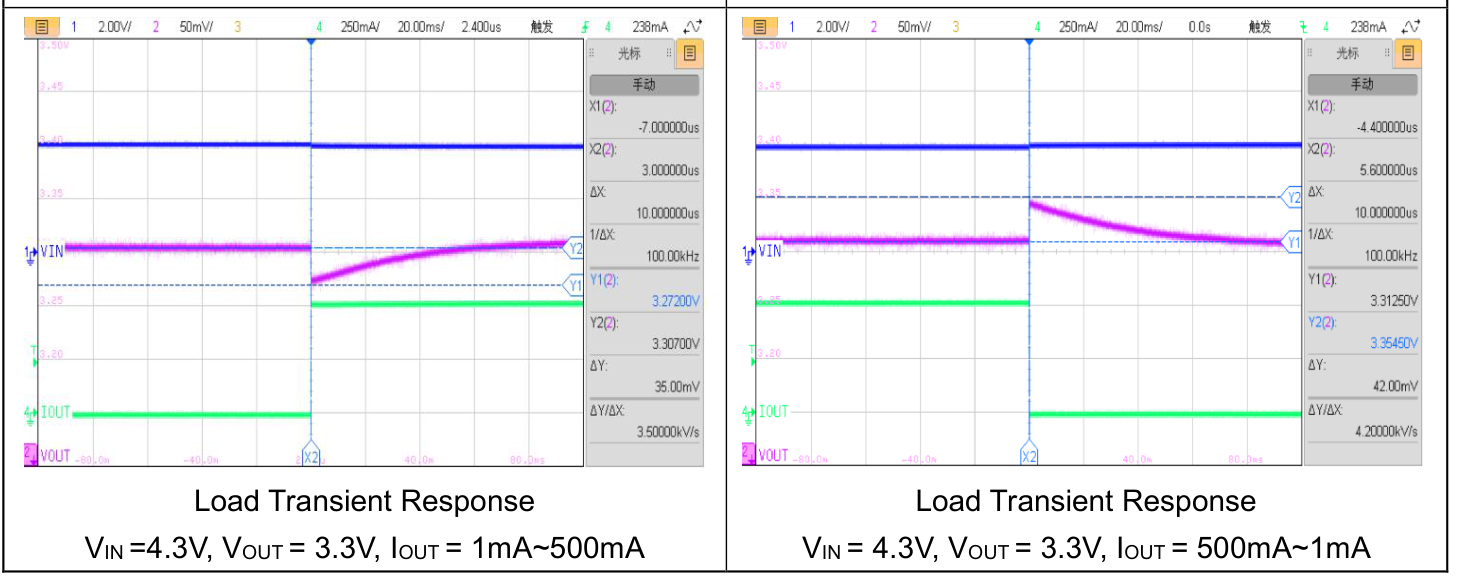
Figure 3. Original load-transient plots from page 12 of ETEK's ET559XX datasheet Rev1.2.b. Input is 4.3V, output is 3.3V, and load switches between 1mA and 500mA. Original oscilloscope annotations are retained.
Higher load capability changes the comparison
TI's TPS796 provides a reference at a higher current level. Its datasheet, revised in January 2026, lists 1A output capability. TPS79633 has a typical dropout voltage of 220mV at 1A. Alongside LINEARIN's 180mV at 100mA and ETEK's 280mV at 500mA, the numbers first reveal different test currents. Their numerical order does not establish a performance ranking.
The TI document also distinguishes new and legacy die versions. The new die has typical ground current of 700μA over a stated load range of 0A to 1A. An evaluation needs one identified version throughout; combining the better specifications from different die versions would describe a product that the datasheet does not define.
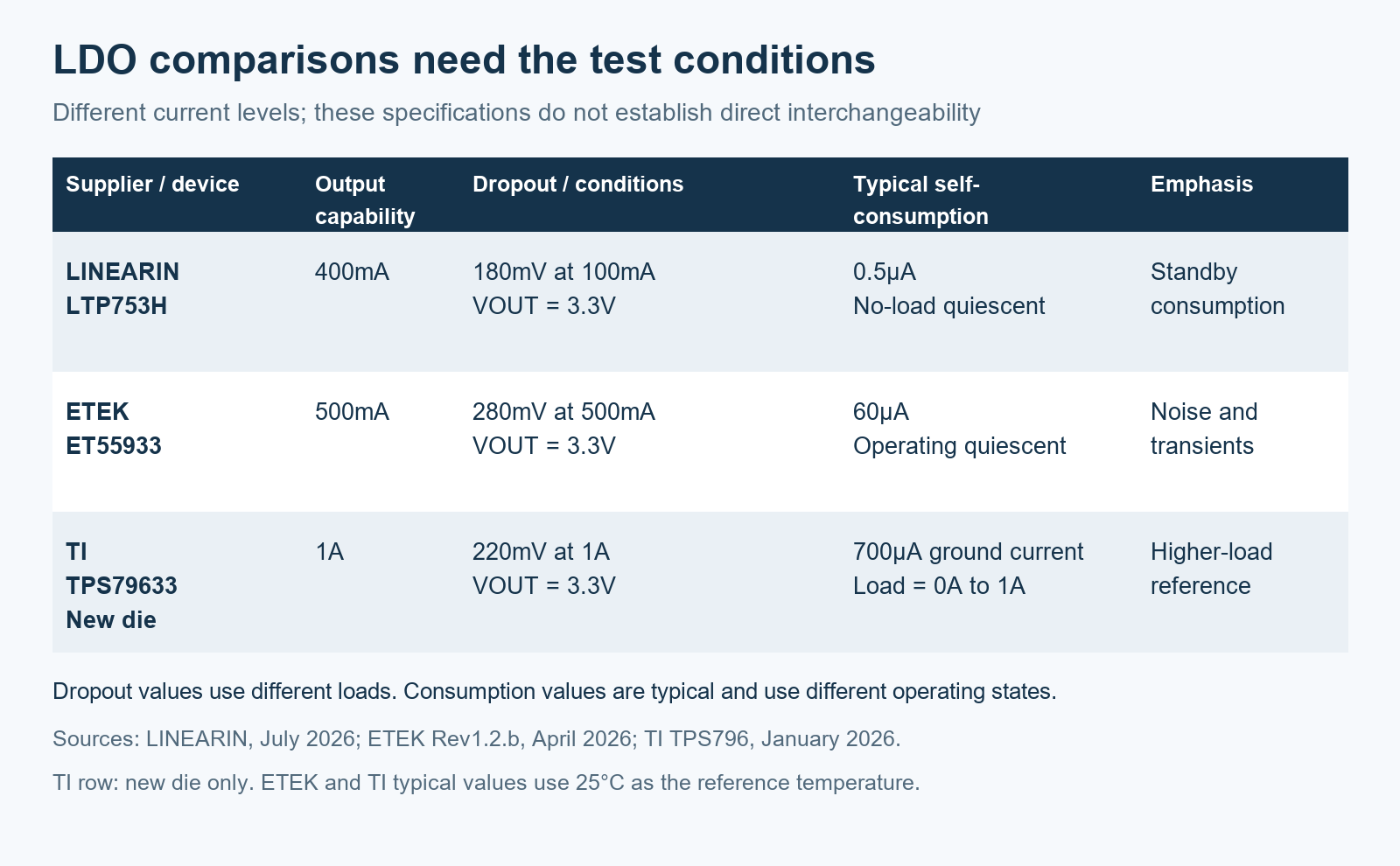
Figure 4. Published specifications from LINEARIN's July 2026 announcement, ETEK's April 2026 datasheet revision and TI's January 2026 revision. These products occupy different current levels and do not constitute a direct replacement list.
For buyers considering Chinese suppliers, LTP753H offers a concrete candidate for low standby consumption, while ET559XX provides 500mA capability with documented noise, PSRR and transient conditions. Engineers can evaluate always-on and analog supply rails separately, and purchasing teams can specify the required output voltage, package and complete ordering code.
Those specifications establish candidates for evaluation. Acceptance on an existing board depends on tests under the same operating conditions; published parameters alone do not demonstrate completed customer substitution.
Based on manufacturer information reviewed through September 22, 2026. This article is for industry discussion; use the applicable device documentation and design validation for implementation.