
Chinese power and specialty resistors: from board components to braking and load systems
A supplier search for “power resistors” can lead to a ceramic part on a power-supply board, an aluminum-housed unit beside a drive, or a complete cabinet used to test a generator. These products share an energy-dissipation function, but their engineering and delivery requirements differ substantially.
For overseas equipment makers assessing Chinese suppliers, the useful distinction is the load the product must handle. Continuous operation calls for a sustained thermal path. Precharge and deceleration can impose a short, intense pulse. A load bank adds switching, measurement, cooling and protection around the resistor elements.
Mainland suppliers Aotrou, Zenithsun, Eagtop and Fullde cover devices, assemblies and cabinets. RESI (Kaibu Ruisi) also lists planar power and solid ceramic products. Their published offerings connect to power conversion, precharge, braking and load testing, with structures shaped by each duty.
1. Through-hole and cement resistors remain the starting point
A leaded resistor on a power board may use metal film, metal oxide film or a wirewound element. “Through-hole” describes the connection method; power loss, pulse loading, voltage and installation space determine the internal design.
Wirewound resistors typically wind resistance-alloy wire around an insulating former before adding a coating or enclosure. Material, wire diameter and length establish different resistance and power combinations. Ceramic-tube units, coated axial parts and some cement resistors use this route.
A common cement resistor has a white ceramic housing around a resistive element and filling material. Similar-looking products can still differ in element construction, lead position, parasitic inductance and overload behavior. Aotrou's catalog includes horizontal, vertical, plug-in and bracket-mounted cement resistors, alongside painted, vitreous-coated and corrugated wirewound products. Mounting style affects the position on the board and mechanical support; larger tube and corrugated structures extend into equipment-level power assemblies.
The resistor and nearby components each have temperature limits. Stand-off height, spacing and airflow influence heat removal. Fusible resistors add a specified protective behavior: they operate as resistors normally and open under defined overload conditions. An ordinary resistor's failure after overheating does not establish the same fuse characteristic.
As power increases, the part can become a separate cabinet component. Eagtop's June 2026 prospectus describes resistors in wind-power converters and industrial braking, where terminals, mounting and cooling differ considerably from a small axial component.

Figure 1. Industrial drive illustration reproduced from Eagtop's June 2026 prospectus. The two Chinese labels identify the resistor at the upper arrow and the inductor at the lower arrow. The source note reads “compiled from public market information.” This is an explanation of component location, not a verified customer bill of materials.
2. The mounting arrangement forms part of the power rating
Chinese catalogs commonly describe gold-colored, trapezoidal and boat-shaped aluminum housings. The housing protects and mounts the resistor and also transfers heat. Heat passes from the element through internal filling and the case to a mounting plate, heatsink or surrounding air.
Free-air operation and installation on a specified heatsink may permit different power levels. A derating curve may use ambient temperature, case temperature or mounting-surface temperature, so the measurement point matters.
Planar thick-film power resistors place the resistive layer on a substrate connected to an external cooling structure. TO-220 and TO-247 packages also appear in resistor catalogs. Although familiar from power semiconductors, these parts provide resistive dissipation, limiting or absorption.
RESI (Kaibu Ruisi) separates planar power, solid ceramic and high-power wirewound products in its catalog. Different elements and enclosures create different thermal paths and installation requirements.

Figure 2. Conceptual thermal path. Ambient temperature, case temperature and installation conditions affect allowable power. No particular model rating is represented.
Contact quality, interface material and mounting pressure affect thermal resistance. Air or coolant carries heat away from the heatsink. For heatsink-mounted products, that heatsink forms part of the conditions needed to achieve the rating. Cabinet airflow and neighboring heat sources then influence the installed temperature distribution.
Taiwan-based Token offers a separate point of reference, with heatsink-mounted molded power resistors, wirewound resistors and resistor cabinets. A power comparison requires each supplier's cooling and load conditions.
3. Precharge concentrates stress at switch-on
Connecting an uncharged DC-link capacitor directly to a battery or power source can produce a large inrush current. A precharge resistor initially limits this current. Once the capacitor reaches the required condition, the circuit transfers to its normal power path.
Zenithsun described its ASZ 200W100R precharge resistor in August 2026 for high-voltage applications including energy storage. Such a duty depends on resistance, continuous power, energy per event and repetition interval.
Consider an ideal 1,000 µF capacitor initially at zero volts, charged from a constant 400 V source through 100 Ω. Ignoring other losses, the initial current is 4 A and instantaneous resistor power is 1,600 W. Both decay as the capacitor charges. The RC time constant is 0.1 s.
Over the complete ideal charge, the resistor dissipates ½CV², or 80 J. If the event repeats every 10 s and each event starts with an uncharged capacitor, the average power attributable to these pulses is approximately 8 W.

Figure 3. Formula-derived RC example, not an ASZ or other product measurement. The 8 W average does not establish that a particular resistor can survive the pulse.
The 1,600 W peak, 80 J energy and 8 W average describe different aspects of the same duty. Residual heat affects repeated starts. Actual capacitor voltage at switch-on, transfer timing and other circuit losses change the result. Delayed completion can prolong the resistor's load, while frequent restarts reduce its cooling time. Manufacturer pulse ratings therefore depend on waveform, duration, resistance and starting temperature.
Discharge resistors handle energy remaining in a capacitor after shutdown. Aotrou described RTP high-power thick-film high-voltage resistors for discharge circuits in energy-storage converters in September 2026. Precharge raises capacitor voltage and discharge lowers it; both require an energy and instantaneous-load calculation.
Fujian Millimeter Electronics introduced a sulfur-resistant, high-pulse chip thick-film product in July 2026. Its description covers electrode material, resistive-film structure and heat-spreading design. Small packages can be developed for defined pulses, with capability limited by the specified waveform and operating conditions.
4. Braking resistors dissipate regenerated energy
During motor deceleration or when a load is lowered, mechanical energy can return through the motor and drive power stage to the DC link. Continued energy input raises DC-link voltage. A braking chopper switches a resistor into the dissipation path, converting electrical energy to heat.
The braking unit controls when the path conducts; the resistor absorbs energy. Some drives integrate this switching function, while others require an external module. A system with a regenerative unit may instead return energy to the supply. The drive architecture determines the available paths.

Figure 4. Energy-flow concept, not a wiring diagram. Drive, chopper and resistor arrangements are system specific.
At a given DC-link voltage, reducing resistance increases current and instantaneous power when the chopper conducts. Resistance must match the drive's current capability, while the power specification concerns the resistor's thermal loading. Occasional deceleration, repeated stops and prolonged lowering create different energy profiles. Inertia, speed changes and braking frequency determine the energy and cooling intervals.
Aotrou described MBRB and LBRB resistor boxes in June 2026, extending from resistor elements to enclosures and cooling structures. Zenithsun also has braking resistor and resistor-bank offerings. Terminals, element arrangements, airflow and mounting all contribute to assembly performance.
Eagtop's June 2026 prospectus describes integrated bending of resistance strip and aluminum-housing technology, listing the relevant technologies as in batch production. Resistance strip provides a structural route distinct from winding round wire. The document identifies wind-converter low-voltage ride-through, damping and filtering, and industrial braking among the applications.
Specialty requirements also include high voltage and low inductance. Aotrou described RI40 vitreous-enamel high-voltage and RI82 non-inductive high-voltage chip products in September 2026. Voltage division depends on insulation and voltage distribution, while fast current changes in damping or absorption circuits make stray inductance significant. A “non-inductive” description still needs the relevant structure and measured specification.
5. Load banks add control and protection
A resistive load bank draws power from equipment under test, such as a supply or generator. Resistor stages establish the load, while measurement and control systems record the response and manage operation.
On March 20, 2026, Guangdong Fullde Electronics disclosed delivery of an LB-600KW-AC400V-J water-cooled load bank to a company in Poland. According to Fullde, the equipment integrates voltage, current and power monitoring, supports automatic loading sequences, and includes flow, temperature, pressure and overload protection.
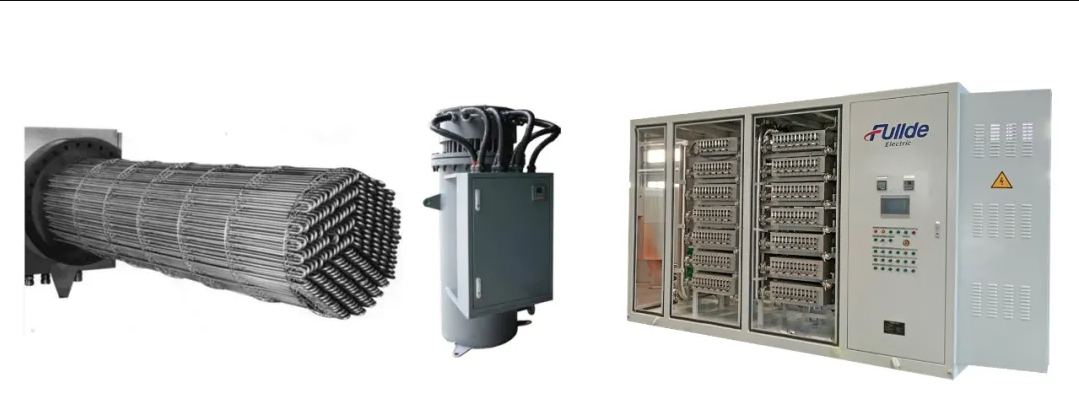
Figure 5. Original manufacturer composite from Fullde's March 2026 water-cooled load delivery case. It illustrates elements, modules and a cabinet, without establishing that every pictured item is a specific delivered model or that the image depicts the customer's site.
Sustained operation depends on coolant flow, temperature, pressure and heat exchange as well as the resistor elements. The cooling system adds its own failure conditions and protection requirements.
On September 18, 2026, Zenithsun reported delivery of 13 load devices for ground-based aviation-system load simulation: 12 AC/DC load banks and one RLC load bank, with ducted cooling. A resistive load primarily consumes active power. Adding inductance and capacitance allows an RLC bank to establish reactive load conditions. Voltage, frequency and power-factor requirements affect the equipment configuration.
Staged switching, measurement, control and fault shutdown are part of the completed load bank. Fullde's catalog also includes neutral-grounding resistors and power-system energy-dissipation products, with distinct duties in industrial equipment, power distribution and testing.
6. Compare suppliers at the same product level
The table summarizes the mainland companies covered by the source material. It is a product map, not an exhaustive national list or a ranking by scale.
| Mainland supplier | Product directions covered | Examples in public material |
|---|---|---|
| Aotrou | Cement, wirewound, aluminum-housed, braking boxes and high-voltage resistors | MBRB/LBRB, RTP and RI40/RI82 descriptions in 2026 |
| Zenithsun | Precharge, braking, water-cooled resistors and load banks | ASZ 200W100R introduction and disclosure of 13 ground-test load devices |
| Shanghai Eagtop | Wind-power and industrial power resistors and assemblies | 2026 prospectus descriptions of applications, strip bending and aluminum encapsulation |
| Guangdong Fullde | Braking, grounding, energy dissipation and load-test systems | LB-600KW-AC400V-J water-cooled load-bank delivery disclosed in 2026 |
| RESI (Kaibu Ruisi) | Planar power, solid ceramic and high-power wirewound products | Current catalog categories; undated detailed ratings are not used here |
| Fujian Millimeter Electronics | Sulfur-resistant, high-pulse chip thick-film products | July 2026 product introduction |
Standard parts supply package, value and mounting choices. Precharge and braking assemblies are designed around an equipment duty. Load banks integrate the resistor with measurement, control, cooling and protection. This distinction also affects how production scale should be interpreted: a cabinet's rating, stage count and customization influence manufacturing effort, so cabinet output and discrete-resistor output are different measures.
For an equipment buyer, a useful comparison therefore starts with the delivered object and its operating conditions. Continuous dissipation requires a defined thermal path; short events need peak, energy and repetition limits; high voltage adds insulation and field-distribution requirements. The resistor body, package and system design together determine whether the supplied product suits the application.
The next article covers thermistors, varistors and adjustable resistors, whose functions include temperature sensing, overvoltage protection and calibration.
Prepared from public information available through October 2026 for industry discussion. Product ratings, installation conditions and supply status must be checked against current manufacturer documentation and the intended application.
