
Chinese fast-recovery diode suppliers compete on switching losses and production consistency
For engineers and buyers evaluating Chinese fast-recovery diodes, a catalogue entry is only the beginning. The useful questions concern switching conditions, manufacturing consistency and the customer's stage of adoption. Recent disclosures show domestic suppliers delivering dies and traction modules in volume, while some newer products remain in verification. Those are different levels of commercial progress.
This article focuses on silicon fast-recovery diodes, or FRDs. They serve high-frequency conversion, freewheeling and power-module applications, where dynamic behavior matters alongside forward conduction. SiC Schottky diodes and transistor body diodes require separate comparisons. Within the silicon FRD market, a small packaged auxiliary diode and a high-current traction-module die also serve different purchasing requirements.
Recovery behavior must be evaluated in the intended circuit
A silicon PN diode stores charge during forward conduction. When the circuit commutates, reverse current can flow before the device regains its blocking state. Reverse-recovery time, trr, describes the duration under a specified measurement criterion; reverse-recovery charge, Qrr, is the integral of the reverse-recovery current.
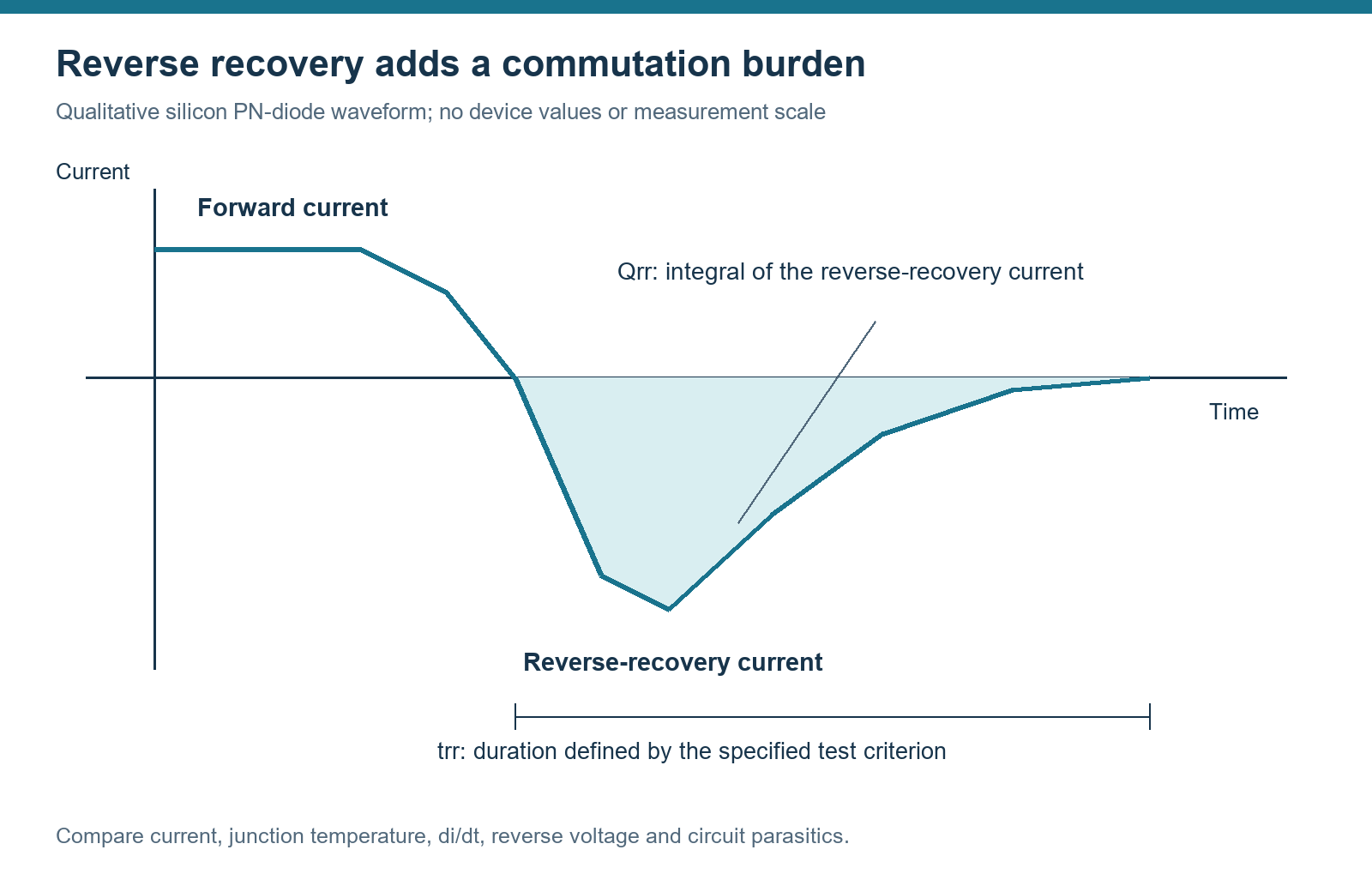
Figure 1. Conceptual silicon-diode recovery waveform, without device values or a measurement scale. The applicable datasheet defines the recovery-time criterion.
Recovery places a burden on the commutating switch as well as the diode. The current waveform interacts with circuit parasitics and can contribute to overshoot and ringing. A shorter recovery-time headline therefore does not, by itself, establish better converter efficiency.
Forward voltage introduces another trade-off. Reducing conduction losses and reducing stored charge are not always aligned objectives. Useful comparisons match forward current, junction temperature, switching frequency and the commutation circuit. Recovery softness, thermal behavior and the resulting stress on adjacent components belong in that assessment.
The intended application sets the commercial boundary too. High-voltage surface-mount devices for auxiliary circuits cannot be ranked directly against bare dies designed for high-current automotive modules. Their current levels, packaging constraints and validation requirements differ.
Chinese suppliers participate at different points in the value chain
Recent company disclosures identify a substantial domestic supplier base, but they do not support a single ranking of FRD capability. The following examples distinguish product scope from verified adoption.
| Supplier | Recent disclosed position | Relevant limitation |
|---|---|---|
| Silan Microelectronics | Self-developed FRD dies alongside IGBTs, including automotive traction applications and volume supply | Die shipments and completed-module shipments are separate measures |
| United Nova Technology | Volume delivery of traction modules using self-developed fourth-generation IGBT and FRD technology | Module adoption does not establish market-wide FRD share |
| WeEn Semiconductors | An established FRD range and a fifth-generation 1200 V project | The newer project was in product verification in the cited disclosure |
| CR Micro | FRD design and manufacturing, including lifetime control, recovery softness and avalanche behavior | Performance requires device-specific test conditions |
| Jilin Sino-Microelectronics | FRDs among its core products, supported by R&D and reliability facilities | Laboratory capability is not automotive qualification for every FRD |
| Jiangsu Jiejie Microelectronics | FRDs within an integrated diode and protection-device business | Company-wide investment is broader than FRDs |
| Yangjie Technology | An FRD portfolio and recent work on dies, packaging and applications | Older model specifications are not used as evidence of current performance |
| Galaxy Microelectronics | FRD die and passivation manufacturing processes | Process disclosure does not establish a like-for-like international ranking |
| JSCJ | July 2026 disclosures covering ultrafast series and high-voltage, high-current FRD wafers | A product presentation does not establish specific customer adoption |
| Perfectway | A July 2026 catalogue entry for ES5JGB | Incomplete public parameters do not establish recovery time or customers |
This is a selection of suppliers with recent evidence, not a complete national directory. Group revenue is especially unsuitable as a shortcut: it may include transistors, protection devices, modules or other businesses.
Volume shipments and new-product verification represent different progress
Silan reports volume supply of IGBT and FRD dies to multiple Chinese and overseas module-packaging customers. It also reports volume traction-module business and customer assessment of a subsequent generation aimed at improved performance and cost. These statements cover related but distinct products and stages.
United Nova Technology reports volume delivery of traction modules using its self-developed fourth-generation IGBT and FRD technology to multiple Chinese and overseas customers. That is stronger commercial evidence than a sample announcement, while still being specific to the disclosed module business.
WeEn's newer FRD project illustrates the need to preserve stage labels. Its July 2026 verification opinion describes a fifth-generation 1200 V FRD project in product verification. Intended improvements in forward voltage and recovery behavior should not be presented as completed mass-production results.

Figure 2. Unaltered excerpt from page 61 of WeEn's July 2026 verification opinion. English reading guide: the fifth-generation 1200 V FRD project is described as being in product verification; its development targets are not evidence of volume production.
For procurement teams, repeat orders add another test. A device must retain its characteristics across production batches, and changes to the process, package or manufacturing location must be managed with the customer. Qualification of one product generation cannot simply be transferred to every subsequent device.
International comparisons need the complete test conditions
Vishay's June 2026 introduction of 1200 V, 1 A to 3 A FRDs provides a recent reference for auxiliary, clamp, snubber and driver circuits. These devices address a different position in the system from large-current automotive traction dies.
The datasheet for VS-E7SX0112HM3V, revised on 14 July 2026, demonstrates why recovery figures need their conditions. It specifies a maximum trr of 50 ns at a junction temperature of 25°C, a forward current of 0.5 A, a reverse current of 1 A and a recovery-current criterion of 0.25 A.
A different test uses a forward current of 1 A, di/dt of 200 A/µs and reverse voltage of 800 V. Under those conditions, typical trr is 91 ns at 25°C and 120 ns at 125°C. Typical Qrr is 105 nC and 200 nC at the same respective temperatures. These values cannot be combined into one test result or substituted for the 50 ns maximum.

Figure 3. Original English parameter table from page 2 of the VS-E7SX0112HM3V datasheet, revised 14 July 2026. Typical and maximum values, temperature columns and test conditions must be read together.
The family includes standard and AEC-Q101-qualified versions in the SMPC HV package, with a minimum creepage distance of 5.4 mm. Packaging and qualification are part of the comparison, alongside dynamic parameters.
Chinese disclosures concerning recovery softness or avalanche capability, including those from CR Micro, need the same treatment. A lack of publicly available, matched test data prevents a defensible ranking; it does not prove the absence of technical capability.
Company profit does not reveal FRD profitability
Silan's first-half 2026 net profit attributable to shareholders was approximately RMB 516 million, up 94.84% year on year. Net profit excluding non-recurring items was approximately RMB 271 million, up 0.67%. The different growth rates matter when assessing how much improvement came from recurring operations.

Figure 4. Silan's H1 2026 company-wide profit measures, in RMB millions. They are not FRD product earnings. Values are rounded from the reported amounts.
The report includes approximately RMB 194 million of after-tax gains associated with investment valuations. That amount should not simply be subtracted from reported net profit to reconstruct adjusted profit: other non-recurring items also affect the calculation.
Jiejie's approximately RMB 130 million of R&D spending, up 24.51%, is likewise a company-wide figure. Capacity ramp-up and depreciation pressures cannot all be assigned to FRDs. Neither disclosure provides a standalone FRD gross margin.
A higher-performance device may command a better selling price while requiring more testing, tighter yield control and longer qualification. The resulting profit depends on production costs and the life of the customer programme, not just the price premium.
Process consistency determines whether better performance becomes a durable business
FRD manufacturing draws on carrier-lifetime control, diffusion, termination design, passivation and packaging. CR Micro discusses heavy-metal doping in this context; Galaxy describes relevant manufacturing processes. These capabilities influence the balance among forward voltage, recovery and reliability.
At module level, interconnects and thermal design become part of the outcome. A die that performs well in isolation still has to work with the switching device, package and cooling arrangement. Rejects, rework and inconsistent batches also affect the cost of each accepted part.
The useful evidence for overseas buyers is consequently specific: matched high-temperature performance, repeatable manufacturing, documented customer adoption and continued deliveries at a sustainable cost. Chinese suppliers have moved beyond catalogue availability in several FRD applications. Their next competitive gains will depend on how consistently those devices perform in customers' circuits and production programmes.