
In July 2026, GigaDevice disclosed that cumulative shipments of its automotive memory products had exceeded 450 million units. Products shown at the same time included GD25 and GD55 SPI NOR Flash and GD5F SPI NAND Flash for digital cockpits, ADAS, domain controllers, and zonal controllers.
Treating 450 million as only a sales number misses the important change. Domestic automotive Flash is moving beyond comparable data sheets toward evidence of qualification, volume delivery, and specific production-vehicle cases.
That does not make every device a direct replacement for an overseas part. Automotive qualification is only the entry ticket; interfaces, software, functional safety, PPAP, and full-vehicle validation still determine BOM adoption.
1. Why 450 Million Matters Beyond Shipment Scale
GigaDevice says cumulative automotive-memory shipments passed 200 million units in 2024, exceeded 300 million in its 2025 annual report, and passed 450 million in July 2026.
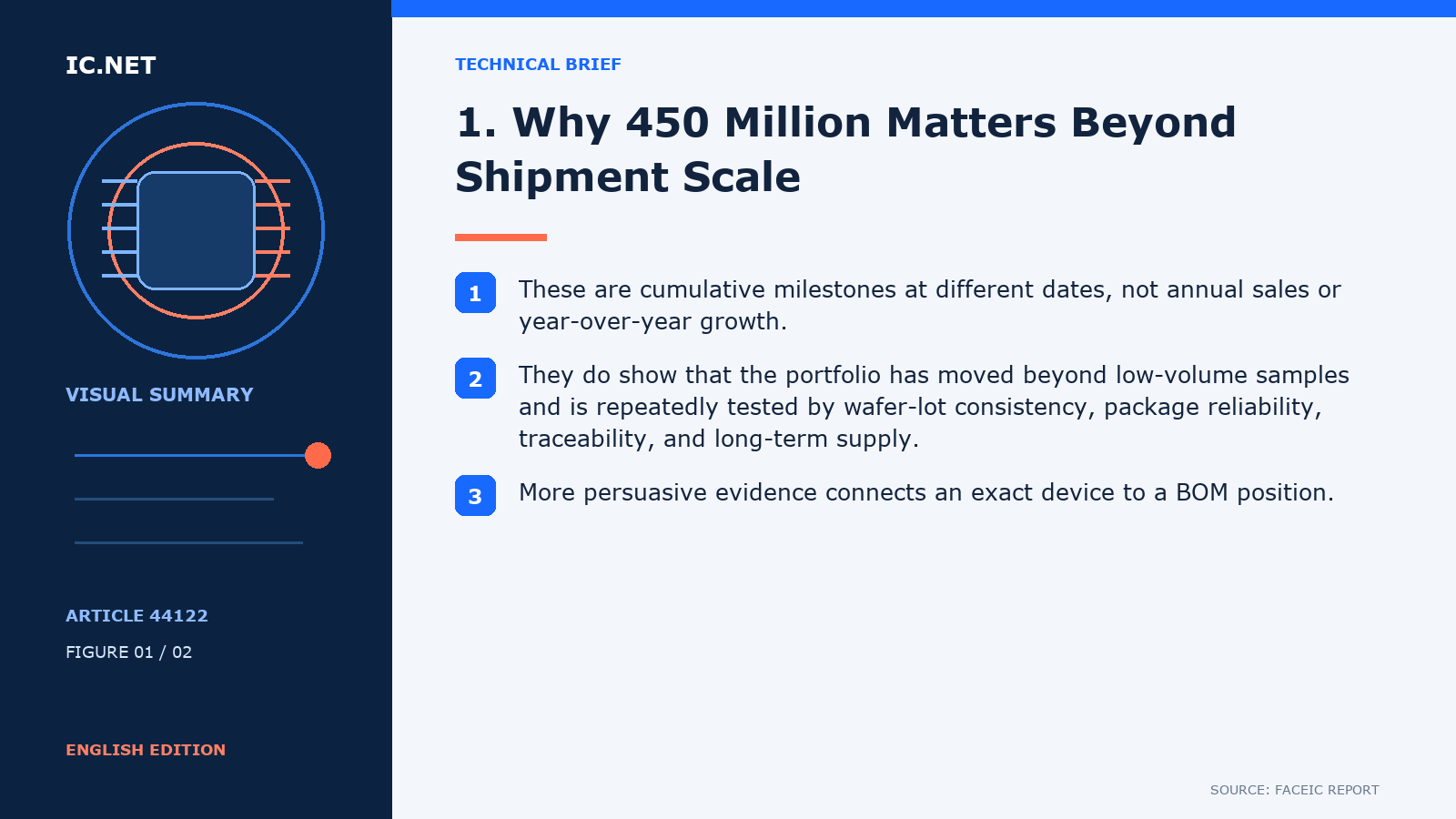
These are cumulative milestones at different dates, not annual sales or year-over-year growth. They do show that the portfolio has moved beyond low-volume samples and is repeatedly tested by wafer-lot consistency, package reliability, traceability, and long-term supply.
More persuasive evidence connects an exact device to a BOM position. In 2023, GigaDevice disclosed use of its automotive GD25F128F SPI NOR in a CDC active-suspension controller from Mingran Technology. More than tens of thousands of the controllers had shipped and were in production on Chery Tiggo 9 and Exeed Yaoguang vehicles. GD25F128F stores program code in that design, has 128 Mb capacity, and supports ECC.
That case establishes adoption of GD25F128F in one controller and production vehicles. It cannot be extrapolated to say that every GD25, GD55, and GD5F device entered those vehicles.
2. GD25, GD55, and GD5F Serve Different Roles in the BOM
External Flash in an automotive controller generally connects to an MCU or SoC and stores boot code, applications, configuration, and some operating data. Capacity, read bandwidth, endurance, and power-loss protection determine the memory type.
GD25 primarily supports Standard, Dual, and Quad SPI for code and boot storage. GD55 emphasizes high-speed interfaces including Octal SPI and DTR for domain controllers, cockpits, and ADAS platforms needing more code-read bandwidth. The complete automotive GD25/55 SPI NOR family spans 2 Mb to 2 Gb, with read bandwidth up to 400 MB/s; some devices of 64 Mb and above provide ECC and CRC.
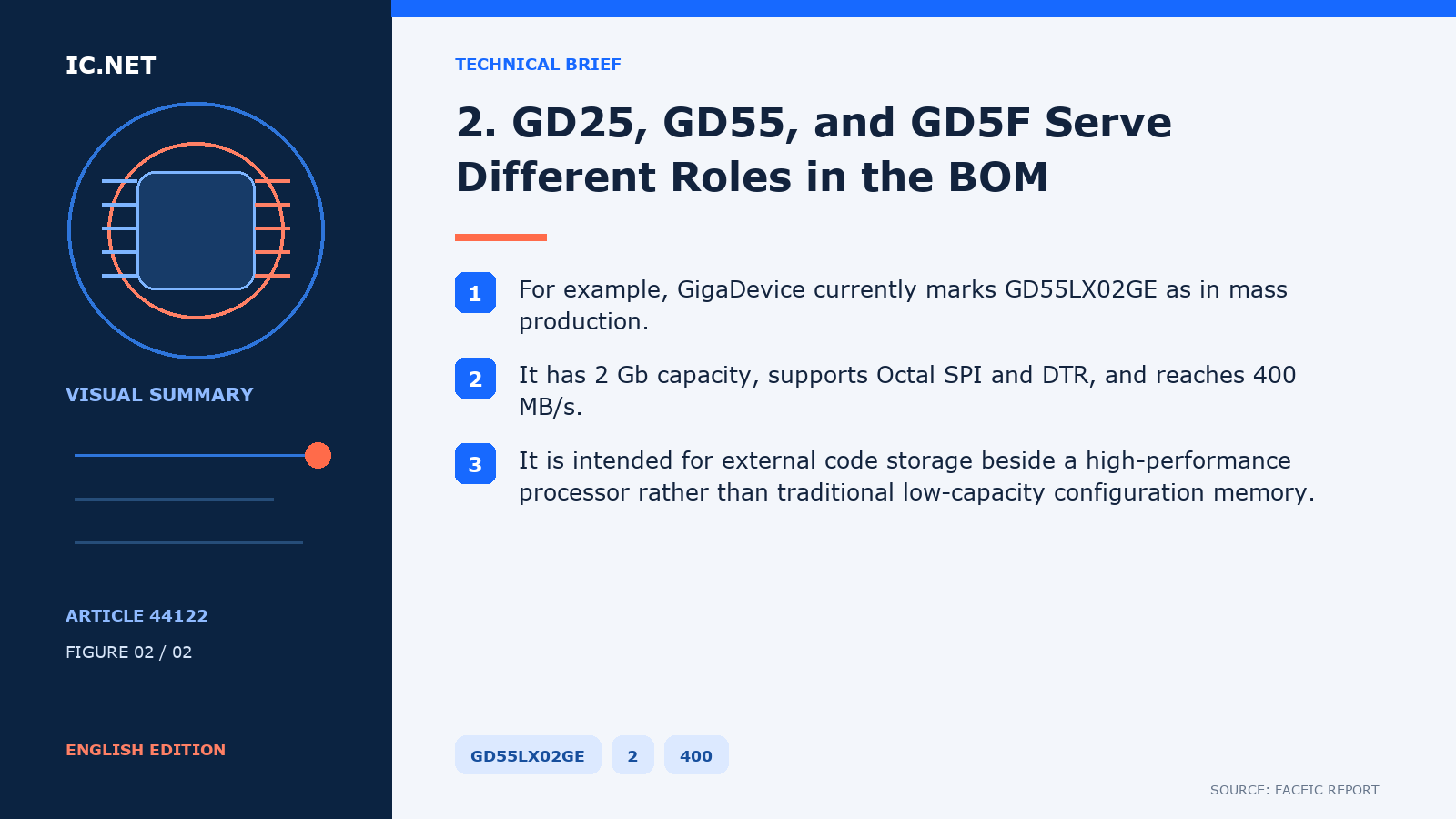
For example, GigaDevice currently marks GD55LX02GE as in mass production. It has 2 Gb capacity, supports Octal SPI and DTR, and reaches 400 MB/s. It is intended for external code storage beside a high-performance processor rather than traditional low-capacity configuration memory.
GD5F is SPI NAND. The GD5F family qualified to AEC-Q100 in 2022 spans 1 Gb to 4 Gb, integrates ECC, and targets higher-capacity applications including gateways, dash cameras, digital cockpits, and T-Boxes.
The three lines are therefore not simply high, medium, and low grades, and one vehicle does not necessarily use all three. Selection follows controller architecture, host interface, and the data being stored.
3. AEC-Q100 and ASIL D Address Different Problems
As of July 2026, GigaDevice said its automotive memory products were qualified to AEC-Q100. AEC-Q100 primarily validates component reliability under automotive stresses such as temperature cycling, high-temperature operating life, ESD, and humidity. It is a baseline for automotive supply.
In functional safety, the complete automotive GD25/55 SPI NOR families obtained ISO 26262:2018 ASIL D product certification in 2024. The scope extends beyond long-term component operation to random hardware faults, systematic faults, and safety mechanisms that can be incorporated into vehicle or controller analysis.
The certifications do not replace each other and should not be conflated. Public materials support that the complete GD5F family has passed AEC-Q100 and entered production, and that GigaDevice automotive memory is developed under an ASIL D functional-safety process. Without another product certificate, however, the GD25/55 ASIL D product certification should not be extended to every GD5F device.
A certificate also does not create an automatic design win. Tier 1s and automakers review safety manuals, failure modes, diagnostic coverage, lot traceability, change notifications, and long-term supply. Consistent delivery of those materials can matter more than a marginal parameter advantage.
4. The Domestic-Adoption Bottleneck Has Shifted to Low-Risk Introduction
The first question about domestic automotive Flash used to be whether a product met capacity, temperature, and interface requirements. As qualifications, production devices, and cumulative shipments create an evidence chain, the question becomes how to replace the incumbent at controlled cost without recurring problems after production.
First, build an exact compatibility matrix. Even with the same capacity and package name, compare voltage, pinout, instruction set, SFDP, erase granularity, boot timing, xSPI or OPI modes, power-loss behavior, ECC, and CRC. If the host Boot ROM or driver does not support the device, it is not a solder-in replacement.
Second, complete system validation. Beyond temperature and life testing, cover boot success, repeated power cycling, abnormal power loss, software updates, signal integrity, EMC, production lots, and corner conditions. A safety-related controller must also incorporate the memory's safety materials into system analysis.
Third, evaluate production capability. GigaDevice operates a fabless model, and its annual report identifies external uncertainty in wafer fabrication, assembly and test capacity, and cost. Cumulative shipments establish historical scale; they do not replace a forward review of capacity allocation, multisourcing, PCN processes, and quality response.
A cautious introduction starts on a new platform or second-source BOM, closes small-batch production, system validation, and field-data loops, and then increases share. This reduces requalification cost and avoids forcing excessive one-time pressure onto software and the supply chain.
Conclusion
The accurate position is not that every GigaDevice automotive Flash device directly replaces an overseas product. It is that parts of the portfolio have crossed from parameter matching to certification, production cases, and shipment scale.
The next competition is not only capacity, speed, and price. It is who can turn functional-safety documentation, lot consistency, software integration, quality response, and long-term supply into a repeatable introduction process. That is the dividing line between a device that can be used and one customers are comfortable using.
Disclaimer: This article is based on public manufacturer information for industry and product-trend analysis only. It does not constitute selection or procurement advice for a specific part.