
Gallium nitride is commonly associated with compact, efficient phone chargers. A strategic partnership between Infineon and German photovoltaic manufacturer BRC Solar moves 100 V CoolGaN into a harsher, much longer-lived application: the power optimizer mounted behind an outdoor solar module.
Infineon has confirmed that BRC Solar's M600-E and M605-M optimizers use 100 V CoolGaN transistors as their main power switches. This is a disclosed end-product selection rather than a sampling or evaluation announcement. The boundary is that no specific GaN part number, procurement volume, or shipment scale has been disclosed. The design win is confirmed; its volume is unknown.
1. The Application: BRC Solar's GaN Optimizers and Their Role
A series-connected PV string has a bottleneck effect: one shaded or failed module can reduce generation across the string. A module-level power optimizer uses independent MPPT to adjust the voltage and current of the affected module, limiting the loss and maximizing system output.
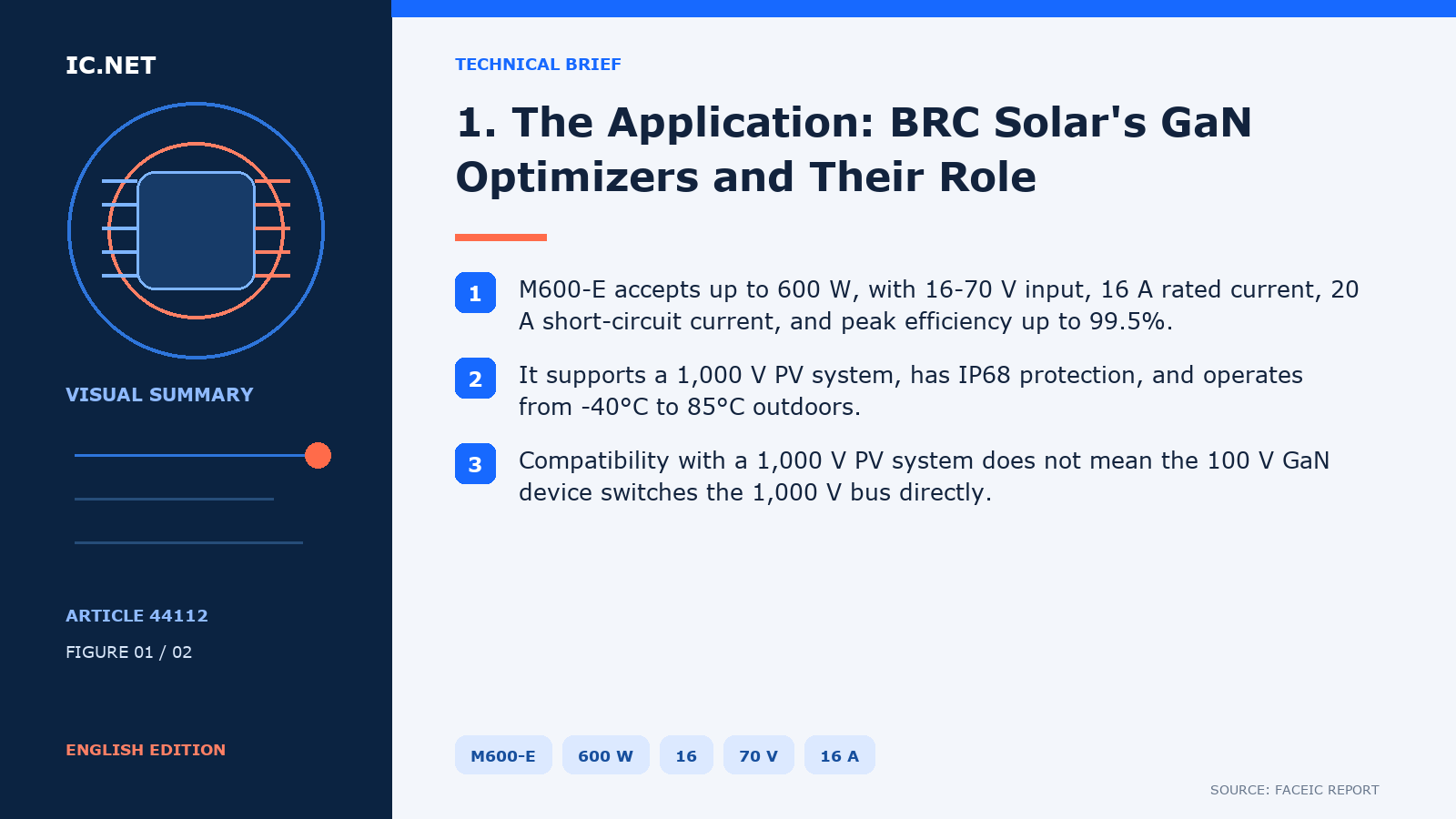
M600-E accepts up to 600 W, with 16-70 V input, 16 A rated current, 20 A short-circuit current, and peak efficiency up to 99.5%. It supports a 1,000 V PV system, has IP68 protection, and operates from -40°C to 85°C outdoors.
One misconception needs correction. Compatibility with a 1,000 V PV system does not mean the 100 V GaN device switches the 1,000 V bus directly. The transistor performs low-voltage DC-DC conversion at one solar module. The 1,000 V figure is the maximum voltage class of the complete string system; the two belong to different power paths.
M605-M adds detailed module-level monitoring to M600-E and uses power-line communications to connect with BRConnect 2.0 for real-time module data. The vendor lists availability in the third quarter of 2026, so it has not yet reached large-volume delivery. Neither Infineon nor BRC Solar has disclosed the number of GaN devices per optimizer, purchase volume, or installed quantity.
2. Why Choose 100 V GaN for a 600 W Solar Optimizer?
BRC Solar's optimizer uses a buck topology. When shading reduces a module's current, the optimizer lowers output voltage and raises operating current to match the rest of the string and minimize energy loss. Continuous conversion at high frequency and high current is a natural target for GaN.
A conventional 100 V silicon MOSFET is mature, but at high switching frequency its switching and reverse-recovery losses force tradeoffs among frequency, efficiency, passive size, and cooling. A 100 V CoolGaN device has low gate and output charge and no body-diode reverse recovery, reducing high-frequency switching loss and supporting a higher operating frequency. That can shrink inductors and capacitors and improve thermal design.
Infineon's 100 V CoolGaN G3 IGC033S10S1 illustrates the series capability. It uses a 3 mm × 5 mm PQFN package, has typical on-resistance of 2.4 mΩ, and total gate charge of 11 nC. This is a reference for technology capability, not the disclosed part used by BRC Solar. The exact end-product device remains unannounced.
A 70 V maximum optimizer input appears to leave 30 V of margin to a 100 V transistor, but outdoor operation reduces that margin through cable parasitics, switch-node ringing, turn-off spikes, temperature drift, and device variation. Robust PV design controls the spike across all conditions through derating, layout, gate-drive tuning, and surge testing rather than assuming the arithmetic margin is sufficient.
3. The Main Barrier for Solar GaN Is 25-Year Reliability
A consumer charger operates for a few years and is inexpensive to replace. A rooftop power optimizer is an exceptionally long-life product, and BRC Solar specifies a 25-year warranty. It must tolerate temperature cycling, humidity, lightning surges, and sustained full-load operation outdoors, where replacement is difficult and expensive. Long-term reliability matters more than peak efficiency in this application.
High-frequency GaN switching is a double-edged tool. It enables efficiency and small size, but high dv/dt can create voltage ringing and common-mode interference and places severe demands on parasitic control, gate timing, dead time, sensing, and EMC. A poor drive or layout can turn laboratory efficiency into field failures.
Compared with the previous M500, M600-E increases power from 570 W to 600 W and rated current from 15 A to 16 A, slightly broadens voltage coverage, and becomes substantially smaller. Dimensions fall from 78 mm × 161.5 mm × 30 mm to 78 mm × 145 mm × 22 mm. GaN is one contributor; magnetic redesign, control algorithms, PCB layout, and thermal improvements also matter. The complete system result should not be credited to the transistor alone.
4. GaN Replaces a Specific BOM Position, Not Every Silicon MOSFET
CoolGaN occupies the main DC-DC power-switch position in the optimizer, not the entire product. The system still requires an MPPT controller, sensing, gate drive, passives, communications, protection, and connectors.
Silicon MOSFETs retain substantial value in lower-frequency, space-tolerant, cost-sensitive applications because their supply chain is mature, drive is simple, engineering experience is extensive, and cost is controlled.
The likely trend is targeted GaN adoption in high-power-density, high-efficiency, high-reliability, space-constrained segments rather than universal replacement. The partnership matters because 100 V GaN is leaving the familiar fast-charger market for a long-life industrial PV application.
Procurement and engineering should next verify the full part number, devices per unit, gate-drive compatibility, domestic alternatives, measured temperature rise, field failure rate, and long-term lead time before drawing conclusions about technology and supply risk.
5. Conclusion: the Solar Design Win Is Real; a Volume Breakout Needs Time
Infineon's 100 V CoolGaN selection in BRC Solar optimizers is an industrial milestone. Moving from chargers to outdoor solar shows GaN's value shifting from attractive parameters toward system reliability, with module-level MPPT emerging as a new 100 V application.
One customer selection does not establish broad GaN substitution in solar. The industry still lacks public volume-deployment data, long-duration outdoor field data, and validation across multiple customers.
GaN has successfully reached the rooftop. Whether it becomes a large market will be decided not by one partnership announcement, but by stable operation over a 25-year life, volume deployment, and continuously demonstrated engineering reliability.
Disclaimer: This article analyzes manufacturer disclosures and does not constitute investment advice or a part recommendation. No inference is made about undisclosed part numbers, purchase volumes, or supply relationships.