
Innovision Semiconductor deserves a closer look among China's developers of 16-phase power controllers. On July 14, the company announced an award for its IS6214A at the 2026 Open Compute technology conference. Its product catalog also lists a different 16-phase controller, the IS6209A, as available.
One appears in a news announcement; the other has a product listing. Together, they provide a way to examine Innovision's broader portfolio of power stages, controllers, modules and protection devices. To understand where a China-developed alternative could fit, the unit of comparison needs to be the whole voltage regulator module, or VRM, supplying the processor.
1. From a 70 A power stage to a 16-phase controller
Innovision was founded in May 2016. Its official company history describes a progression from a 70 A power stage in 2021 to an eight-phase controller in 2022 and a 16-phase digital controller in 2025.
The sequence matters because these devices perform different jobs. A power stage integrates the driver and power MOSFETs that switch electrical energy. A multiphase controller coordinates the phases and adjusts the output using feedback. By developing high-current power devices before adding the controller, Innovision established a basis for co-designing the two. Its catalog also includes switching converters, buck modules and electronic fuses, extending the portfolio beyond processor-core power.
Individual part numbers make the portfolio easier to evaluate. The IS6201A is a dual-output, eight-phase controller; power-stage offerings include the 70 A IS6806A and 90 A IS6816B. These are identifiable devices that engineers can investigate separately. A broad portfolio supports further evaluation of solution capability, but it does not establish which combinations any customer has actually adopted.
2. IS6214A and IS6209A: keep the specifications and evidence separate
Innovision's announcement describes the IS6214A as a dual-loop, mixed-signal, 16-phase PWM controller for AI server power. It uses the TCOT control architecture and is reported to support PMBus, AVSBus and PWM-VID. The IS6209A product page specifies PMBus/SVI3, a switching frequency of 200 kHz to 3 MHz per phase, a 7 × 7 mm QFN package and an available supply status. These protocol, parameter and availability claims belong to their respective part numbers. They should not be combined into a generic “Innovision 16-phase specification.”
Phase counts also need careful reading. The IS6209A parameter table states N + M ≤ 16, while its description gives a maximum of 16 phases for Loop 1 and eight for Loop 2. The former is a total limit; the latter are individual loop limits. They do not add up to 24 phases, and dual output does not mean 16 + 16 phases. Valid allocations still need to be checked against the configuration rules. Phase count describes the number of power branches the controller can coordinate; output count describes the number of independently regulated voltage rails.
Interfaces determine whether a controller can work with the intended processor platform. PMBus handles configuration and telemetry, but does not by itself provide the processor's voltage-control interface, sequencing or firmware integration. Innovision also describes a graphical configuration tool, on-chip nonvolatile memory and dynamic phase control for the IS6209A. Dynamic phase control adds or sheds active phases as the load changes. Configuration reuse and fault diagnosis matter to an engineering team just as much as the headline number “16.”
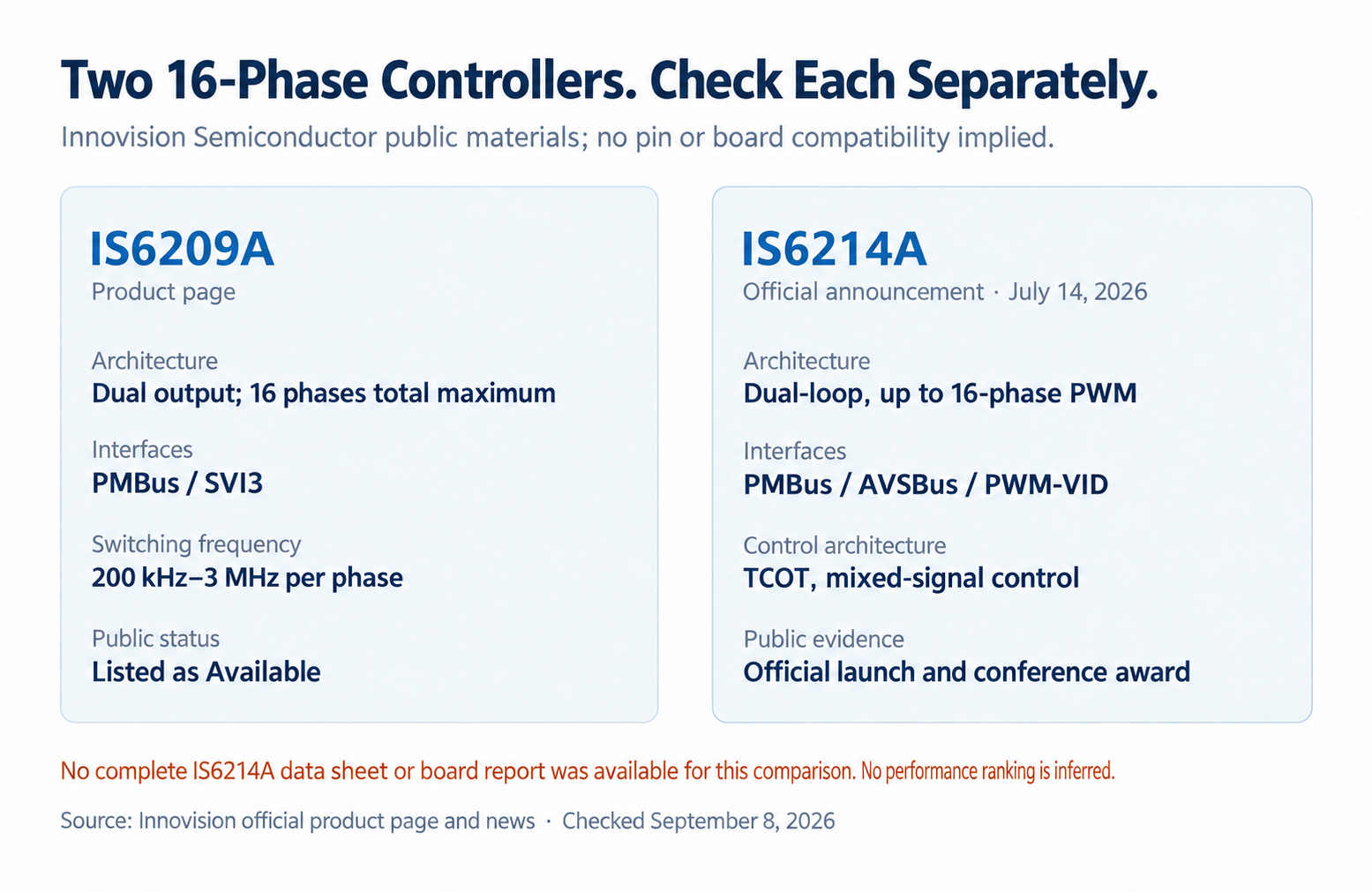
Figure 1. Comparison based on Innovision's official product page and announcement, checked on September 8, 2026. Availability is recorded separately for each model and does not establish customer adoption.
3. At 1,000 A, evaluate the controller and power stages on the same board
A simple calculation shows why high-current multiphase power is difficult. A hypothetical load drawing 1,000 A at 1 V requires 1,000 W. If one section of the power path has an equivalent resistance of 0.1 milliohm, that section alone dissipates 100 W through I²R loss. This is an illustration of sensitivity to resistance, not a measurement of an Innovision product or a particular server. At these currents, copper, vias, connections and cooling directly affect the design.
The controller sends PWM signals. The power stages, inductors and power paths deliver energy to the load, while output capacitors temporarily supply the difference when the load changes faster than the converter can respond. More parallel phases can share current and heat, but current balancing, transient response, layout and switching losses must be considered together. Multiplying 16 by a power stage's rated current does not establish the reliable continuous-current capability of a board.
Having both controllers and power stages in its portfolio gives Innovision an opportunity to coordinate current sensing, temperature monitoring and protection within a common development and debugging process.
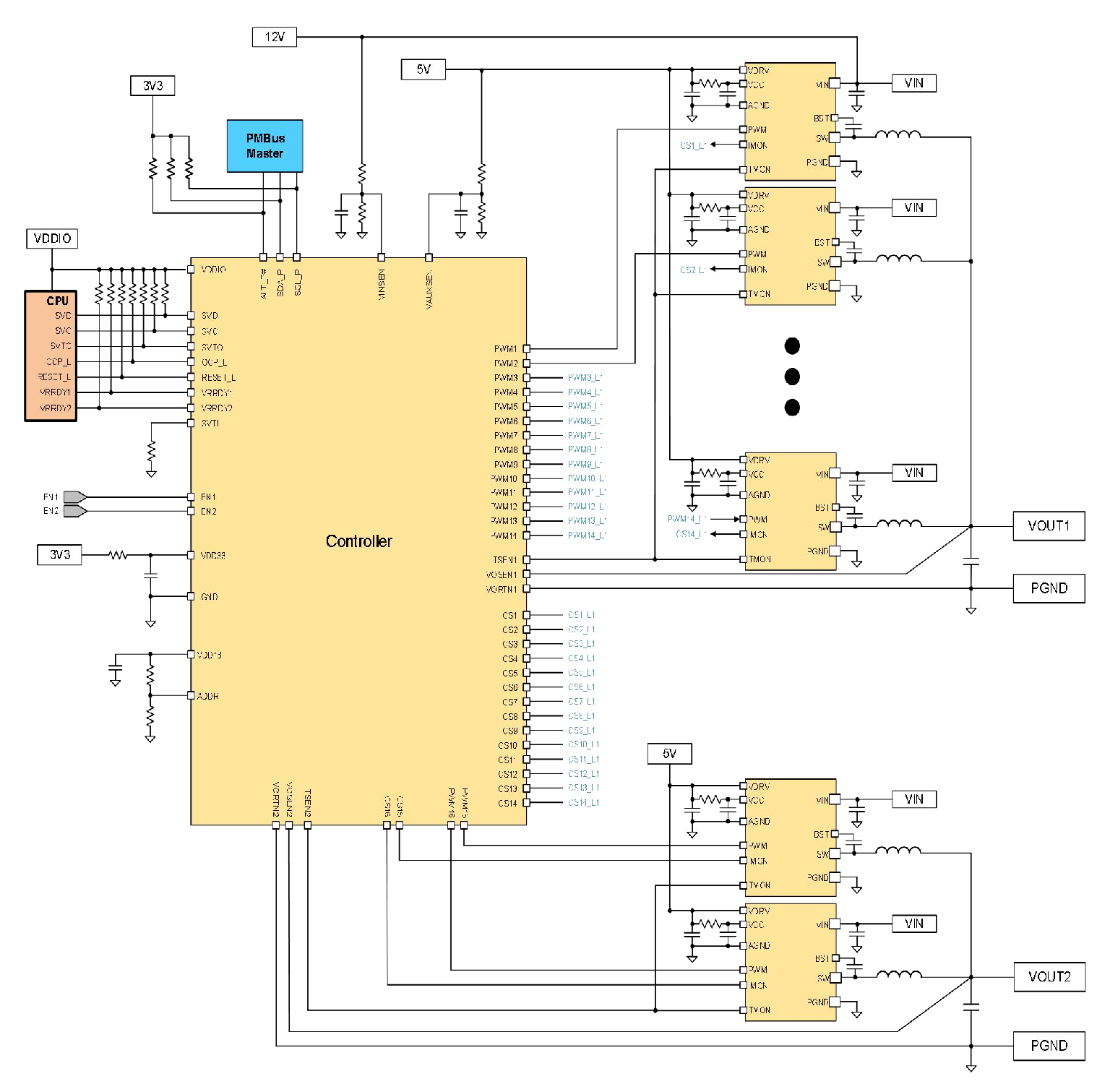
Figure 2. Original typical application circuit from the IS6209A product page. It shows the roles of the controller, power stages, inductors and two outputs. This manufacturer reference circuit is not a customer's actual BOM and does not replace the complete design documentation.
4. From board-level VRMs to vertical power delivery
At the same conference, Innovision discussed vertical power delivery and showed an architecture placing the IS6825A close to an XPU. The motivation is the same: when very large currents travel at very low voltages, reducing path length has value. It also introduces new design constraints. Module dimensions, space behind the PCB, cooling and assembly must be addressed together. An architecture illustration cannot be treated as evidence of a production customer design.
China's 16-phase controller market includes other identifiable products. Bright Power Semiconductor's official BPD93136 page also lists up to 16 phases, dual outputs and PWMVID, PMBus and AVSBus interfaces. This establishes a comparison baseline, not direct interchangeability with Innovision's devices. Engineering and procurement teams still need to check package pinouts, development tools, board changes and the full cost of validation.
Buying a coordinated set of devices also involves trade-offs. Support from one supplier may simplify coordination across several components. But if several BOM items depend on that supplier's configuration and tools, a second-source strategy needs to be planned earlier. A practical evaluation starts by establishing protocol and electrical requirements on a new project, then proceeds through board and system tests. It should also examine wafer fabrication and assembly/test sources, lot consistency, supply commitments and product-change notifications. Device price, board redesign, validation and ongoing maintenance together determine the cost of switching suppliers.
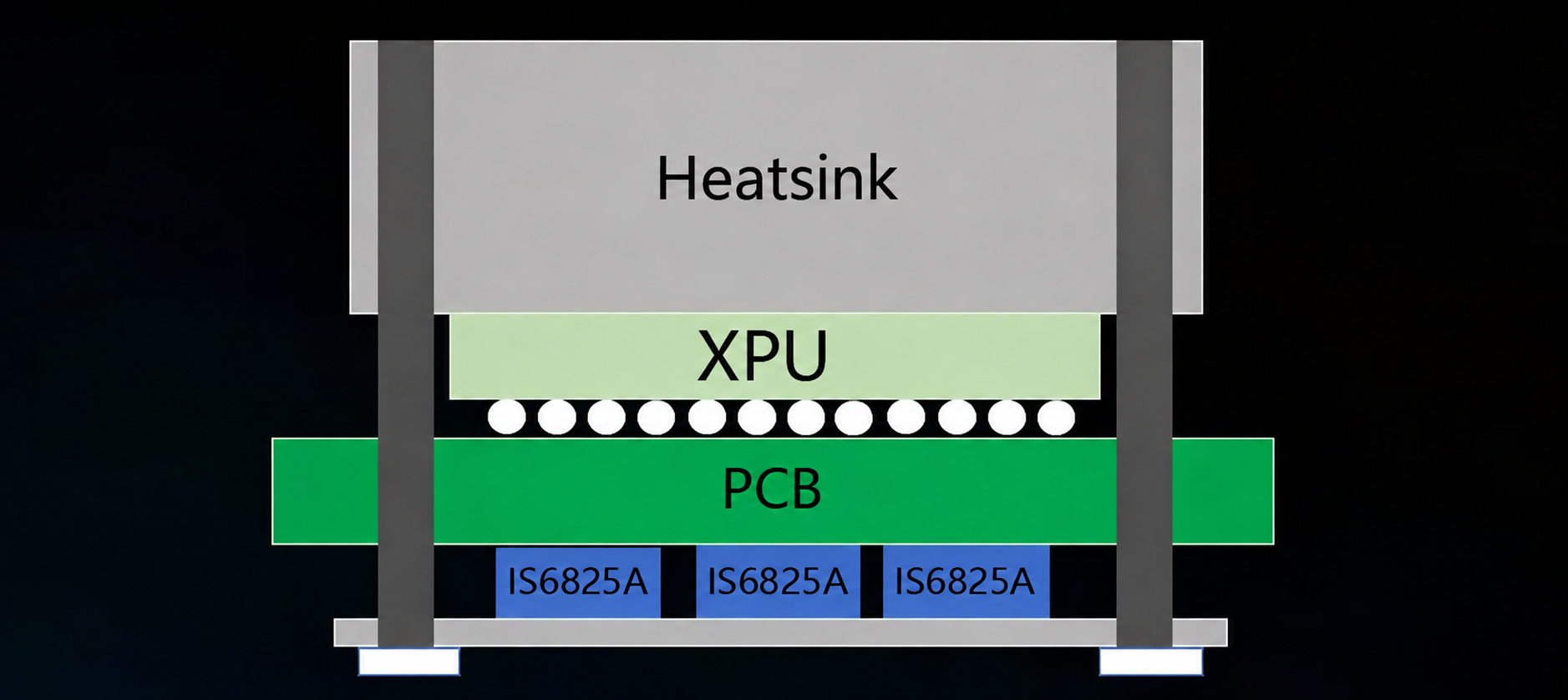
Figure 3. English-localized version of Innovision's vertical power delivery illustration, showing the relative positions of the IS6825A, PCB and XPU. It is an architecture illustration, not an end-product photograph or evidence of a confirmed customer supply relationship.
Conclusion
Innovision is worth following because it has introduced 16-phase controllers with different interfaces and continues to build out the surrounding power stages and related devices. The most useful next evidence would identify specific platforms, complete test conditions and sustained delivery records. Suppliers that can provide those materials will have a stronger chance of turning a China-developed controller from an entry on a selection list into a power solution that customers can maintain over time.
Disclaimer: This article is based on public materials checked as of September 8, 2026. It is intended for industry discussion, not investment, procurement or part-selection advice. Specifications, availability and validation status remain subject to the latest manufacturer and customer documentation.
