
Liquid cooling GPUs and CPUs is no longer unusual. The next target is deeper in the rack: the power busbar.
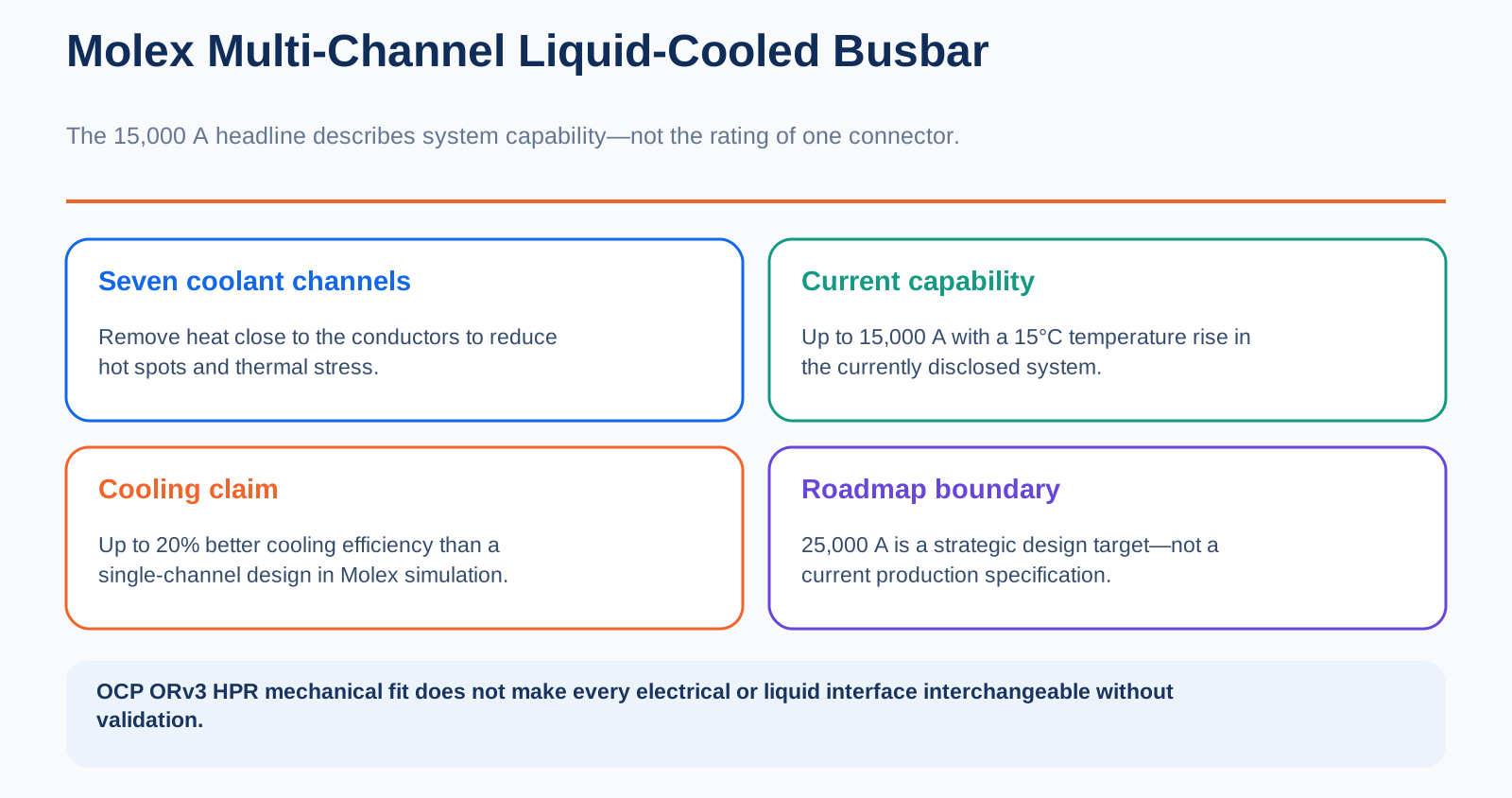
At Computex in June 2026, Molex showed a multi-channel liquid-cooled busbar with seven independent coolant channels built into the power-distribution backbone. Molex currently specifies up to 15,000 A with a 15°C temperature rise at that current. Its simulations indicate up to 20% better cooling efficiency than a single-channel design, while the product roadmap targets 25,000 A.
Those numbers need context. The 15,000 A figure is not the rating of one connector, and it does not mean the current product already supports a 1 MW rack. Molex describes a typical application of roughly 750kW at 48 V or 52 V. By simple calculation, a 1 MW rack would require about 20.8kA at 48 V or 19.2kA at 52 V. The 1 MW rack is an architectural direction; 15,000 A is the system capability Molex currently discloses. They are not interchangeable claims.
The larger point is that the thermal bottleneck in an AI rack is spreading beyond GPUs, CPUs and switch silicon into the power-distribution backbone. Connector suppliers are no longer selling only plugs, copper bars and fluid couplings. They are being asked to deliver a rack system in which electrical, thermal and fluid performance all work together.
1. The 15,000 A rating belongs to a busbar system, not a connector
A busbar used to have a straightforward job: carry high current from the power shelf to server trays or compute boards. As current rises, conductor loss increases with I²R. Adding more copper reduces resistance, but it also adds weight, occupies more space and makes the rear of the rack harder to package and service.
Molex turns the busbar into a combined copper-and-coolant structure. Seven coolant channels remove heat close to the conductor, reducing local hot spots and thermal stress. The public product page also lists a flow range of approximately 1-10LPM and an end-to-end pressure drop below 1bar. A liquid-cooled busbar must therefore pass electrical, thermal and fluid tests at the same time. It is more than a thicker passive copper bar.
The published figures still have limits. The 20% number is the maximum simulated improvement over a single-channel design; it is not a 20% reduction in total system energy and does not mean PUE falls by 20%. The 25,000 A figure is a strategic design target, not a current production rating. Compliance with the OCP ORv3 HPR mechanical envelope helps with rack fit and migration, but it does not make every electrical interface, fluid interface or competing product interchangeable without validation.
2. An AI rack has one highway for power and another for heat
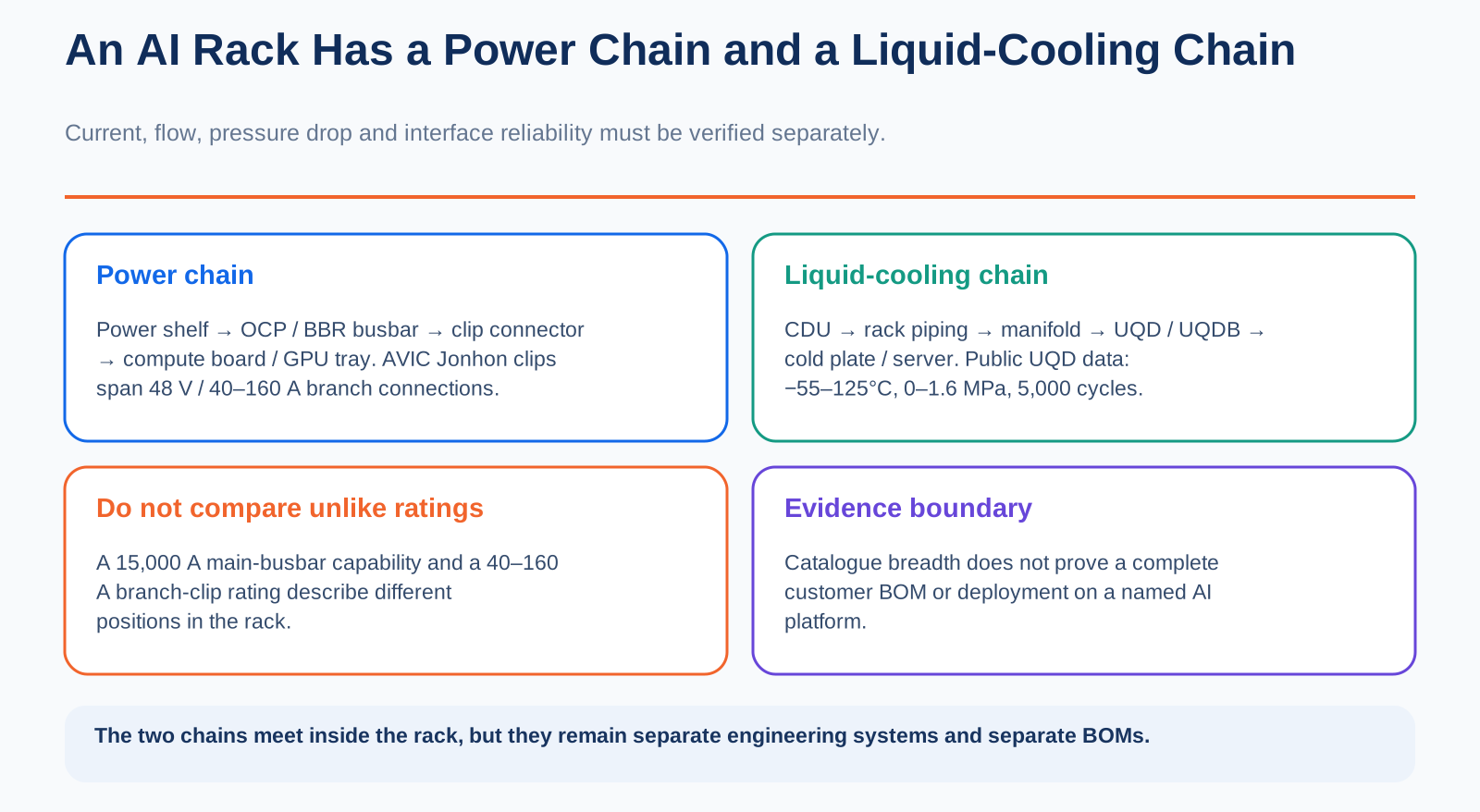
The rack power path usually starts at facility power or a distribution unit, enters a power shelf, and is converted by AC/DC or DC/DC stages into a 48 V or 52 V bus. Rack busbars, branch connectors, cables or flexible copper links then carry power to GPU trays, where board-level DC/DC converters and VRMs generate the lower voltages used by the chips. The main busbar serves the trunk; clips, cable assemblies and board-level power connectors serve the branches. Their current ratings should not be treated as directly comparable numbers.
The liquid-cooling loop is a separate system. A CDU manages heat exchange, pumping and coolant quality. Coolant moves through rack piping into a manifold, then through UQD or UQDB quick-disconnects and hoses to cold plates on GPUs, CPUs, switch silicon or optical modules before returning. Molex's liquid-cooled busbar adds a special branch between the two systems: coolant now enters not only chip cold plates, but also the power-distribution busbar itself.
Whether the busbar branch shares a CDU, manifold and coolant with GPU cold plates depends on the rack design. Current determines conductors and contacts; flow and pressure drop determine pipes, pumps and couplings. The systems meet inside the rack, but they are not the same bill of materials.
3. AVIC Jonhon has the component breadth, but not yet a disclosed 15,000 A peer product
AVIC Jonhon's 2025 annual report identifies products on both sides of the architecture. Its power portfolio includes BBR flexible copper busbars for compute systems, OCP busbars and compute power connectors. Its liquid-cooling portfolio includes UQD and UQDB fluid connectors, hoses and assemblies, cold plates and cooling-source equipment.
The company's public catalogue lists four clip products for specific connection points: CZ43-2YR-11-4.6 at 48 V/60 A, CZ43-2Y-13-6 at 48 V/40 A, CZ43-2Y-32(HW) at 48 V/100 A, and CZ43-1Y-32 at 48 V/160 A. They provide quick connections between busbars, or between a busbar and a load, in OCP and Scorpion server racks. These are branch interfaces, not a 15,000 A main busbar. The much smaller numbers do not mean the products are behind in current-carrying capability; they describe different positions in the system.
AVIC Jonhon also specifies an operating-temperature range of −55°C to 125°C, an operating-pressure range of 0-1.6MPa and 5,000 mating cycles for its UQD products. The 1.6MPa value is an operating-pressure rating. Molex's figure below 1bar is the end-to-end pressure drop through the busbar's coolant path. Again, they are different metrics.
In a June 2026 investor-research record, AVIC Jonhon said its high-speed copper cables, structured cabling, liquid-cooling connectors and cold-plate assemblies had reached volume use at leading customers, without naming customers or complete part numbers. That statement does not prove its OCP busbars are already shipping at scale, and it does not establish that the company offers a 15,000 A integrated liquid-cooled busbar. Public information confirms a broad component portfolio; it does not yet show that the components have been integrated and qualified as a directly comparable system.
4. Six questions procurement should ask before buying a liquid-cooled busbar
First, define the architecture. Is the rack bus 48 V or 52 V? Does 15,000 A refer to the complete busbar, one conductor or a parallel system? How are continuous power, transient power and redundancy defined?
Second, verify electrical performance. End-to-end resistance, voltage drop, contact temperature rise, current sharing, overload capability and short-circuit withstand must not be collapsed into one headline current rating.
Third, obtain the full thermal and fluid test conditions. What inlet temperature, flow rate, coolant, ambient temperature, test duration and busbar dimensions produced the 15°C temperature rise?
Fourth, validate material compatibility. Compatibility with dielectric and non-dielectric coolants does not mean compatibility with every formulation. Seal swelling, copper-aluminium corrosion, particle contamination and coolant conductivity can all affect long-term operation.
Fifth, examine failure modes. How does the system detect, derate and shut down after a pump stop, reduced flow, partial blockage, slow leak or incompletely latched coupling?
Sixth, address mechanics and service. Does ORv3 envelope compatibility extend to connectors, hoses, assembly tolerances and field replacement? Does a second source require a new validation cycle?
The commercial comparison therefore cannot stop at quotations for a Molex busbar, an AVIC Jonhon OCP busbar or a UQD connector. Total cost also includes copper, pumping power, CDU capacity, valves, sensors, leak detection, rack redesign, validation time and service downtime. Liquid cooling may reduce conductor temperature rise, but it does not remove engineering complexity. It moves that complexity from copper sizing into joint electrical, thermal and fluid validation.
Conclusion
The most important part of Molex's announcement is not the 15,000 A headline. It is the decision to make the power busbar part of the liquid-cooling system. As AI racks move to higher power, competition will shift from individual busbars, clips and quick-disconnects toward the complete interface matrix among the power shelf, main busbar, branch connections, manifold, hoses, cold plates and CDU.
AVIC Jonhon already has OCP busbars, BBR flexible copper busbars, power connectors, UQD/UQDB products, hoses and cold plates. That breadth gives the China-based supplier a credible foundation for a China-sourced AI-rack BOM. Public information, however, does not yet prove that it has an integrated liquid-cooled busbar directly comparable with Molex's 15,000 A system, nor does it confirm specific customer or platform relationships.
The next step for China-based suppliers is not simply to show that both electrical and liquid-cooling products exist in the catalogue. They need to demonstrate that the two systems can pass like-for-like testing, repeat across production lots and remain serviceable in the same rack. Complete part numbers, temperature-rise curves, flow and pressure-drop data, fault isolation, platform qualification and volume-delivery evidence will mark the transition from component supplier to AI-rack system supplier.
Disclaimer: This article is for industry discussion only. It is not investment, procurement or product-selection advice. Confirm product specifications, supply relationships and application status using current manufacturer documentation and program-level validation.