
Discussion of domestic automotive chips often falls into one of two extremes: either complete substitution is declared a success, or every program is dismissed as still existing only in presentations. Motorcomm's three automotive communications product lines show a more realistic, layered progression.
One supplier can have a mature product with shipments in the tens of millions, a newer product already installed in vehicles, and another still undergoing automaker validation. That is not contradictory messaging. It is normal in automotive semiconductors: there is no single substitution result, only progress by exact part, product line, and program milestone.
Using official public information, this article separates the industrial status of Motorcomm's YT80, YT99, and YT78/YT79 lines.
1. YT80 Reaches 15 Million Units: Automotive PHY Moves from Usable to Repeatable Scale
An automotive Ethernet PHY is the physical foundation of the vehicle network, transmitting data among domain controllers, sensors, and wiring. Unlike a consumer device, it must tolerate long-term temperature cycling, difficult EMC, harness attenuation, and ESD while maintaining consistency across production lots. Functional connectivity alone is far from volume installation by an automaker.
Motorcomm's core YT80 automotive PHY family is beyond sample validation. YT8010A targets 100BASE-T1 and supports RGMII, MII, and RMII. The YT8011A family supports both 100BASE-T1 and 1000BASE-T1 with high-speed RGMII and SGMII interfaces. The core devices are qualified to AEC-Q100 Grade 1 and offered in mainstream QFN36, QFN48, and QFN40 packages for a broad range of automotive control applications.
Motorcomm's 2025 annual report says that 4 automotive PHY products were in mass production, represented by YT8010A and YT8011A. By April 2026, cumulative YT80 shipments had exceeded 15 million units.
That does not establish complete replacement of overseas automotive PHYs, but it does demonstrate validation in a large number of vehicles, repeat orders, and stable delivery. The key questions for YT80 have moved beyond basic ability to enter a vehicle toward capacity assurance, cost optimization, field-data iteration, and multisupplier backup.
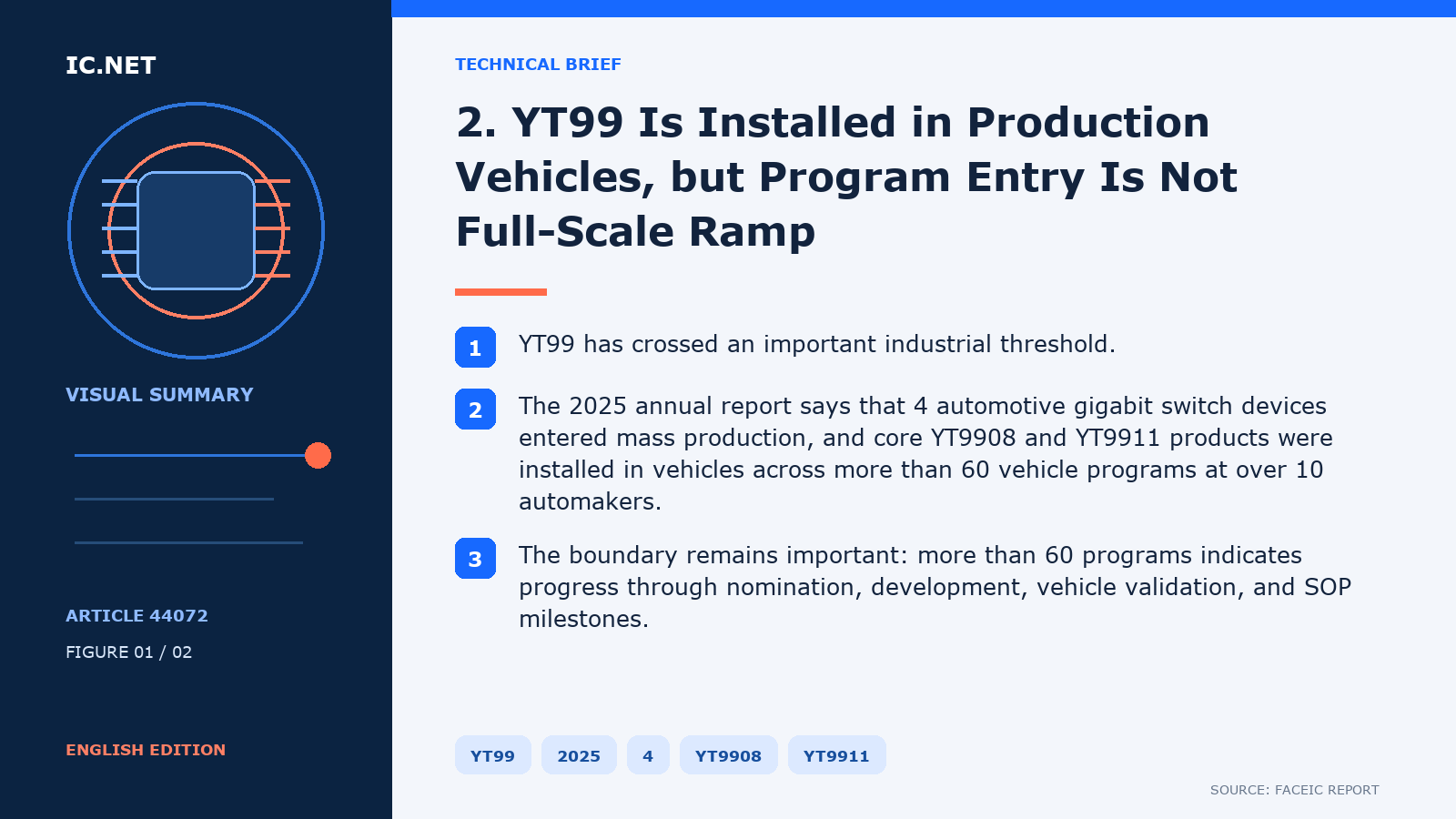
2. YT99 Is Installed in Production Vehicles, but Program Entry Is Not Full-Scale Ramp
If a PHY answers how one data link is transmitted, a TSN switch answers how multiple links are aggregated and synchronized. It is a hub for the vehicle network, determining the efficiency and determinism of ADAS, cockpit, and central-gateway traffic.
The YT99 family includes the 8-port YT9908 and 11-port YT9911 for intelligent-driving, cockpit, and central-gateway applications. YT9911CP uses BGA and PCIe expansion for high-end multidomain integration; YT9911CL uses a general-purpose QFP package for mainstream production vehicles. The series supports uplinks up to 10G, can integrate multiple 100 Mbps and 1 Gbps automotive Ethernet PHYs, and supports mainstream TSN timing protocols including 802.1AS and 802.1CB.
YT99 has crossed an important industrial threshold. The 2025 annual report says that 4 automotive gigabit switch devices entered mass production, and core YT9908 and YT9911 products were installed in vehicles across more than 60 vehicle programs at over 10 automakers.
The boundary remains important: more than 60 programs indicates progress through nomination, development, vehicle validation, and SOP milestones. It does not mean all programs are at large scale or map to one fixed part number. Compared with the mature shipment level of YT80, YT99 remains in a phase of program deployment and gradual volume growth.
Evaluation should therefore focus on PPAP completeness, vehicle SOP timing, stable quarterly delivery, TSN scheduling stability, software-tool maturity, and field failure data—not whether production is possible at all.
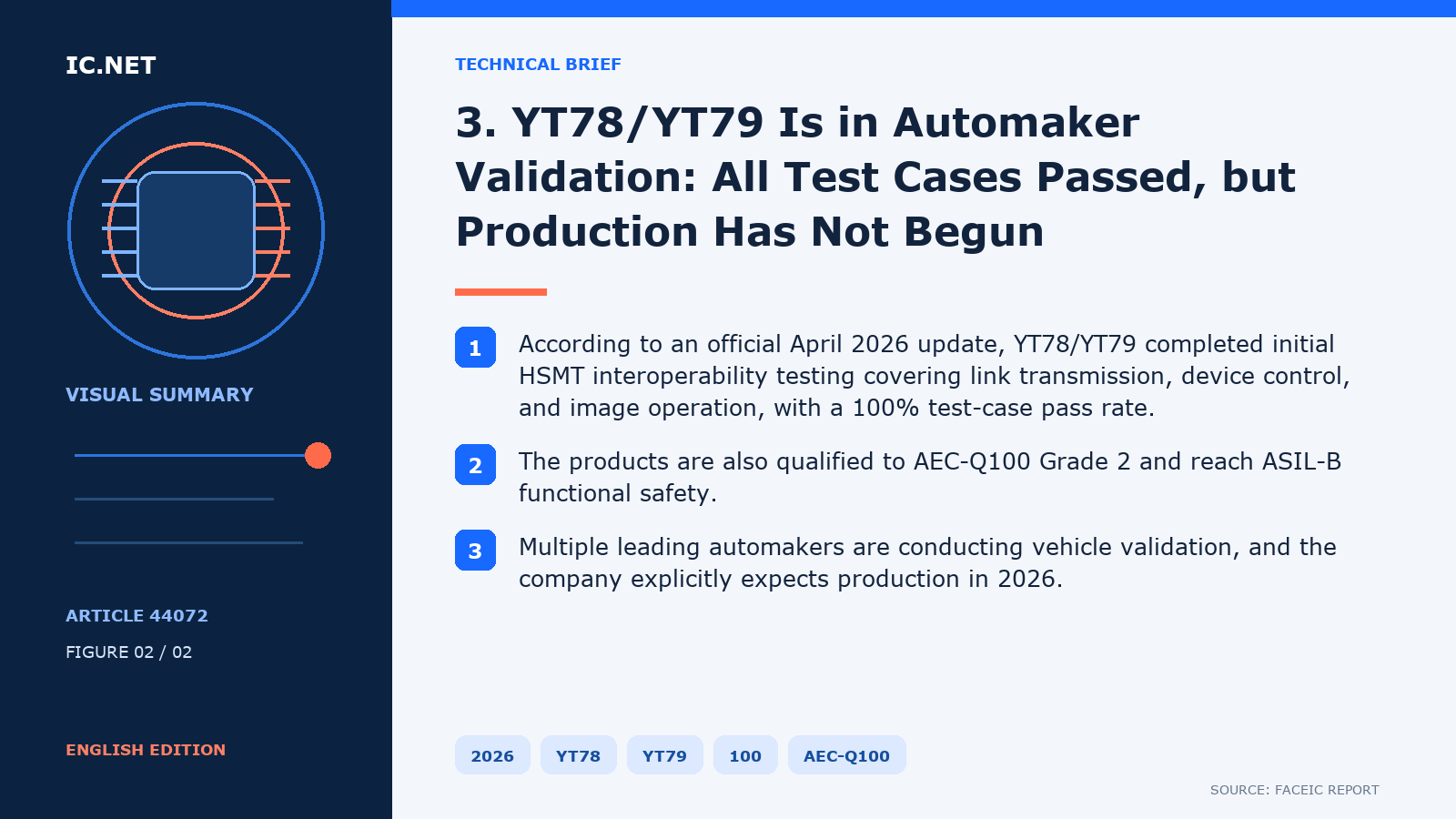
3. YT78/YT79 Is in Automaker Validation: All Test Cases Passed, but Production Has Not Begun
Automotive SerDes devices carry camera image data over a serial link and recover it at the domain controller, directly affecting stability, image quality, and latency in an automotive vision architecture.
Motorcomm's YT78/YT79 family includes 3 serializers and 6 deserializers supporting 2 Gbps-6.4 Gbps, for automotive cameras from 2 million to 12 million pixels. Product information is available for YT7821/7811/7801 and YT7921/7911/7901, but data-sheet availability indicates product definition, not volume supply.
According to an official April 2026 update, YT78/YT79 completed initial HSMT interoperability testing covering link transmission, device control, and image operation, with a 100% test-case pass rate. The products are also qualified to AEC-Q100 Grade 2 and reach ASIL-B functional safety. Multiple leading automakers are conducting vehicle validation, and the company explicitly expects production in 2026.
Pin compatibility and BOM fit address only the entry-level substitution threshold. Automotive programs still have to revalidate cable loss, link margin, EMC, reverse-channel control, MIPI timing, and vehicle-level functional-safety redundancy.
At this stage, YT78/YT79 is an evaluation option for domestic substitution and designs should retain a fallback to the incumbent. Until automaker SOP nomination and volume orders are in place, "expected production" cannot be treated as formal volume supply.
4. Automotive Substitution Must Be Verified BOM Position by BOM Position
The three lines show that domestic automotive communications substitution is not all or nothing. YT80, YT99, and YT78/YT79 occupy different BOM positions, serve different functions, face different qualification requirements, and progress at different rates. Their parameters and status cannot be compared horizontally, and one product line cannot represent the entire substitution level.
A rigorous evaluation checks six dimensions: the complete exact part number; automotive qualification and interoperability status; every milestone from sampling and nomination through vehicle validation and SOP; evidence of production-vehicle deployment; long-term price and lead-time stability; and a redundant fallback to the incumbent design.
For YT80, the focus is volume cost and long-term vehicle field reliability. For YT99, it is program ramp and software-ecosystem maturity. For YT78/YT79, it is closure of vehicle validation and the first production deployment.
Conclusion: Layered Deployment Is the Real Pace of Automotive Substitution
Motorcomm has neither replaced all automotive communications chips nor remained entirely at the sample stage. Its progress is clearly layered: the automotive PHY has reached tens of millions of shipments; the TSN switch is in production vehicles and entering program ramp; and automotive SerDes is advancing through validation toward its first production breakthrough.
Automotive development follows one central rule: marketing status can change quickly, but a production BOM closes one validation layer at a time. The final measure of domestic substitution is not a parameter or roadmap, but sustained stable delivery, long-term reliability, and adaptation across real vehicle scenarios.
Disclaimer: This article analyzes public information and does not constitute investment advice, part recommendations, or a judgment about unconfirmed supply relationships. Selection and status are subject to manufacturer information and customer validation.