
Entry-level MCU competition used to be straightforward: compare clock speed, Flash capacity, and tiny differences in unit price. NXP's introduction of the MCX C15/C16 series in May 2026 changed the rules.
Built around Cortex-M23, the new devices target legacy 8- and 16-bit applications while integrating a 16-bit ADC, programmable-gain amplifier, high-speed comparator, and FlexPWM at an entry-level price. The strategy directly targets external analog ICs on low-end control boards: one MCU reduces the BOM.
Chinese MCU vendors already have distinct positions. GigaDevice GD32E230, Geehy APM32F035, and MindMotion MM32SPIN0280 address the market in different ways. The competition is no longer homogeneous parameter matching. It is a contest to remove the most board-level peripherals and reduce total system BOM cost, not merely replace the main controller.
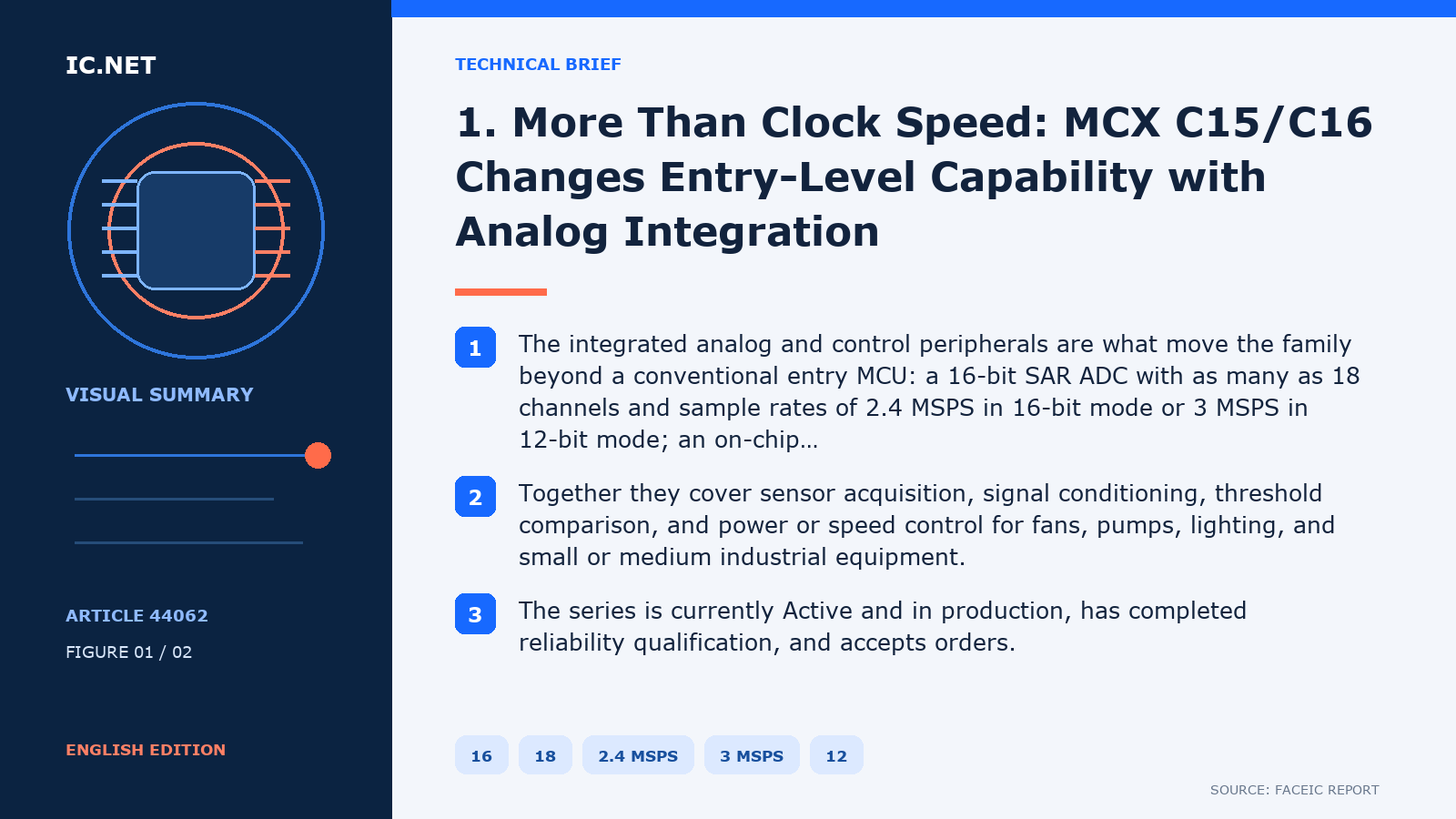
1. More Than Clock Speed: MCX C15/C16 Changes Entry-Level Capability with Analog Integration
MCX C15 uses a 48 MHz Cortex-M23, while MCX C16 reaches 72 MHz. Flash options are 32 KB and 64 KB for lightweight industrial and consumer control. Representative parts include MCXC151VFM with 32 KB Flash, 6 KB SRAM, and an H-PQFN32 package, and MCXC162VFT with 64 KB Flash, 12 KB SRAM, and H-PQFN48.
One specification discrepancy needs correction. NXP's product overview has listed up to 16 KB SRAM, but the detailed data sheet, block diagram, and formal part list top out at 12 KB. Selection should follow the exact orderable part.
The integrated analog and control peripherals are what move the family beyond a conventional entry MCU: a 16-bit SAR ADC with as many as 18 channels and sample rates of 2.4 MSPS in 16-bit mode or 3 MSPS in 12-bit mode; an on-chip programmable-gain amplifier; a high-speed comparator with an internal 8-bit DAC reference; and FlexPWM with six complementary outputs.
Together they cover sensor acquisition, signal conditioning, threshold comparison, and power or speed control for fans, pumps, lighting, and small or medium industrial equipment.
The series is currently Active and in production, has completed reliability qualification, and accepts orders. Some QFN16 and QFN24 package versions are planned only for December 2026, however, so not every package and configuration is yet broadly available. Channel inventory, lead time, and customer volume adoption still require verification.
2. Three Domestic Positions Counter NXP in Different Ways
Chinese suppliers have not simply copied NXP's parameter list. They follow three different routes shaped by application requirements.
1. GigaDevice GD32E230: general-purpose, low-cost migration
GD32E230 also uses Cortex-M23 at up to 72 MHz and provides 64 KB Flash plus 8 KB SRAM, a 1.8-3.6 V supply range, and a general-purpose LQFP48 package. Its compute and memory are close to MCX C16, making it suitable for general 8- or 16-bit designs moving to 32 bits. It lacks a 16-bit ADC and on-chip amplifier, so it fits cost-sensitive control projects with modest analog-accuracy requirements.
2. Geehy APM32F035: motor-control specialization with more analog channels
This device uses a 72 MHz Cortex-M0+ with 64 KB Flash and 8 + 2 KB SRAM. It includes a 16-channel 12-bit ADC, 4 on-chip amplifiers, 2 comparators, an advanced timer, and CAN. Rather than maximizing ADC resolution, it adds multiple analog-front-end channels for current sensing, overcurrent protection, and accurate PWM speed control, reducing external analog parts in motor and industrial-control applications.
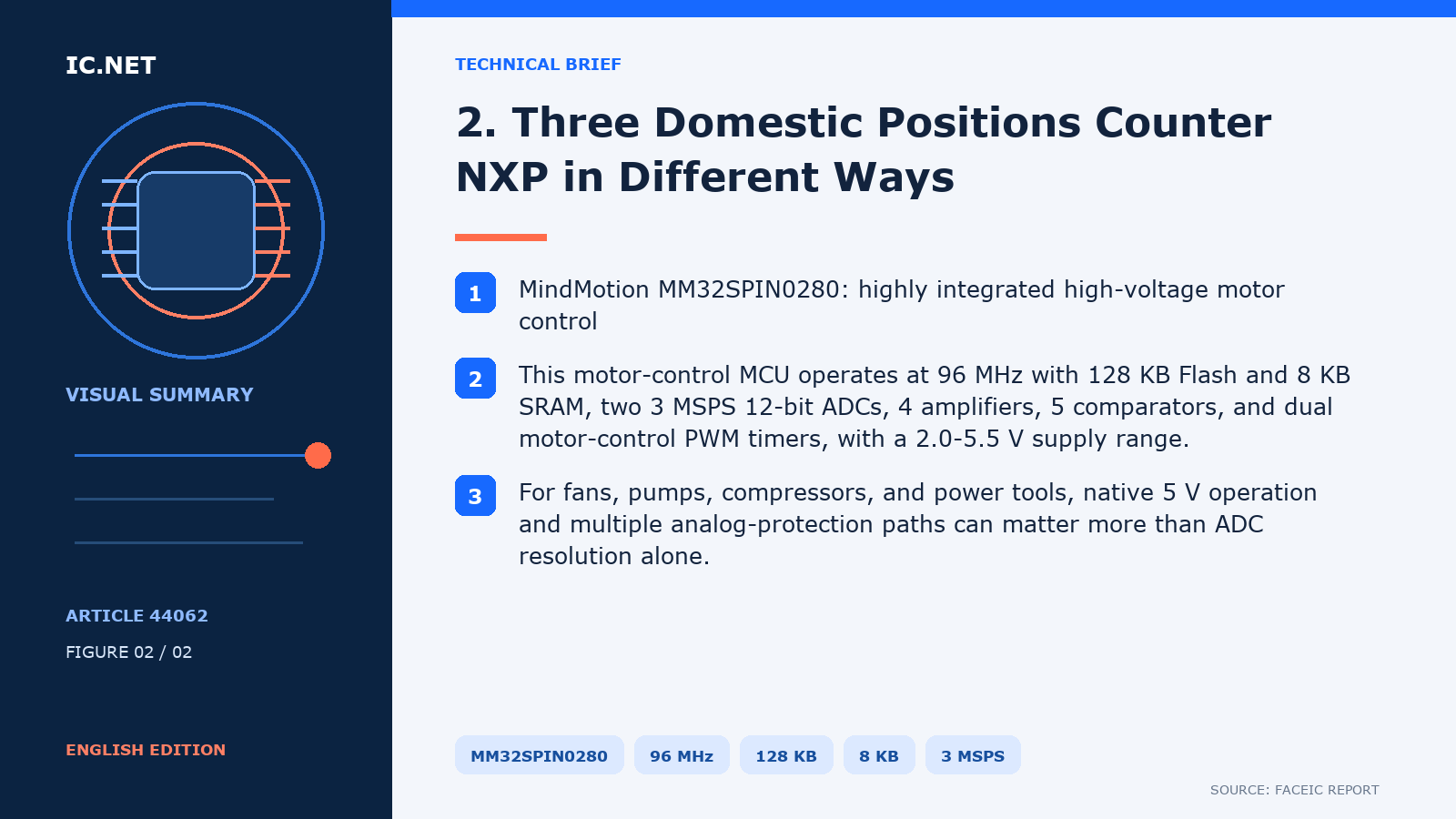
3. MindMotion MM32SPIN0280: highly integrated high-voltage motor control
This motor-control MCU operates at 96 MHz with 128 KB Flash and 8 KB SRAM, two 3 MSPS 12-bit ADCs, 4 amplifiers, 5 comparators, and dual motor-control PWM timers, with a 2.0-5.5 V supply range. For fans, pumps, compressors, and power tools, native 5 V operation and multiple analog-protection paths can matter more than ADC resolution alone.
None is a direct replacement for MCX C15/C16. Together they provide complementary positions: GD32E230 emphasizes general value, while APM32 and MM32 focus on highly integrated motor control. The domestic opportunity is not a parameter contest, but targeted system BOM reduction.
3. Parameters Are Not Performance: Which Saves More, a 16-Bit ADC or Multiple Amplifiers?
The easiest selection error is to treat "16-bit ADC" as proof of product superiority. Nominal resolution is not effective accuracy; reference noise, temperature drift, linearity, PCB layout, and sampling timing all affect the result.
MCX C16 has a theoretical advantage in high-precision acquisition. The multiple amplifiers and comparators in Geehy and MindMotion devices can more directly remove external amplifiers, comparators, and references from designs needing multichannel current monitoring, threshold protection, and real-time fault response.
Integration does not justify removing every external safeguard. Selection still requires amplifier offset, gain bandwidth, temperature drift, common-mode input range, and the safety architecture of critical protection loops. Redundancy may remain necessary in important equipment.
PWM blocks also cannot be compared by channel count alone. Dead-time control, complementary outputs, brake protection, fault linkage, and synchronized ADC triggering determine motor-control stability. Timer logic and registers vary significantly among MCU architectures; changing the controller still requires complete tuning and validation of the power stage.
4. Before Asking the Unit Price, Calculate Six Hidden Costs
First is parameter and compatibility cost. Cortex-M23 in both GD32E230 and MCX C16 does not imply compatible pins, registers, clock trees, or peripheral drivers. APM32F035 and MM32SPIN0280 differ even more in core, power, and peripheral organization.
Second is validation. Build A/B boards using the same sensor, shunt, gate driver, and power stage, then compare effective ADC accuracy, amplifier offset and drift, comparator delay, PWM dead time, overcurrent shutdown, and EMC. Lighting an LED on a development board is not BOM-replacement validation.
Third is software and production. An MCU change requires another review of startup code, compiler, programmers, debug interface, production tests, update mechanism, and fault logs. Data sheets, tools, and examples from Geehy, MindMotion, and GigaDevice reduce work; their availability does not eliminate migration cost.
The remaining costs are lot consistency, long-term supply, and the complete BOM. Public information does not support a like-for-like volume-price comparison for all four devices at the same quantity, package, and delivery terms, nor a conclusion about inventory or lead time. Procurement must include external ADCs, amplifiers, comparators, references, oscillators, PCB area, certification, and maintenance of a second solution—not only the tax-inclusive MCU price.
5. Conclusion: MCU Competition Has Become a System-Level BOM Contest
MCX C15/C16 does not make traditional 8- and 16-bit MCUs obsolete. It changes the rules for entry-level 32-bit devices from hardware-parameter comparisons to system integration and finished-product cost reduction.
Domestic vendors take differentiated paths: GD32E230 serves low-cost general upgrades, while APM32F035 and MM32SPIN0280 use dense analog integration to focus on motor and industrial control.
New programs should neither chase a 16-bit ADC headline nor assume that domestic value is sufficient on its own. A credible selection minimizes external components, controls cost and migration risk, and protects supply under the target operating conditions, EMC standard, and fault architecture. Only a solution that passes full production validation creates real BOM savings.
Disclaimer: This article is for industry and technical discussion only and does not constitute investment, procurement, or part recommendations. Parameters, supply, and qualification status are subject to the latest manufacturer and authorized-channel information.