
Qualcomm's price-increase notice has brought the semiconductor industry's accumulated cost pressure into the open.
According to an internal customer notice obtained by industry media, Qualcomm plans a double-digit price increase across products shipped after September 1, 2026. Qualcomm CEO Cristiano Amon subsequently confirmed publicly that the company would raise chip prices from September 1 in an effort to return margins to a historically reasonable range.
One boundary is essential: the "double-digit" figure comes only from the customer-side internal notice. Qualcomm has not published adjustments for every part number, region, or long-term agreement. It does not mean that every Snapdragon device will uniformly rise by more than 10%, and it certainly does not mean that phone, automotive, and IoT products will immediately increase by the same amount.
1. The Rule Is Clear: No Uniform Double-Digit Price, and the Shipment Date Controls
In its fiscal Q3 2026 results, Qualcomm said the semiconductor supply chain was facing broad increases in wafer fabrication, advanced assembly and test, memory, and core raw materials, and that it would absorb the pressure through phased product-pricing adjustments. The change applies only to the QCT chip business. It is completely separate from QTL patent-licensing fees, and the two must not be conflated.
At almost the same time, TSMC was negotiating 2027 foundry pricing with major customers, with increases of up to approximately 10% on some advanced-process programs, depending on customer scale, product type, and process node. That does not prove that TSMC is the sole driver of Qualcomm's adjustment. It does show that the fixed cost of advanced capacity, production equipment, upstream materials, and overseas fabs is passing layer by layer into IC design companies. Wafer and packaging costs directly raise the manufacturing cost of the chip itself, while the continuing memory shortage compresses the end-product BOM from the other side.
A common procurement mistake is to remember only the September 1 date and miss that shipment, not order placement, is the effective event. Whether open orders that ship after September, non-cancelable orders, annual rebate agreements, and project-specific contracts use the new price must be determined from formal written terms issued by Qualcomm or an authorized channel. An oral notice is not sufficient for forecasting cost.
2. Smartphones Face Pressure from Both Sides, but No Public Increase Exists for Flagship Parts
The Snapdragon 8 Elite Gen 5, represented by part numbers SM8850-AC and SM8850-1-AD, uses an advanced 3 nm process and supports flagship LPDDR5X and UFS 4.1 configurations. No public information currently confirms the actual increase for either device. They are useful observation points for the high-end smartphone platform, not confirmed examples of a particular adjustment.
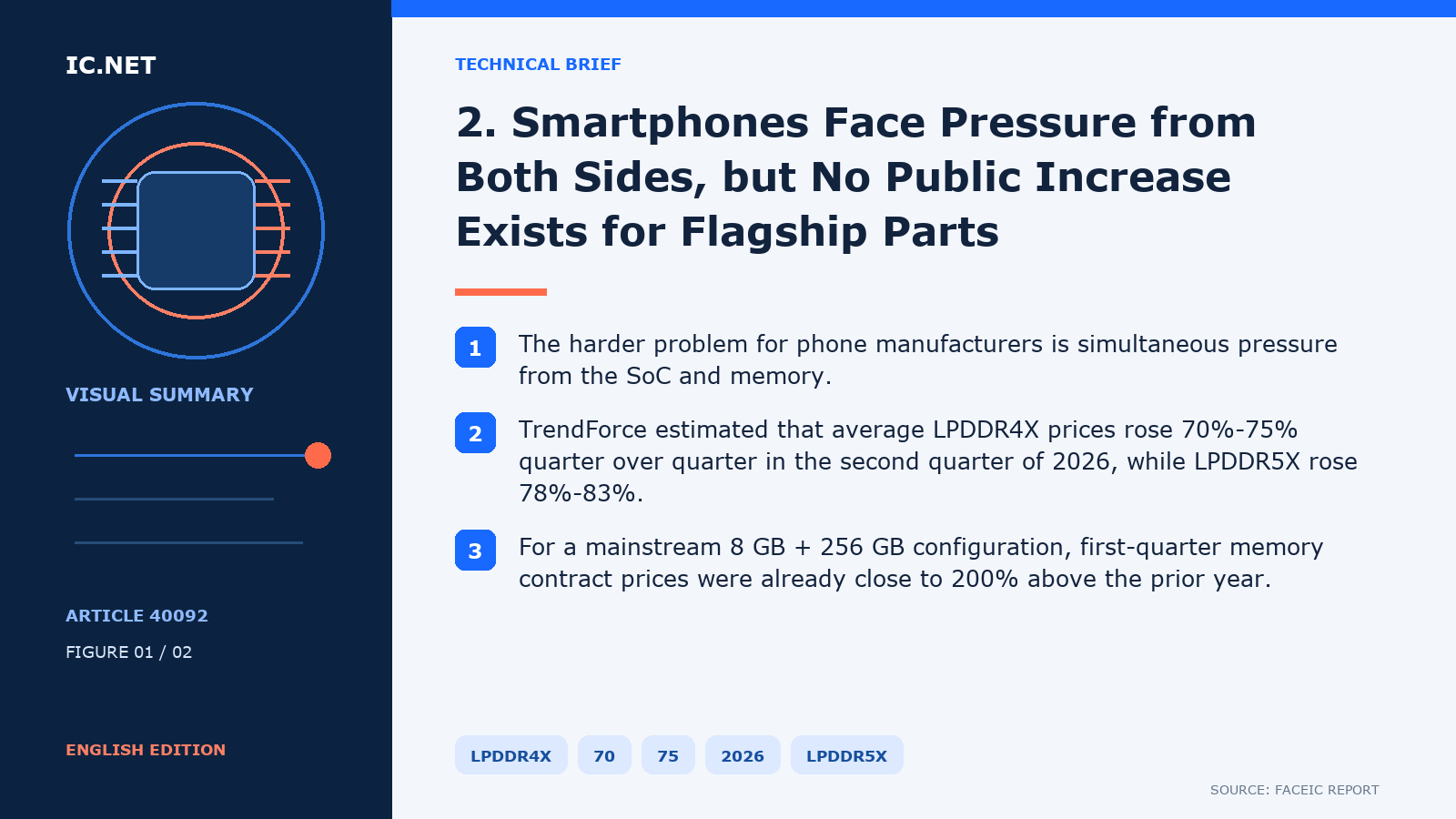
The harder problem for phone manufacturers is simultaneous pressure from the SoC and memory. TrendForce estimated that average LPDDR4X prices rose 70%-75% quarter over quarter in the second quarter of 2026, while LPDDR5X rose 78%-83%. For a mainstream 8 GB + 256 GB configuration, first-quarter memory contract prices were already close to 200% above the prior year. Memory's share of a smartphone BOM increased from the previous 10%-15% range to 30%-40%.
This point is frequently misunderstood: LPDDR5X, UFS, and the main SoC are independent purchasing lines on a phone motherboard. Higher wafer and packaging costs raise the price of Qualcomm's chip, while memory inflation squeezes the complete-device margin from another direction. A Qualcomm chip increase above 10% does not imply an equal increase in phone retail price. Vendors have more options: reduce the supply of 16 GB variants, move midrange models back to 8 GB, reuse a previous-generation flagship processor, or quietly narrow promotional discounts.
MediaTek's Dimensity 9500 will naturally receive more attention in new-program evaluations, but it also uses TSMC N3P. More importantly, changing a smartphone platform involves far more than replacing one chip. It affects PMIC power, RF, ISP tuning, thermal design, carrier certification, and the entire software ecosystem. A new processor part number cannot make that work disappear.
3. Automotive and IoT Feel the Impact Later as Costs Move Through Contracts
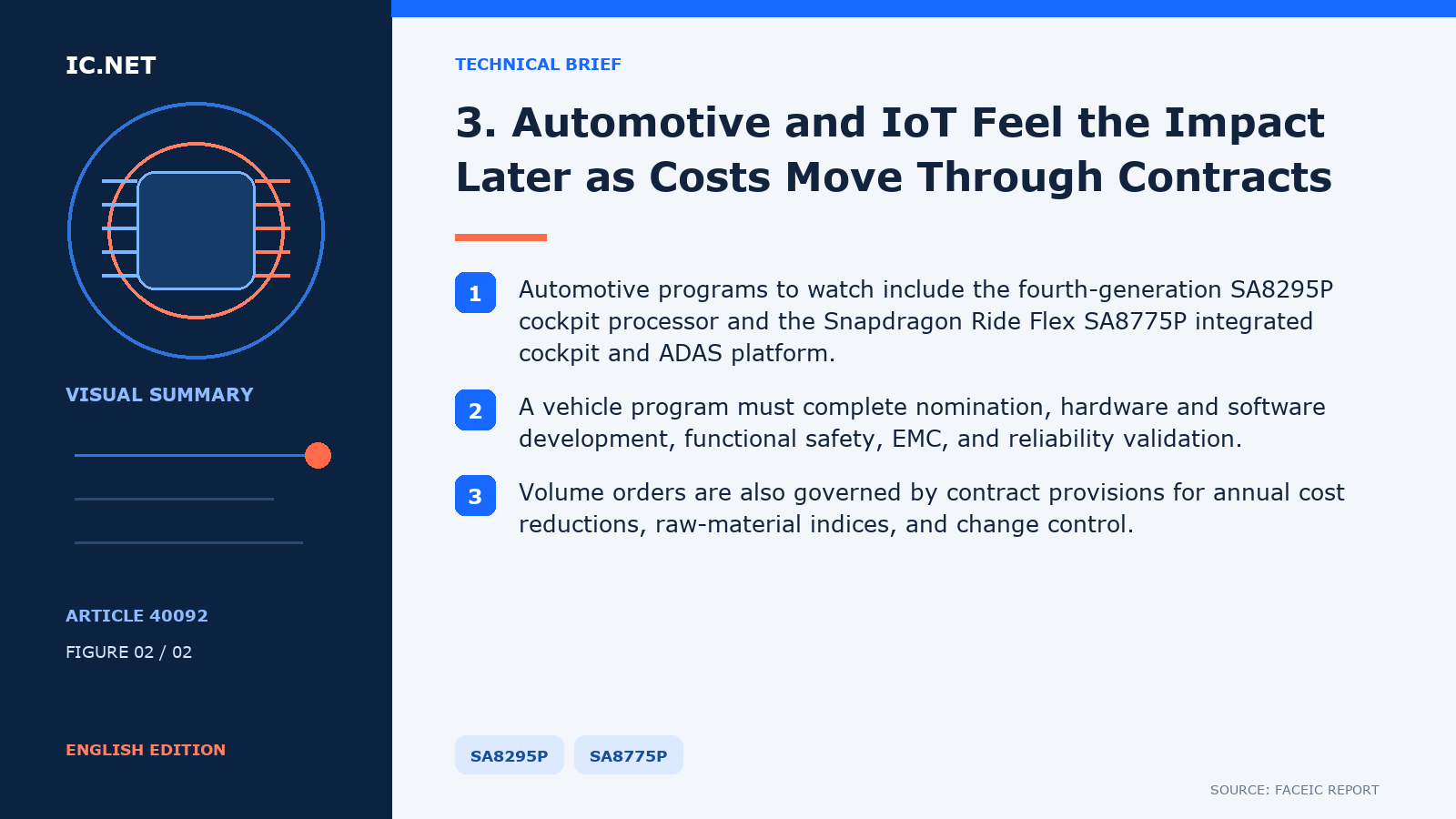
Qualcomm's fiscal Q3 2026 QCT revenue mix shows why this adjustment cannot be viewed only through phones. Handset revenue was $5.086 billion, down 20% year over year; automotive revenue was $1.588 billion, up 61%; and IoT revenue was $1.830 billion, up 9%. Automotive and IoT are no longer marginal reporting lines, but long project contracts and strict qualification processes mean they will not experience the September effect in the same way as consumer electronics.
Automotive programs to watch include the fourth-generation SA8295P cockpit processor and the Snapdragon Ride Flex SA8775P integrated cockpit and ADAS platform. A vehicle program must complete nomination, hardware and software development, functional safety, EMC, and reliability validation. Volume orders are also governed by contract provisions for annual cost reductions, raw-material indices, and change control. Pressure will appear mainly in quotations for new programs, renewal negotiations, and contract amendments. It does not cause every vehicle already in production to change BOM material on September 1. Without formal approval from the automaker and Tier 1, purchasing cannot replace the main processor solely because of a price notice.
IoT will be more internally segmented. The Dragonwing QCS6490 delivers 12 Dense TOPS and the QCS8550 delivers 48 Dense TOPS, serving applications such as service robots, smart cameras, edge-AI boxes, and industrial terminals. When the customer buys a bare SoC, LPDDR and UFS are separate peripheral materials. When the customer buys an integrated module, memory and flash are already embedded in the module quotation, making cost pass-through more direct.
Domestic Rockchip platforms such as the RK3576 and RK3588 will receive more evaluations, but both publicly specify 6 TOPS of NPU performance. That cannot be equated directly with Qualcomm's platforms across compute definitions, operator support, ISP capability, wireless connectivity, and software ecosystem. A switch also has to account for Android or Linux versions, GMS licensing, the camera pipeline, NPU model migration, industrial temperature range, and long-term supply. A price increase lengthens the alternatives list; it does not create a seamless replacement.
4. A Procurement Checklist: Confirm Six Facts Before Building Inventory
For this adjustment, procurement should first obtain six items from Qualcomm or an authorized channel: the complete list of affected part numbers, formal old and new quotations, the exact shipment date on which the change takes effect, treatment of open orders, settlement-currency and delivery-region rules, and the provisions governing rebates and non-cancelable orders. A claim of an "across-the-board increase" without a complete part list is a risk alert, not a basis for changing project cost.
The second step is a three-level cost model covering the SoC, module, and finished system.
- Smartphone programs should calculate the combined effect of the SoC, LPDDR, UFS, PMIC, and RF devices.
- Automotive programs should add software licenses, board redesign, requalification, and project-change overhead.
- IoT programs should distinguish among a bare die or SoC, a system-on-module, and a complete functional module.
If a second supplier genuinely needs to be introduced, begin qualification on a new project or in a noncore BOM position and retain the existing design as a fallback. Do not let price anxiety force a rushed material substitution.
Conclusion: Product Mix Will Change Before Retail Prices Do
The first programs to feel the cost pressure after September will be new smartphone designs and incremental shipment lots. Automotive and IoT effects will emerge progressively in new nominations, contract renewals, and module quotations.
Qualcomm's ability to pass costs downstream rests not only on processor performance, but also on matched RF, full-stack software, industry certifications, and the high migration cost created by years of program development.
The greatest risk is not a single chip rising by more than 10%. It is the simultaneous increase of SoCs, memory, and foundry costs until the finished-system BOM has no buffer left. What purchasing needs now is not a market rumor, but a formal quotation containing the full part list, shipment trigger, and contract boundaries.
Disclaimer: This article is compiled from public information for industry discussion only. It does not constitute investment, procurement, or part-selection advice. Prices, availability, and contract terms are subject to the latest notice from the manufacturer or its authorized channels.