
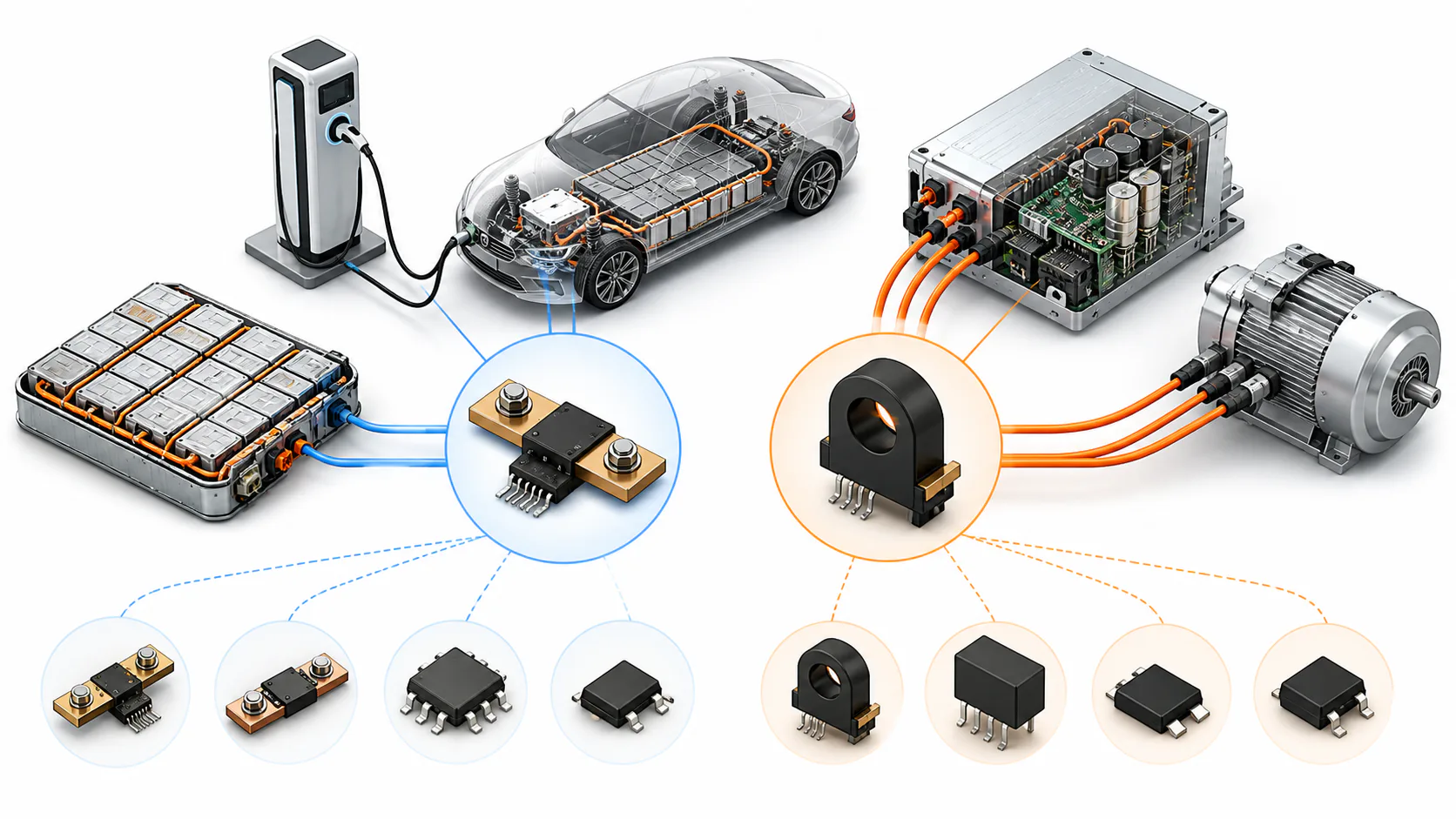
Why current sensing is a strategic part, not a jelly-bean
Voltage is water pressure; current is water flow. In a power system it is the current — how much, and how steadily it flows — that determines heating, loss, over-current and short-circuit protection, charge speed and motor torque. If the BMS is the battery's brain and the inverter is the motor's muscle, the current-sense amplifier and the Hall sensor are their eyes.
Three subsystems can't function without them:
- BMS — current sensing drives SOC estimation, over-current protection, charge/discharge strategy and pack life. Get the current wrong and the system drives with a blurred windscreen: charging too slowly, or too hard.
- Inverter — three-phase currents must be sensed in real time to time the IGBT / SiC MOSFET switching. Better current accuracy means finer motor control — more torque, less ripple, no burn-out.
- On-board charger (OBC) & charging pile — here current sensing is safety. High-power fast charging is not "more current is better"; it is holding current inside the envelope the cells, cables and modules will tolerate.
Two topologies, two sourcing conversations
Route 1 — Shunt resistor + current-sense amplifier. A small resistor in the current path; measure the millivolt drop across it. High accuracy, good linearity, controllable cost. Fits the BMS low-voltage side, 12 V / 48 V systems, motor control and industrial power. The real design question is not "can it measure" but "can it stay accurate in PWM noise" — for inverters and motor control, PWM rejection is the parameter that separates parts.
| Role | Part | Note |
|---|---|---|
| Incumbent / benchmark | TI INA240-Q1 | The reference part most Western BOMs already spec |
| China-based alternative | 3PEAK TPA132Q | Automotive-grade current-sense amp |
| China-based alternative | SG Micro SGM840xQ | Low-side / motor-control periphery |
Route 2 — Hall-effect current sensor. Measures the magnetic field the current generates, so isolation comes for free. This is the high-voltage, high-current route: OBC, DC-DC, charging piles, PV inverters, storage PCS, e-drive. Here the parameters that matter are isolation withstand voltage, bandwidth, temperature drift, zero-point offset drift, and immunity to external magnetic fields.
| Role | Part | Note |
|---|---|---|
| Incumbent / benchmark | TI TMCS1123-Q1 / 1133-Q1 / 1143 | Isolated Hall current-sense family |
| China-based alternative | NOVOSENSE NSM201x / NSM2015-Q1 | Integrated Hall sensor + isolation ecosystem |
| China-based alternative | Chipanalog CA-IS23025S / 30S / 50S | Isolated Hall, spans BMS to power sampling |
| China-based alternative | Saizhuo SC4643 | Linear-Hall option |
Where the second-source opportunity actually is
Second-sourcing is not swapping an import for a cheaper local part. Current-sense ICs fail in a specific way: they benchmark beautifully on the lab table and then drift once they're on the vehicle. EV, storage and charging environments are brutal — high voltage, high temperature, high humidity, strong EMI, long run times.
- NOVOSENSE — strongest where an integrated Hall sensor plus an isolation-IC ecosystem lets a buyer do a system-level second source around OBC, DC-DC, PV inverter and charging pile.
- Chipanalog — carries both isolated op-amps and integrated Hall sensors, so it enters from the BMS and power-sampling side.
- 3PEAK / SG Micro — the entry point is the automotive-grade current-sense amplifier, low-side sensing and motor-control periphery.
The alternatives that hold up are the ones that pass system validation alongside the BMS, isolation, gate driver and protection devices — not the ones that shave a few cents off a single line item.
The engineer's selection checklist
Don't buy on "how many amps, how many cents." Judge a current-sense part on six axes: current range · bandwidth · response time · isolation withstand voltage · temperature drift · PWM rejection.
- Low-voltage, low-current → shunt + current-sense amp usually wins.
- High-voltage, high-current → Hall or isolated sampling has the edge.
- Motor / inverter → weight bandwidth and PWM rejection.
- Charging pile / OBC → weight isolation withstand, creepage/clearance and safety certification.
- Automotive program → also demand AEC-Q100, functional-safety documentation and long-term supply commitment.
Bottom line
Current-sense ICs don't sit centre-stage the way MCUs, SiC or IGBTs do — but they decide whether a system runs safely, stably and efficiently. For a buyer building supply-chain resilience into an EV, storage or charging design, the China-based bench is now credible enough to qualify as a genuine second source. The decision point isn't price. It's whether the part keeps its numbers in the loudest, hottest, most dangerous corner of the board.