
Discussion of AI server power usually centers on 48 V/54 V buses, GaN power devices, and multiphase high-current conversion. With GPU power measured in kilowatts, a 1.5 W auxiliary rail can look insignificant.
TI's UCC34141-Q1 and UCC33420, introduced in March 2026, target that overlooked 1.5 W class. By integrating a planar transformer, isolated power stage, and protection, they rework the isolated-bias architecture and can substantially simplify a traditional discrete BOM for auxiliary rails in AI server and industrial high-voltage systems.
Their role needs a clear boundary: these modules do not power CPU or GPU cores and cannot connect directly to a 48 V/54 V high-voltage bus. They serve isolated power islands in server PSUs, BBUs, and high-voltage equipment, supplying auxiliary circuits such as SiC/IGBT gate drivers, digital isolators, and isolated communications interfaces.
1. Why 1.5 W Matters for Gate Drivers and Isolated Interfaces
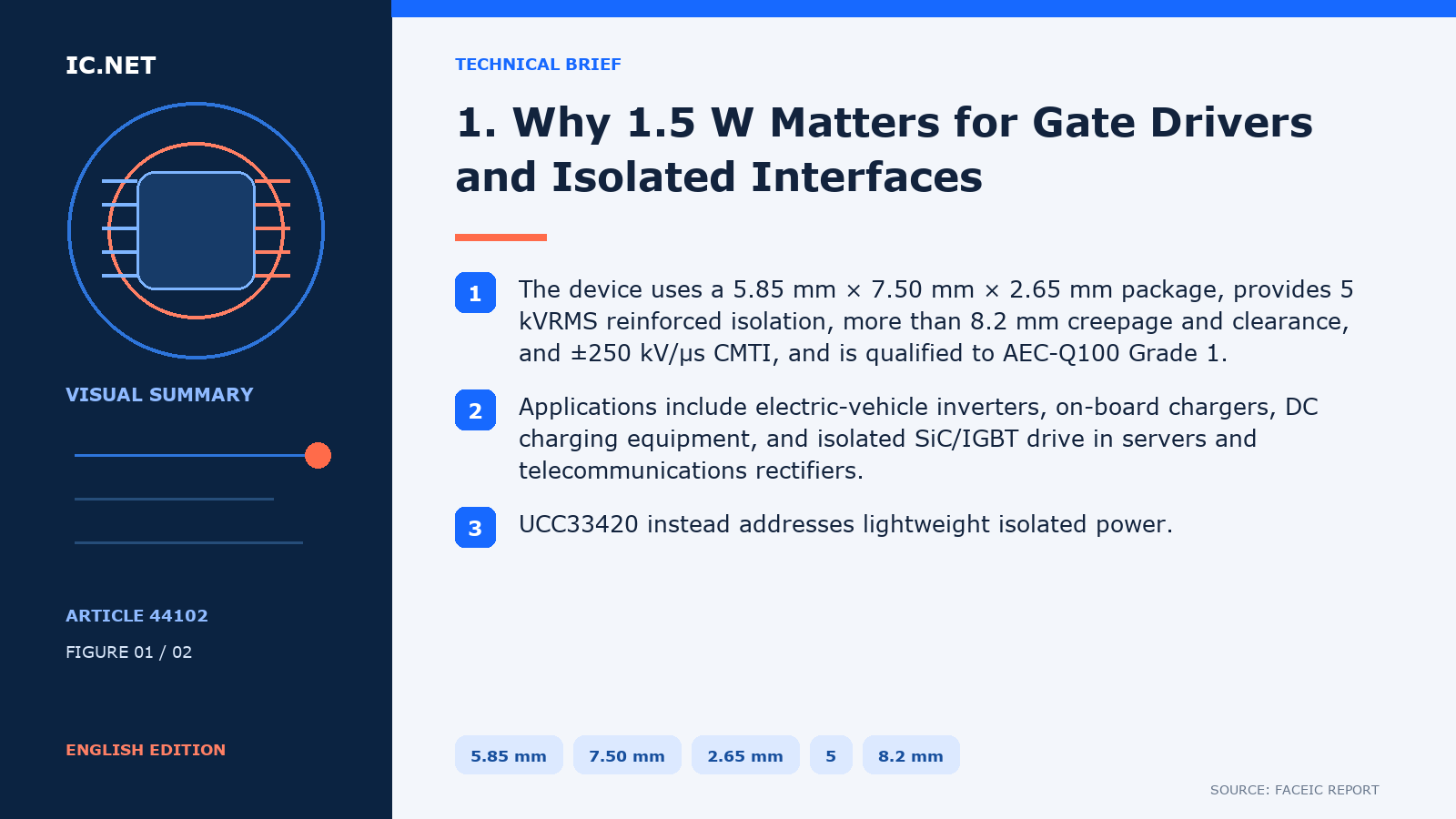
UCC34141-Q1 is an automotive-grade reinforced-isolation power module for high-voltage gate-drive applications. It accepts 5.5-20 V and withstands transients up to 28 V. Positive output is configurable from 15 V to 20 V and negative output from -2 V to -8 V, matching positive and negative bias requirements for SiC and IGBT devices. With an 11-13 V input, an 18-20 V positive output, and ambient temperature below 85°C, it can deliver 1.5 W.
The device uses a 5.85 mm × 7.50 mm × 2.65 mm package, provides 5 kVRMS reinforced isolation, more than 8.2 mm creepage and clearance, and ±250 kV/μs CMTI, and is qualified to AEC-Q100 Grade 1. Applications include electric-vehicle inverters, on-board chargers, DC charging equipment, and isolated SiC/IGBT drive in servers and telecommunications rectifiers.
UCC33420 instead addresses lightweight isolated power. It accepts 4.5-5.5 V and produces an isolated 5 V or 5.5 V output. The 5 V setting supports a 300 mA load, for maximum output of 1.5 W. Its thin 4 mm × 5 mm × 1 mm VSON-12 package provides 3 kVRMS basic isolation and 200 V/ns CMTI and is designed to meet CISPR 32 Class B emissions.
Target applications include PLCs, charging infrastructure, enhanced GaN bias, digital isolators, and isolated RS-485, RS-422, and CAN interfaces. Public information does not establish volume adoption of UCC33420 in a production AI server. Its use for server control and communications isolation is a technically suitable application, not a disclosed volume case.
2. The First Discrete Part to Disappear Is the External Transformer
A conventional isolated-bias design is cumbersome: controller, switches, external transformer, secondary rectification, feedback, protection, input and output capacitors, snubbers, and EMI filtering.
Although the power is around 1 W, transformer turns ratio, leakage inductance, insulation, creepage, parasitics, temperature rise, and lot consistency create substantial tuning and validation work that can delay production.
TI's integrated approach addresses that burden. The company says UCC34141-Q1 reduces solution area by 70% versus a traditional discrete flyback bias supply and by more than 35% versus a conventional integrated-transformer solution, increasing power density by 333% and 150%, respectively.
Those are TI comparisons rather than results for every server supply. The direction is nevertheless clear: as AI server PSUs and BBUs become denser, the board area, development burden, and production variability of a low-power external transformer become harder to justify.
Power, size, and isolation remain a three-way tradeoff. The earlier UCC12050 supports 500 mW with 5 kVRMS reinforced isolation. UCC33420 raises output to 1.5 W in a very small package while using 3 kVRMS basic isolation. For 1.5 W with reinforced isolation, TI offers the related wide-package UCC33421. No one module simultaneously provides minimum size, maximum power, and maximum isolation for every application.
3. Smaller Area Does Not Mean “Place It and Pass”
An integrated power module places the planar transformer, isolated power stage, control, and core protection inside one component, removing much discrete selection and matching. It does not replace system validation or PCB design.
Input and output capacitors, configuration resistors, and filters remain. The dual-output UCC34141-Q1 also requires the negative-rail inductor, feedback network, and gate-driver bypass capacitance. Proximity to high-dv/dt nodes imposes constraints on routing, return paths, isolation keepouts, and thermal vias.
Output capability also depends on conditions. UCC34141-Q1 power varies with input, output configuration, and ambient temperature, requiring thermal derating and safe-operating-area checks at high temperature. The 300 mA rating for UCC33420 is a maximum and should not be assumed sustainable indefinitely under every high-temperature, high-interference condition. Some safety certifications are still planned, so nominal isolation specifications cannot be treated as finished-system compliance.
4. Production Status Is Not Volume Adoption, and Integration Creates a New Supply Risk
TI marks UCC34141-Q1 and UCC33420 ACTIVE and their data sheets use production status, indicating product release and the ability to support preproduction and volume orders. That status does not establish entry into a leading AI server supply chain, stable volume vehicle installation, or routine channel stock.
Integration also concentrates supply risk. A discrete design uses multiple component categories and suppliers, creating more sourcing options. A module consolidates those functions into one part number, simplifying the BOM while creating a single-source dependency.
Selection should therefore compare more than component price. It should include PCB area, transformer development and tuning, incoming inspection, EMI remediation, certification time, assembly labor, schedule risk, second sourcing, compatible alternatives, and a fallback discrete architecture.
5. Conclusion: Small Rails Lead the Modularization of AI Power
AI server power will not replace its core high-power architecture in one step. Modularization starts with isolated bias supplies that have low power but disproportionate tuning difficulty and development cost.
UCC34141-Q1 uses high isolation, high immunity, and positive/negative outputs to target SiC/IGBT gate drive. UCC33420 uses small size and high power density for low-voltage control and isolated communications. Both address the complexity, area, consistency, and qualification cost of an external-transformer design.
Engineering and procurement teams should divide the design by power island and match input, output arrangement, isolation class, CMTI, thermal derating, and system certification. A module can save discrete BOM and development time. It does not remove system validation or supply-chain risk management.
Disclaimer: This article is compiled from public information for industry discussion only. It does not constitute investment, procurement, or part recommendations. Product parameters, certification, and supply status are subject to the latest manufacturer and authorized-channel information.