When engineers select an automotive capacitor, AEC-Q200 qualification is often treated as the first filter. A comparison of actual products, however, shows why that filter cannot complete a BOM decision. EYANG uses soft termination to manage mechanical stress; VIIYONG extends automotive MLCC capacitance to 220 µF; and Launchip is putting a 49-terminal silicon capacitor through detailed reliability evaluation. All address automotive electronics, but they target different failure mechanisms and circuit positions. The meaningful comparison is therefore the problem each device solves and the evidence available for that exact use case.
1. Soft termination, high capacitance and multiple terminals are not one contest
EYANG's automotive A/E families include a 0603, X7R, 100 nF, 100 V soft-termination MLCC. The point is not simply the voltage rating. A compliant termination helps absorb mechanical strain transferred through solder joints during board flex and assembly vibration, improving the mechanical robustness of the component-to-PCB connection.
VIIYONG follows a different route. In April 2026, the company said its 1210-size, 100 µF and 220 µF high-capacitance automotive MLCCs had entered volume supply. These devices target board-level power needs in intelligent-driving and cockpit electronics. Their value is fitting more nominal capacitance into limited board area, although effective capacitance still has to be evaluated under the application's actual DC-bias condition.
Near a processor die, the question changes from "Is there enough capacitance?" to "Is the current loop short enough?" Launchip's multi-terminal silicon capacitor is organized around distributed power and return paths. That is fundamentally different from a soft termination: the former reduces local-loop impedance, while the latter manages mechanical strain. Sharing the word "terminal" does not make the two approaches comparable.
Murata adds another distinct route. Its automotive ATSC and WASC silicon-capacitor families use wire bonding, while ATSC also supports embedded mounting. Murata identifies AEC-Q100 as the applicable automotive qualification standard. Differences in mounting style and qualification regime prevent a simple better-or-worse comparison with AEC-Q200 MLCCs.
These are not pin-for-pin or value-for-value substitutes. They map to separate needs: mechanical robustness, board-level bulk capacitance, package integration and near-die decoupling. Launchip's opportunity is not to replace a 220 µF MLCC with a 2 µF device; it is to improve the power-loop impedance at the circuit positions where that matters.
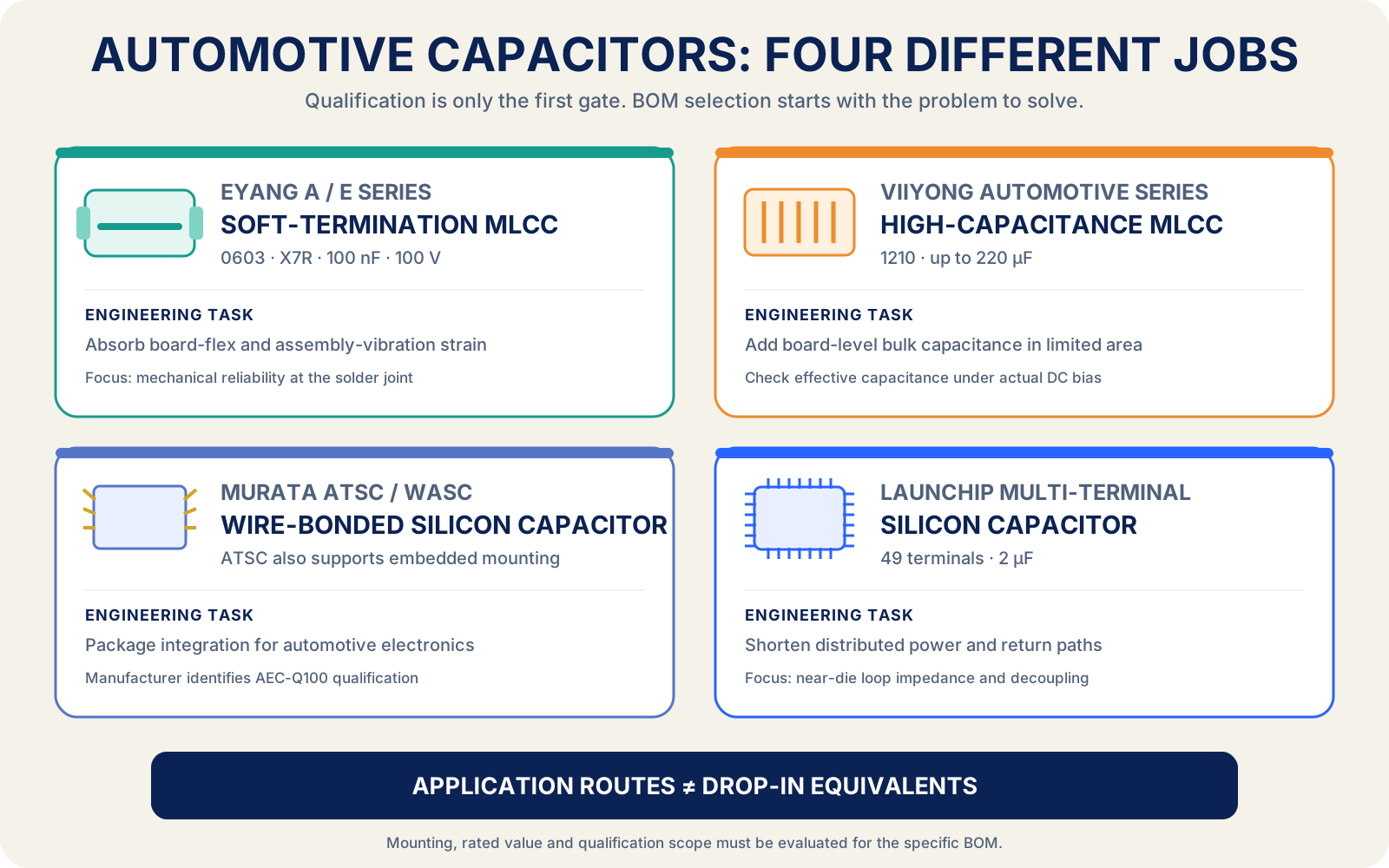
The practical lesson is simple: a capacitor belongs in the comparison only after its mounting method, circuit position and engineering task have been defined.
2. Seventy-seven Launchip samples: a single "Pass" is not the whole story
A multi-terminal structure may have engineering value, but an automotive program still needs to know whether its parameters remain within the allowed range after temperature, voltage and assembly stress.
CTI test report A2260104174101E identifies the submitted Launchip sample as LHC205SA8K003ZS. All 13 listed test items received a Pass conclusion. The program covered biased humidity, high-temperature operating life, shock and vibration, soldering heat and board bending, as well as a customer-requested thermal-shock item.
The high-temperature operating-life test used 77 samples at 125°C with 1.5 V applied for 1,000 hours. Based on the individual 1,000-hour results listed in the report, capacitance change ranged from -1.96% to +2.65%, with 75 of 77 samples inside a ±2% observation band. The report's Pass conclusion also considers capacitance, leakage current, appearance and other requirements; it is not determined by this distribution chart alone.
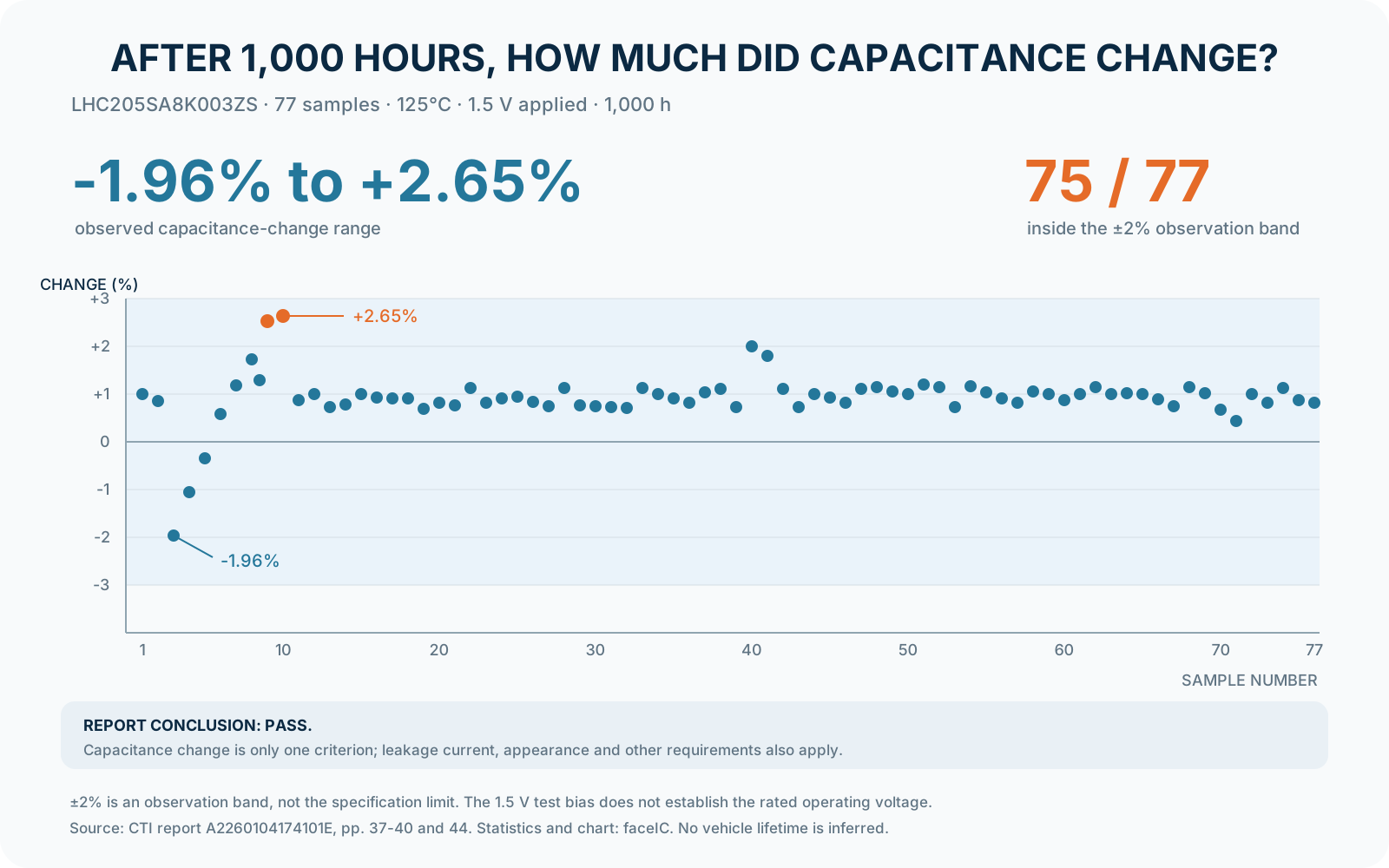
That information is more useful for selection than the phrase "zero failures across 77 samples" by itself: engineers can see how far the measured parameter moved under a stated stress condition.
3. Launchip's value is the combination of structure and inspectable evidence
Compared with EYANG's soft-termination MLCC and VIIYONG's high-capacitance automotive parts, Launchip's 49-terminal, 2 µF silicon capacitor is positioned closer to the die. Around a domain controller or cockpit SoC, nominal capacitance is only part of the problem. The impedance of the loop during a fast load transient also matters. Distributed power and return terminals can shorten that loop and reduce parasitic inductance, but the result still depends on pad design, interconnect and the real mounting process.
Launchip's more defensible differentiation is that it presents the multi-terminal structure together with a detailed stress-test record. A customer can connect the low-parasitic architecture to a specific part number, then examine parameter drift after high-temperature bias and review mechanical and assembly tests. The report, for example, specifies three 260 ±5°C reflow exposures for resistance to soldering heat, and 2 mm deflection held for 60 seconds for board bending. Those conditions extend evaluation beyond initial electrical specifications to performance after defined manufacturing stress.
The results do not prove that silicon capacitors are inherently more resistant to board flex than soft-termination MLCCs, nor do they rank supplier lifetime. They show that this particular Launchip sample has evidence that can be used in an engineering assessment rather than only a structural or material claim.
Launchip's revised white paper also describes wafer-level 100% electrical testing and reliability screening. Qualification testing evaluates performance under design-level stress; outgoing screening supports lot-to-lot delivery consistency. The two complement each other but are not interchangeable. When a China-developed component is introduced, circuit performance, stress stability and supply consistency all need to be assessed.
4. After qualification, the decision still returns to the specific BOM
AEC-Q200 addresses component qualification under prescribed conditions. Approval for a real application remains the user's decision. A production program may still require supplier assessment, PPAP and system-level validation. One report cannot be treated as blanket approval for every part number or vehicle.
The comparison sequence should therefore be: define working voltage, required capacitance and mounting position; examine mechanical structure, parasitics and stress behavior; then confirm the qualification scope of the complete ordering code and the project's own requirements. More terminals cannot replace the board-level bulk capacitance a design needs, while stacking nominal capacitance does not by itself solve a near-die loop problem.
For Launchip, the credible introduction path is to identify circuit positions suited to a multi-terminal silicon capacitor and validate them using the reported results as supporting evidence. "Passed AEC-Q200" should not be presented as a universal pass for every model and application.
Conclusion: automotive competition is about how completely a problem is solved
EYANG's soft termination, VIIYONG's high-capacitance products, and Murata's wire-bonded and embedded routes show that there is no universal automotive-capacitor solution.
Launchip differentiates itself by offering a multi-terminal silicon capacitor for near-die power delivery and backing a specific sample with inspectable stress-test results. The useful message is not merely that a device passed. It is that engineers can see what problem the part is meant to solve, the conditions under which it was evaluated and the work still required to put it into their own design.
Disclosure: This article was compiled by ic.net. Launchip product and test data came from materials supplied by Launchip; information on other vendors came from their official public materials. Please credit Launchip Technology when citing Launchip data. This article is for industry discussion only. Applicability must be confirmed against the complete part documentation and independent project validation.