At the OCTS 2026 Open Compute Technology Summit in Beijing on July 9, a component normally hidden behind the GPU moved into the spotlight: the multiphase PWM controller.
Injoinic Microelectronics presented its dual-loop, 16-phase IS6214A and received an award. BPS showcased a portfolio of AI power solutions including multiphase digital PWM controllers and DrMOS/SPS devices. At almost the same time, Southchip disclosed its SD22442 controller paired with the SD13050 DrMOS. By August, discussion was heating up over whether Chinese AI power ICs were about to replace overseas solutions as a group.
The more important question is this: if domestic controllers have already reached 12 and 16 phases, why are AI server BOMs still reluctant to switch?
1. Sixteen Phases Are No Longer Rare; a Complete Power Solution Is
Powering an AI processor is a little like supplying a factory that turns on every machine at once. A GPU or AI ASIC may jump from a low load to full load in an extremely short period, while its core voltage is only about 1 V and current demand can reach several hundred amperes or even the kiloampere range. A single power stage cannot shoulder that load without overwhelming the devices, routing, and cooling.
A multiphase supply divides the high current among parallel DrMOS or SPS stages. A 16-phase controller acts as the conductor, deciding when each phase switches, how much current it supplies, and how current sharing, phase shedding, protection, and telemetry operate. More phases spread heat and reduce stress per phase, but they do not automatically give the complete power system a better transient response.
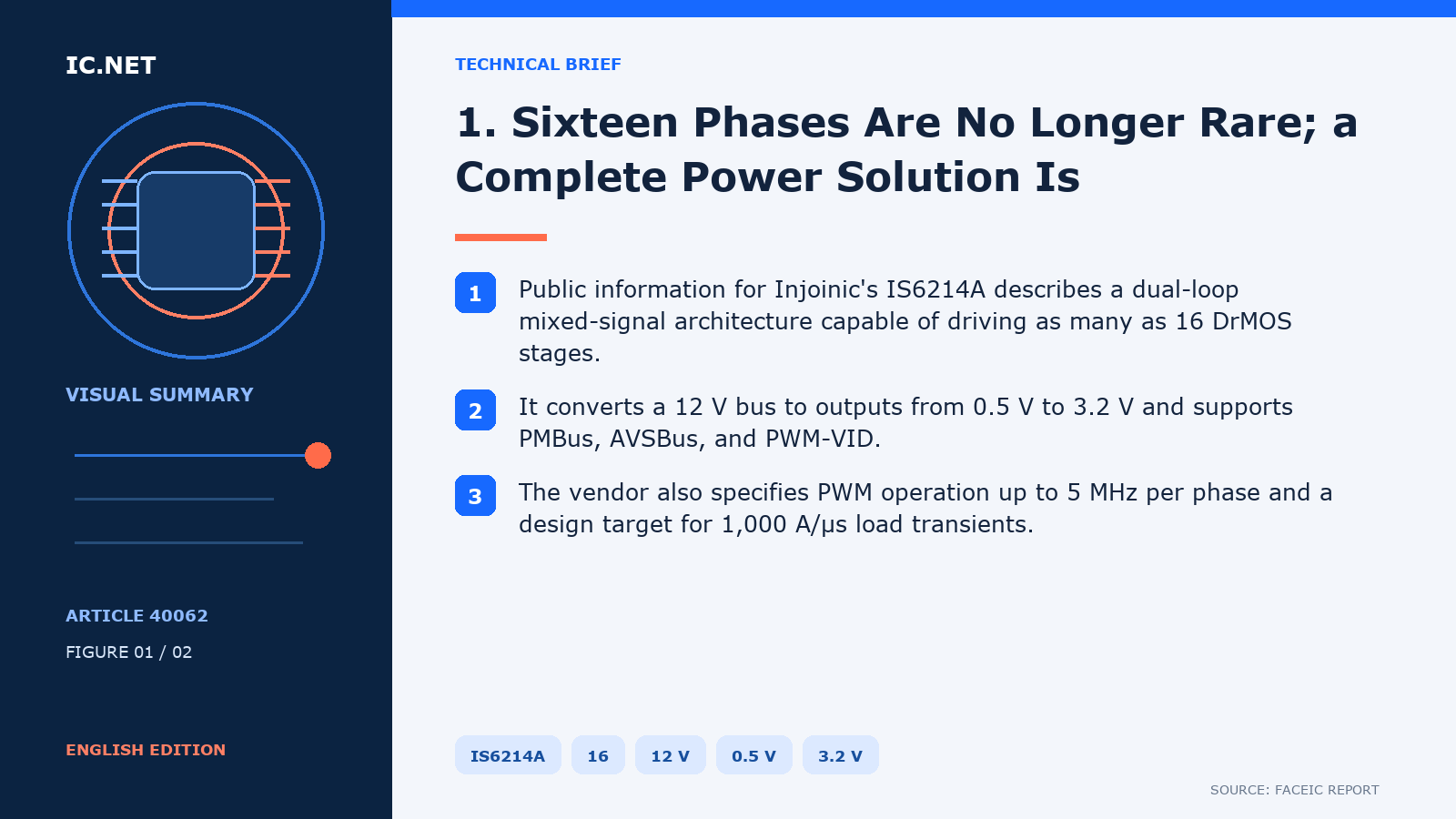
Public information for Injoinic's IS6214A describes a dual-loop mixed-signal architecture capable of driving as many as 16 DrMOS stages. It converts a 12 V bus to outputs from 0.5 V to 3.2 V and supports PMBus, AVSBus, and PWM-VID. The vendor also specifies PWM operation up to 5 MHz per phase and a design target for 1,000 A/μs load transients. Those parameters place a domestic product squarely in the range of core power delivery for AI servers.
BPS's BPD93136 is likewise a dual-rail device supporting up to 16 phases, with PWMVID, PMBus, and AVSBus and a switching-frequency range from 250 kHz to 2 MHz. Its published positioning explicitly covers graphics cards, servers, and AI power. The BPD95036A also uses a dual-rail configuration with up to 16 phases and focuses on PMBus and AVSBus applications.
Sixteen phases, however, are only the admission ticket. The real BOM also includes DrMOS/SPS devices, power inductors or TLVR, output capacitors, PCB copper, and the thermal system. The controller's ability to coordinate all those components matters more than the phase count printed on its data sheet.
2. Injoinic, BPS, and Southchip Are All Participating, but Not for the Same BOM Slot
When domestic vendors are compared, it is easy to focus on the words "multiphase PWM" and overlook differences in phase count, protocol, and target load.
Injoinic's IS6214A and BPS's BPD93136 and BPD95036A reach the 16-phase class and target AI servers, GPU cores, and high-performance computing platforms. Chipown's published information for the PN6855 describes dual-rail digital control with support for up to 12 phases, PMBus compatibility, and voltage-control interfaces including SVID, AVSBus, and PVID. Domestic vendors are building a fuller ladder of 4-, 8-, 12-, and 16-phase products.
Southchip's SD22442, by contrast, is a dual-rail four-phase controller. It pairs with the 22 V, 60 A SD13050 DrMOS and supports PWMVID, PMBus, and MTP configuration. It can serve loads such as CPUs, GPUs, SoCs, and edge-computing processors, but sharing the broad label of "compute-chip power" does not make it interchangeable with a 16-phase AI accelerator controller.
That segmentation is evidence of a maturing market. Not every compute device needs 16 phases. A 16-phase design can add unnecessary cost, board area, and tuning effort to a lower-power GPU, edge processor, autonomous-driving SoC, or auxiliary rail. The right path for domestic substitution is not to assume that more phases are always better, but to fit each controller accurately to the appropriate voltage rail.
3. A Controller Must Speak the Platform's Protocol Before It Can Enter a GPU Design
An AI power controller is not a generic part that works as soon as it is soldered down. NVIDIA platforms may use PWMVID, AMD processors and GPUs may use interfaces in the SVI family, and other CPUs, ASICs, and server platforms may rely on AVSBus. PMBus handles configuration, monitoring, fault logs, and telemetry.
That is why two controllers both labeled "16-phase" are not necessarily equivalent. BPS explicitly positions the BPD93136 for NVIDIA OVR16 power and gives it PWMVID support, while the BPD95036A emphasizes PMBus and AVSBus. Injoinic's IS6214A covers PMBus, AVSBus, and PWM-VID. Among international products, Renesas's RAA228227 is also a dual-output 16-phase solution supporting PMBus and AVSBus, while Infineon's XDPE1A2G7B targets NVIDIA AI servers and GPUs with PMBus and PWM-VID.
Protocol compatibility is only the first step. Register definitions, startup sequencing, dynamic voltage adjustment, fault response, telemetry accuracy, and platform firmware all have to work together. Server vendors are not simply asking whether a domestic device can boot the board. They need to know who can quickly diagnose a transient undershoot, an overheated phase, or drifting telemetry, and who can keep the next production lot from moving materially outside the validated parameters.
The moat around overseas vendors therefore extends beyond the silicon. It includes reference designs, configuration software, models, application engineers, and years of platform-validation data. A vendor that supplies an attractive controller without matched DrMOS stages, tuning tools, and on-site support leaves the customer in the position of replacing an aircraft engine only to discover that the instruments, wiring, and maintenance manuals no longer match.
4. Domestic Adoption Depends on Reducing Validation Cost, Not Just Controller Price
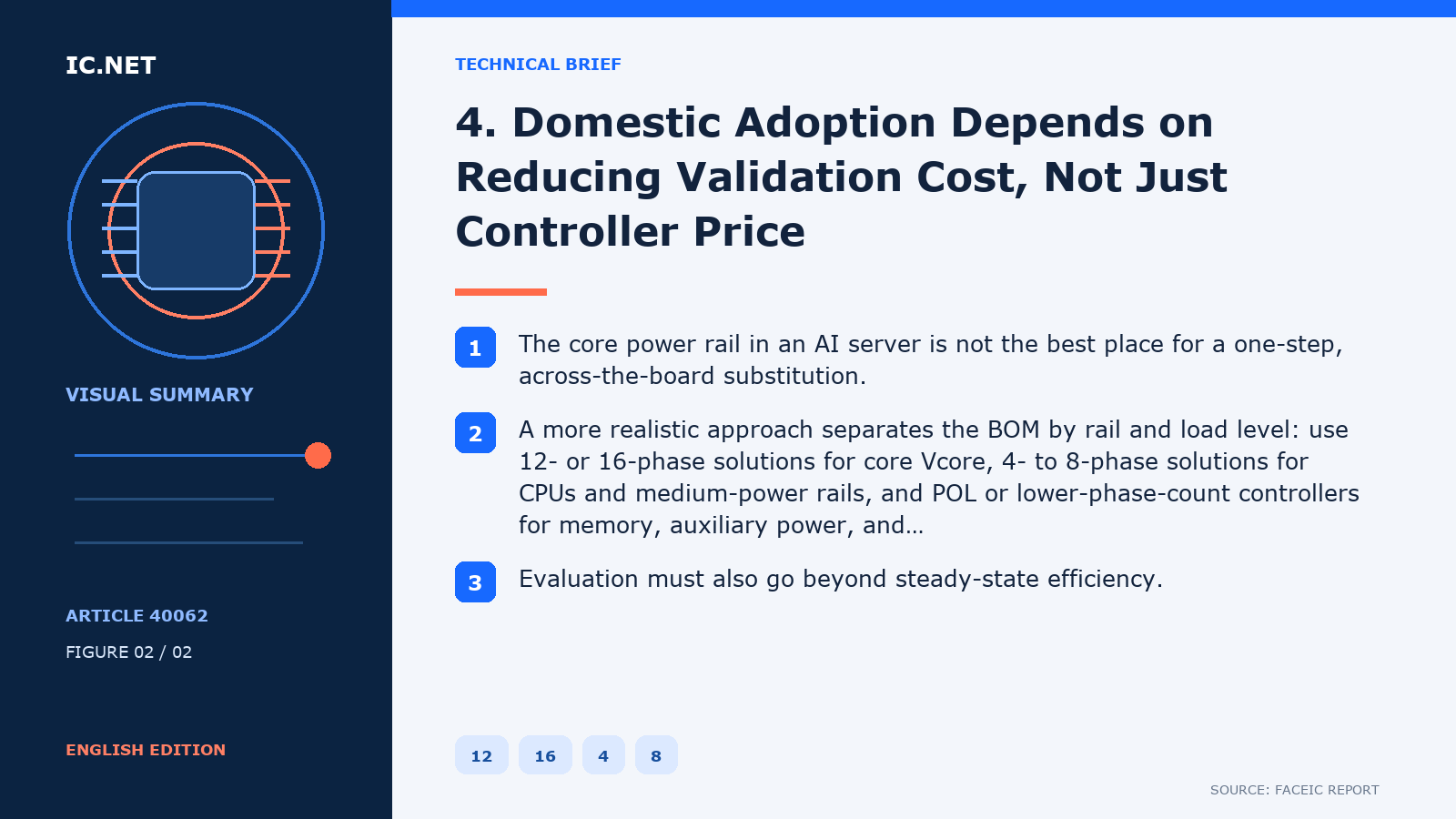
The core power rail in an AI server is not the best place for a one-step, across-the-board substitution. A more realistic approach separates the BOM by rail and load level: use 12- or 16-phase solutions for core Vcore, 4- to 8-phase solutions for CPUs and medium-power rails, and POL or lower-phase-count controllers for memory, auxiliary power, and board-level loads.
Evaluation must also go beyond steady-state efficiency. It should cover overshoot and undershoot under realistic dynamic loads, phase-to-phase current balance, light-load phase shedding, full-load efficiency, DrMOS temperature rise, telemetry error, overcurrent and overtemperature protection, hot and cold start, EMI, and extended burn-in. A controller that saves a few dollars can make the total board BOM more expensive if it requires substantially more output capacitance, PCB copper, or cooling.
A more cautious sourcing strategy is to qualify a domestic second source first on a new platform or a noncritical rail while retaining the incumbent design as the baseline. Once the controller, DrMOS, magnetic components, and configuration tools have passed joint validation, the solution can move gradually toward higher-power core rails. The words "16-phase" alone are not a basis for demanding a pin-to-pin replacement.
Conclusion: The Data Sheets Have Caught Up; the Real Competition Is Just Beginning
The message from OCTS is not that domestic AI multiphase PWM controllers have already completed a wholesale replacement. It is that Chinese vendors can finally bring concrete part numbers, complete protocol support, and matched power stages to the evaluation table.
Injoinic's IS6214A, BPS's BPD93136 and BPD95036A, Chipown's PN6855, and Southchip's SD22442 plus SD13050 address different phase counts and power levels. They show that the discussion has advanced from whether a domestic solution exists to whether it is usable. Yet multiple gates remain between first power-on, platform validation, and formal volume supply: protocols, transient response, thermal design, reliability, and lot-to-lot consistency.
The year 2026 looks more like a concentrated sampling and qualification window for domestic AI power ICs than a moment when overseas solutions leave the market together. The most important question is not who announces another 16-phase controller, but who can deliver the controller, DrMOS, magnetics, toolchain, and field support as one package—and then pass the most punishing test matrix under sustained full load in an AI server.
Disclaimer: This article is an industry analysis based on public information. It does not constitute investment advice, a part recommendation, or confirmation of any supply relationship.