
Nexperia China: the opportunity and constraints of rebuilding on a 300mm platform
For component buyers, Nexperia China's move to a local 300mm wafer platform raises a practical question: how quickly can familiar device categories return through a changed manufacturing and supply system? A September 2026 media event brought renewed attention to its logic, bipolar and power products after the disruption of wafer supply.
Restarting manufacturing is one step in a broader reconstruction. Front-end wafer supply, assembly and testing, technical documentation, customer approvals and after-sales responsibility previously operated within a global organization. These functions now need to be reconnected, and a delay in any one can hold back delivery.
Nexperia China is restoring existing products while investing in new processes and devices, under time pressure from customers evaluating other suppliers. A 300mm platform offers room for lower costs and product development. Revenue recovery depends on how quickly the supporting organization matures.
Existing capability gives the new platform a foundation
Nexperia China retains assembly and test capabilities, engineers, product experience and established customer relationships. Wingtech's 2026 interim report says work on alternative wafer sources began in the fourth quarter of 2025. By the end of the first quarter of 2026, it had introduced a 300mm process platform with a strategic partner in China, combining this with domestic development and Dongguan assembly and test resources.
Existing factories and customer relationships give the reconstruction a starting point. Restoring mature devices can serve established projects, while closer coordination between local engineers and wafer partners can support product adaptation, process changes and troubleshooting.
The larger wafer provides a calculable area advantage. Comparing diameters of 300mm and 200mm gives a geometric area ratio of 2.25. More area creates room for more dies. For standard devices sold in high volumes at low unit prices, improvements in manufacturing efficiency can accumulate into meaningful cost differences.
The product mix also offers opportunities. Vehicle electrification and AI server power need power and control devices, creating possible applications for expanded MOSFET, IGBT and analog portfolios. Entry into those applications still depends on individual product performance, reliability and customer qualification.
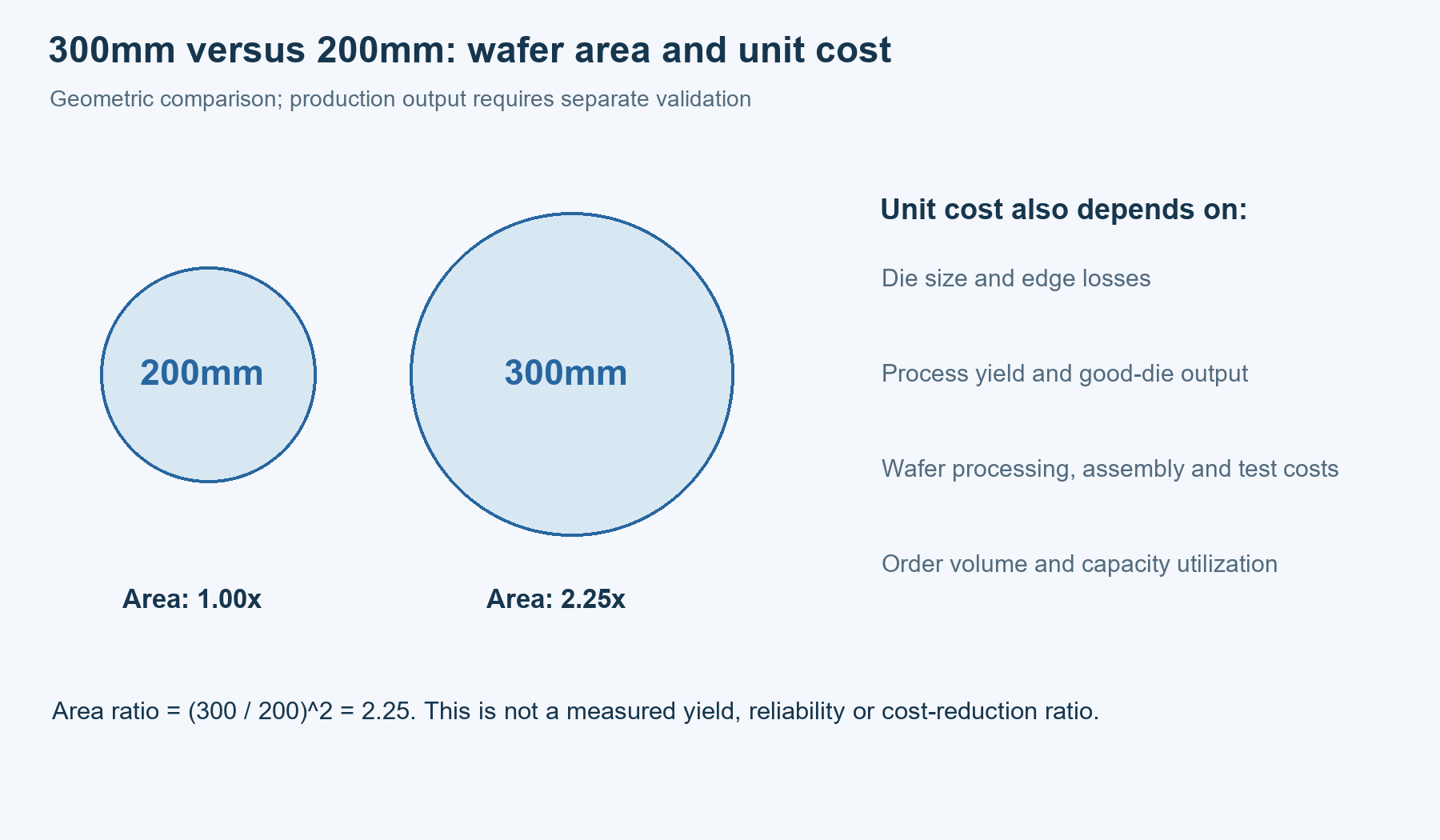
Figure 1. Geometric areas of 300mm and 200mm wafers. The ratio is calculated; actual good-die output and cost depend on process and production conditions.
Product coverage and sustainable supply are still being rebuilt
The interim report lists more than 1,300 logic part numbers in volume production on the 300mm platform and a plan to migrate nearly 3,000 existing products in the fourth quarter. Some 300mm bipolar diodes and transistors had also entered volume production. The migration has produced results, while catalog coverage remains a continuing task.
Power-device progress differs by family. The report describes T2x MOSFETs based on an SGT platform and a 40V-to-100V automotive MOSFET portfolio. It says relevant new products within these groups had reached batch supply to new-energy vehicle and AI-equipment customers. The 1200V FS8 IGBT series was in final reliability validation at that time. Existing-product migration, production ramp-up and new-product qualification all compete for engineering, manufacturing and quality resources.
Delivery pressure comes down to the required part number, monthly volume and continuity between batches. A customer's urgent requirement may be one package, voltage rating or temperature range. A catalog containing thousands of entries may still lack that exact combination.
The report also identifies an underlying constraint: during the first half of 2026, the transistor line, including some ESD and TVS protection products, relied mainly on existing inventory to support deliveries. Inventory-supported shipments still needed to connect with replenishment from the new platform.
Recovery continued into September. Yicai's September 22 site report quoted a company marketing executive describing the restoration of Dongguan assembly and test capacity. Pilot-line production in Wuxi was also intended to cover additional products previously handled by Malaysian and Philippine assembly and test operations. Rebuilding supply therefore extends beyond wafer fabrication to packaging and testing.
Management has to allocate resources across urgent customer requirements, long-tail catalog coverage and new products. The first helps retain orders, the second supports the portfolio, and the third provides future growth. They compete for engineering time, production capacity and delivery commitments.
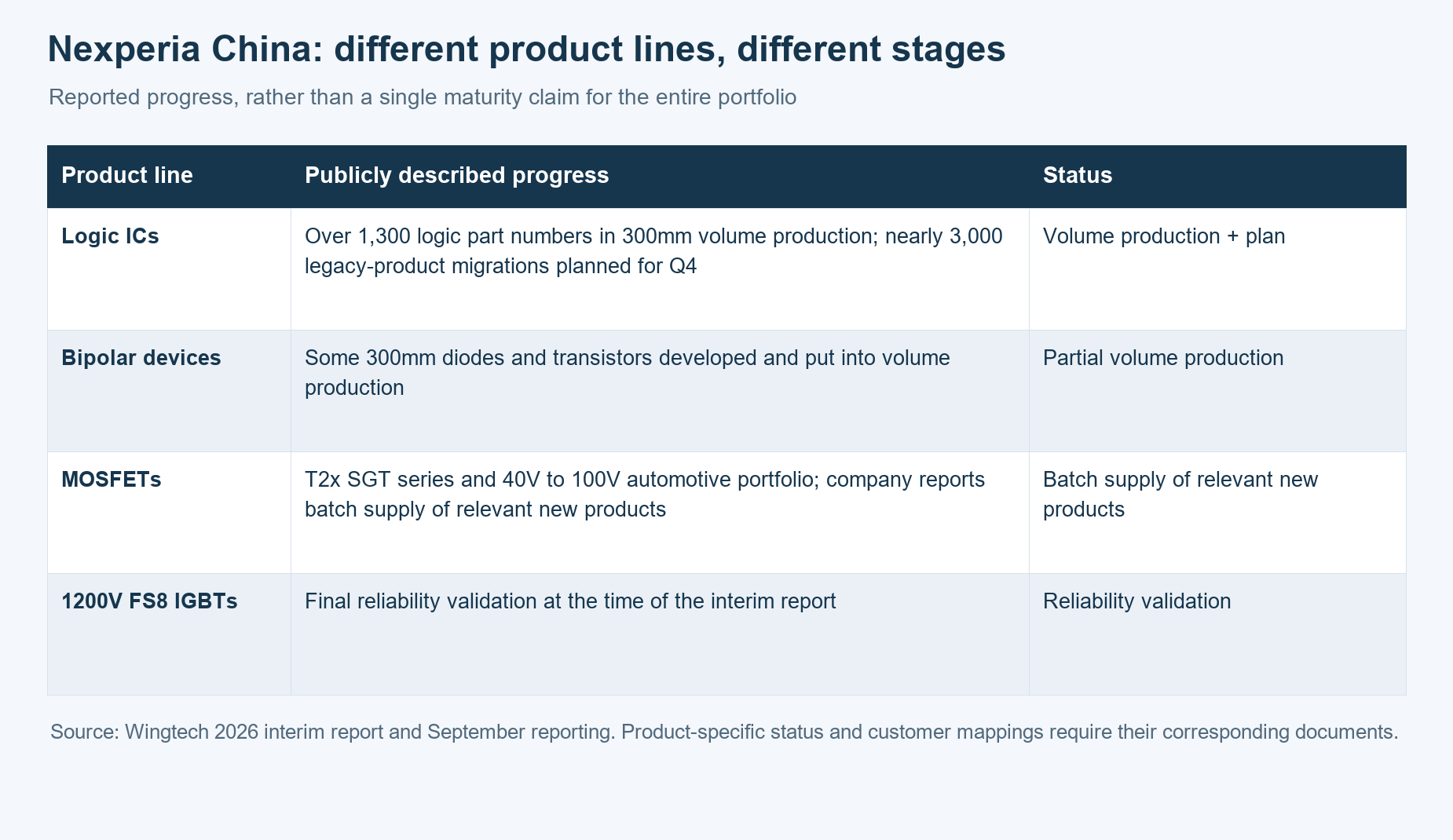
Figure 2. Product progress compiled from Wingtech's 2026 interim report and September reporting. Volume production, batch supply, validation and plans are identified separately; complete customer and part-number mappings require further disclosure.
Technical continuity and rights need product-specific arrangements
The control dispute adds constraints beyond manufacturing. A February 2026 statement from the Dutch Enterprise Chamber said the relevant shares remained owned by Yucheng Holding while interim measures restricted most of its voting rights. Wingtech's interim report also describes limits on control of overseas entities and potential effects on access to wafer fabs, research resources and sales channels.
A semiconductor supply relationship depends on more than production equipment. Device and process revisions, test programs, reliability records, failure analysis and changing customer requirements all need maintenance. When cross-border coordination is restricted, responsibility for those functions and access to the supporting information need to be defined.
Making a device is followed by the continuing task of supporting it. A MOSFET customer may need batch-distribution data, investigation of application failures and managed changes over several years. Changes in coordination between technical teams, databases and factories require local teams to establish the corresponding validation, analysis and support capabilities.
Intellectual-property rights form part of that work. Share ownership, rights in individual technologies and the scope of internal licenses need to be examined separately. The public material reviewed does not establish that the group's entire internal licensing arrangement has ended, nor does it establish one authorization status for every product. The relevant evidence depends on the technology, device and sales jurisdiction.
Existing designs require clarification of their original licenses and supply arrangements. Modified structures or processes require examination of the revised technical design. New developments also require checks against other parties' valid patents. Trademark use needs separate review from technical licensing. These tasks run alongside engineering development and customer documentation.
For automotive and industrial projects with long supply lives, customers need to know who will carry quality responsibility, maintain specifications and change records, and provide support if a dispute arises. Resolving those responsibilities is part of restoring long-term business relationships.
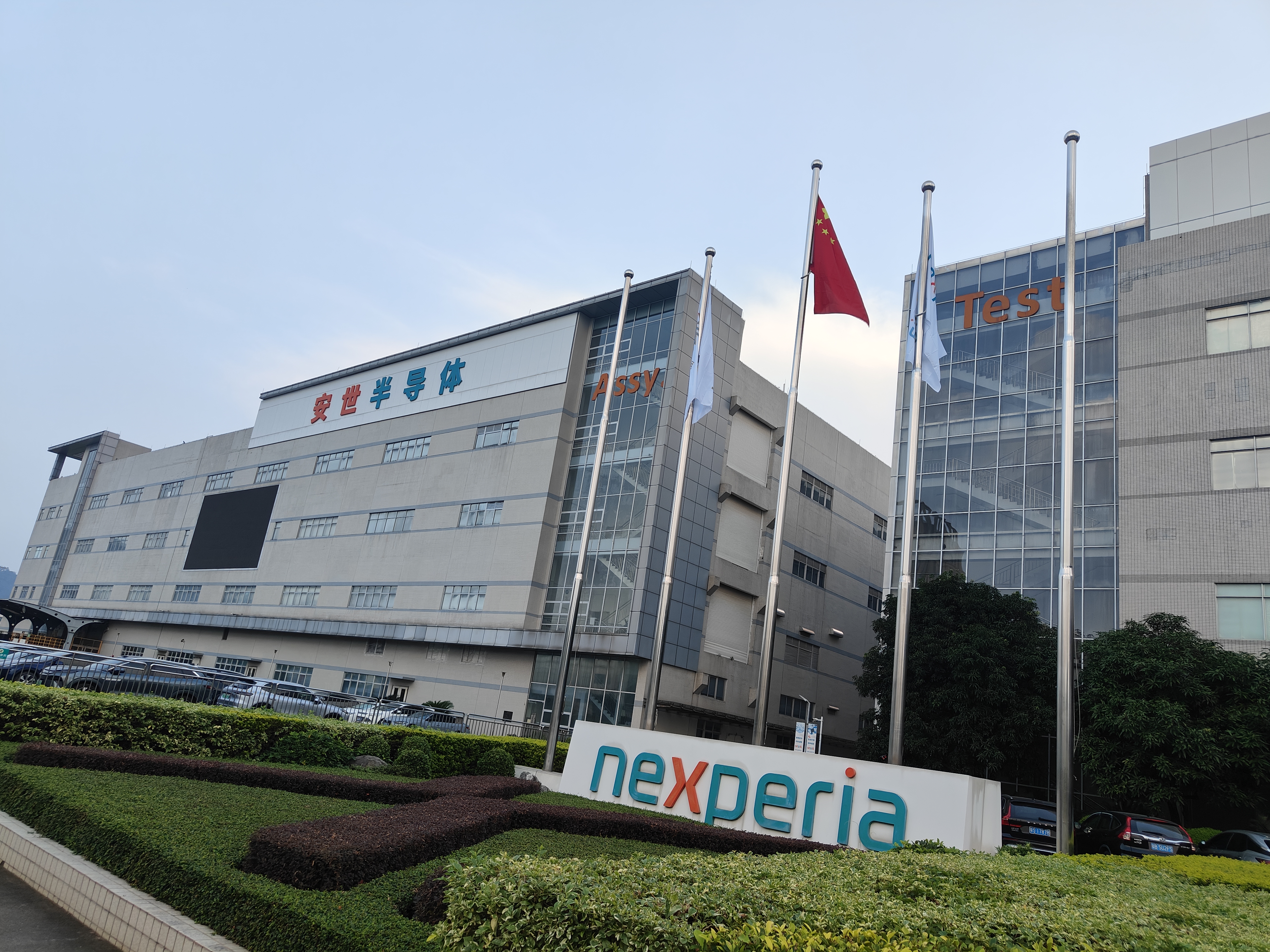
Figure 3. Nexperia China's Dongguan assembly and test facility. Photograph by Yicai reporter Zheng Xutong, published September 22, 2026. Original facility and brand signage is preserved.
Customer approvals determine when capacity produces revenue
Available manufacturing capacity still needs acceptance within customer projects. A changed supply chain can prompt questions about wafer origin, production location, process revision and quality responsibility. Those changes determine the additional testing and approval scope.
In established automotive or industrial equipment, component price is one part of the project cost. Retesting, inventory adjustment and switching between old and new batches consume engineering and quality resources. A lower unit price has to justify the transition without disrupting ongoing supply.
Yicai's September 22 report describes some automotive customers supplying their own wafers to the Dongguan plant for assembly and testing, partly because changing supply chains takes time. This preserves access to existing back-end capability and provides a transitional arrangement for some projects.
Customer acceptance and order recovery are likely to progress by project and part number. A memorandum of cooperation, factory audit, successful sample test and recurring purchasing represent different stages. Wingtech has described work on these activities; their commercial effect ultimately appears in shipments.
Automotive projects also combine several distinct requirements: device reliability evaluation, factory quality systems and approval by an automaker or tier-one supplier for a particular project. The tests required after a platform change depend on the change and the customer. New programs can consider a new device earlier in design, while existing programs usually need more detailed transition planning.
For Nexperia China, manufacturing readiness and customer approvals need to develop together. Capacity may be underused if customers qualify slowly. Delivery commitments may suffer if customers need parts before the corresponding ramp is complete. Engineering, factory and sales schedules therefore need to focus on the same priority part numbers.
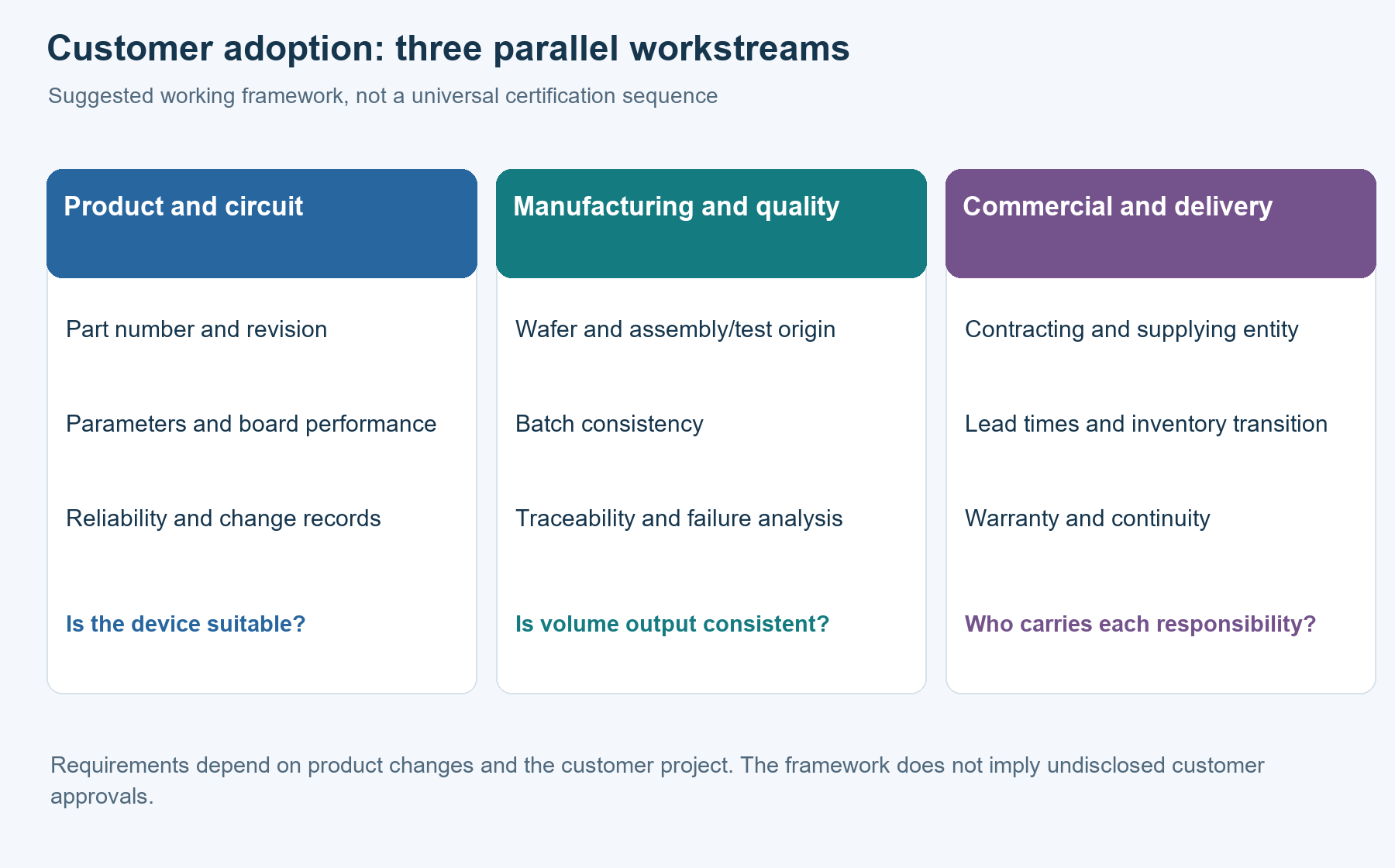
Figure 4. Suggested customer-adoption workstreams, which can proceed in parallel. Product changes and customer requirements determine the actual testing and approvals.
Competitors are pursuing the same project opportunities
The interruption has also encouraged customers to qualify alternative suppliers. Once another device has entered a design and supplies consistently, the return of the original supplier does not automatically restore its previous allocation. Customers may retain a second source to spread delivery risk.
Nexperia China must therefore compete for projects already served by other supply chains. Familiar products and support teams help with existing programs. New programs require a fresh comparison of performance, price, technical support and long-term availability.
The Netherlands-based Nexperia organization is also changing its manufacturing network. On September 17, it announced a cooperation framework with Tata Electronics covering future MOSFET manufacturing at a 300mm Indian wafer fab and assembly and test cooperation. This concerns future capacity, but it illustrates how participants in the former global division of production are seeking new arrangements.
Rebuilding takes time while customer choices continue to change. Earlier delivery recovery offers a better chance of retaining established projects. A later entry into a new design cycle may require more work to win future business. Automotive and AI power demand provide opportunities, but orders must still be won project by project.
Cost reductions have to absorb reconstruction spending
A larger wafer platform can lower costs, while migration brings expenditure before the full order base develops. Process engineering, pilot runs, reliability testing, additional test capability and customer qualification all require resources. Yield, utilization and product mix determine how the wafer-area advantage translates into the cost of acceptable devices.
Time Finance's September reporting observed prices for some 300mm small-signal products 15% to 25% below the corresponding earlier 150mm products, and reductions of up to 30% for some low- and medium-voltage power MOSFETs. These are observations about particular products. Lower prices may attract evaluations while increasing the need for sustainable manufacturing savings as volume and yield develop.
Wingtech's 2026 interim report shows the financial pressure. First-half semiconductor revenue was RMB1.486 billion, with a gross margin of 24.38%. The listed company reported a net loss attributable to shareholders of RMB406 million. These measures have different scopes: the net loss is a consolidated listed-company figure affected by business disposals and changes in consolidation scope.
The report explains that capacity ramp-up, customer qualification after factory changes and conversion into revenue take time, while fixed operating costs and debt interest continue. The company needs to invest in future supply capability and increase deliveries and cash collection so current business can carry more of those costs.
China Chengxin International's May follow-up rating report also identified uncertainty around product coverage, customer introduction and order release. It considered investment pressure manageable at that time, when spending focused mainly on Dongguan assembly and test expansion and research. Subsequent progress indicates a foundation for reconstruction, with scale benefits still to be realized.
Sustained qualified shipments, repeat orders and cash collection will provide operating relief. Catalog expansion, actual sales and the timing of revenue from research spending together determine the duration of the recovery.
IP ownership is a further concern in cross-border reconstruction
The business originated in NXP's standard-products division. The ownership account in the Chinese source places the large majority of patents, trademarks, device layouts, product BOMs and process documentation with Netherlands-registered Nexperia B.V., rather than directly with the Chinese listed parent, Wingtech. Buying shares in a company does not by itself transfer each of that company's assets into the shareholder's name.
That account describes thousands of patents worldwide, most registered to Nexperia B.V., with some inventions arising from German and British operations held by local subsidiaries. It also identifies the Netherlands entity as owner of the Nexperia trademark. The Chinese subsidiaries in Dongguan, Shanghai and Wuxi are described as using much of the group's core technology through internal authorization, with new inventions developed by Chinese entities held by the relevant entities.
For standard devices such as MOSFETs, diodes and logic ICs, the source further attributes the product definitions, test libraries, process recipes and device-model databases to the Netherlands entity, with group factories in Germany, the UK, China and Malaysia producing under internal licenses. These broad descriptions are an ownership account, not a substitute for the documents establishing rights to a particular technology or product. The unresolved scope of those documents is discussed above.
As shareholder, Wingtech would ordinarily exercise influence through company governance. Restrictions on board control or voting rights can limit its ability to direct transfers, licenses or use of a subsidiary's technical assets. Such restrictions do not by themselves establish that the shares have lost all economic value.
The wider issue for cross-border semiconductor acquisitions is the separation between share ownership, governance powers and legal ownership of intellectual property. An acquisition can leave technology assets with an overseas company, where administrative or judicial intervention may constrain the controlling shareholder's access to them. The practical assessment therefore needs the corporate structure and the specific rights and licenses together.
Nexperia China's opportunity combines local 300mm manufacturing resources with established assembly, test, product and customer experience. Its constraints span deliverable part coverage, technical support, quality responsibility, rights arrangements, customer approvals and the cost of sustained investment. Progress in one area may still depend on another before revenue follows.
For buyers tracking the recovery, the most useful evidence will be continuous supply of priority devices, customer qualification turning into batch purchases, new products winning incremental orders, and shipment growth improving profitability and cash collection.
This article provides industry analysis of public material, not investment, purchasing or legal advice. Product status, authorization and customer adoption are subject to formal documents from the relevant entities and project-specific evidence.