
Signal isolation and current measurement: evaluating NOVOSENSE's power-control portfolio
A power-control board brings low-voltage logic close to circuits carrying high voltage and current. Information has to cross between those domains while electrical isolation is maintained. Fast voltage changes can disturb signal transmission, and current-measurement errors can affect regulation and protection.
Chinese supplier NOVOSENSE described its NSI83xx digital isolators and NSM2311 and NSM201x current sensors in June 2026 application material, followed by a broader power portfolio update in September. For engineers and sourcing teams evaluating the supplier, the useful comparison starts with each device's role on the board. TI and Allegro provide references for examining channel arrangements, current-path losses and package choices.
Logic transmission and current feedback have separate roles
A digital isolator transfers logic signals across an isolation barrier. The controller and the circuit on the other side exchange data without a direct conductive signal connection. Industrial communication, isolated sampling interfaces and control signals crossing voltage domains are possible applications.
A current sensor converts the measured current into a signal that the controller can read. In an integrated-conductor Hall sensor, current flows through an internal conductor. A Hall element senses its magnetic field and the device produces a related output voltage. The power-current path remains electrically isolated from the low-voltage measurement circuitry.
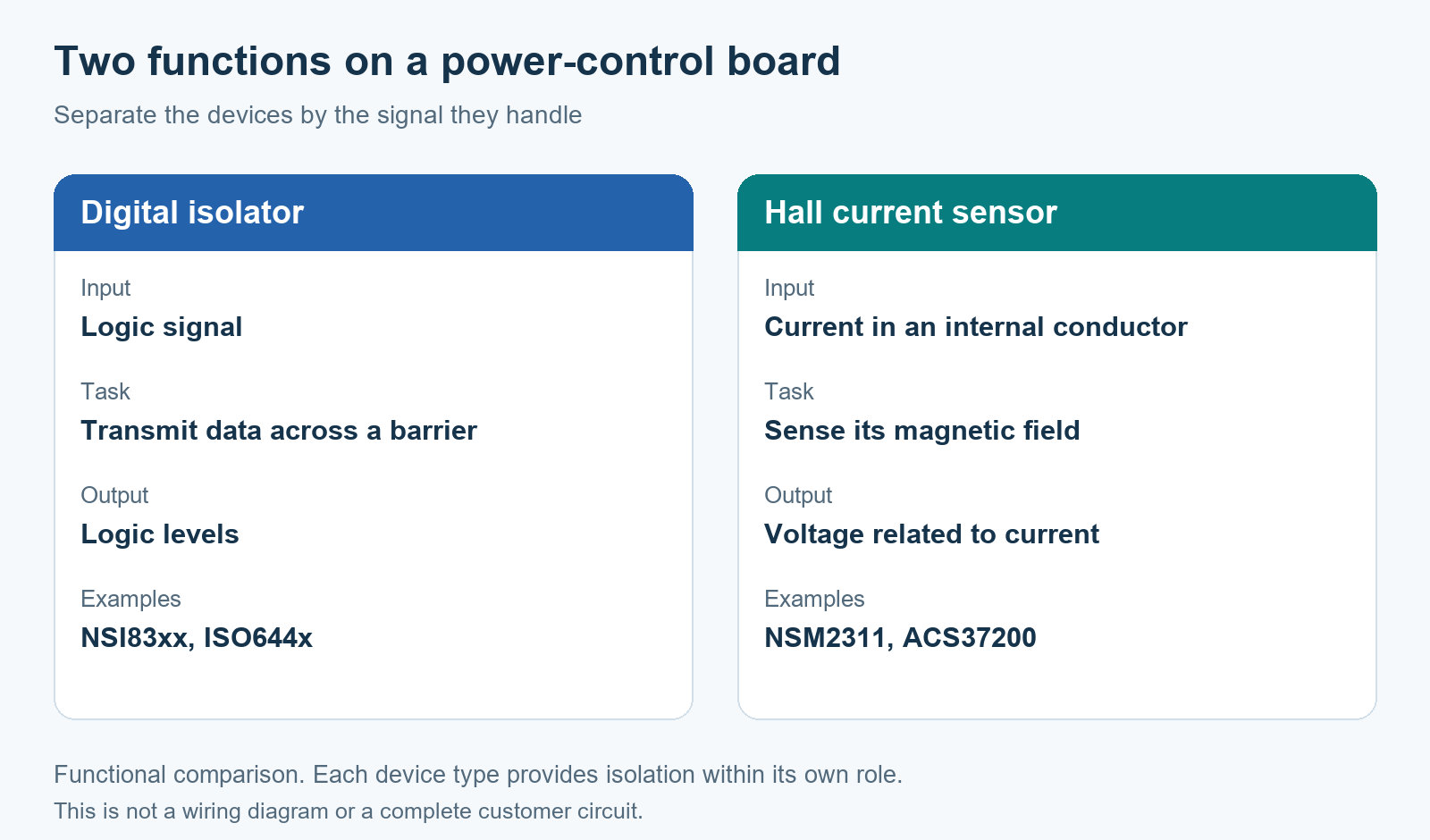
Figure 1. Digital isolators transmit logic, while Hall current sensors provide current feedback. This functional comparison does not represent a complete power-supply circuit.
Both device types can appear on the same board. A further distinction concerns isolated gate drivers: in addition to isolation, they supply the current needed to drive a power transistor's gate. Their drive function separates them from digital isolators when comparing candidate devices.
NSI83xx combines channel choices with immunity requirements
The automotive-grade NSI83xx family described in NOVOSENSE's June disclosure offers one to four channels and data rates up to 100Mbps. The material also emphasizes electromagnetic-interference optimization, electrical-overstress tolerance and common-mode transient immunity.
These characteristics address board-level problems. When power transistors switch rapidly, the potential difference across an isolation barrier can change quickly. Common-mode transient immunity concerns correct signal transmission during that change. EMI behavior affects the ability of the device and nearby circuits to operate together.
TI's ISO644x offers a functional reference. Its May 2026 datasheet revision describes four channels and rates up to 150Mbps, with different direction combinations: ISO6440 has four channels in the same direction, ISO6441 has three forward and one reverse, and ISO6442 has two in each direction.
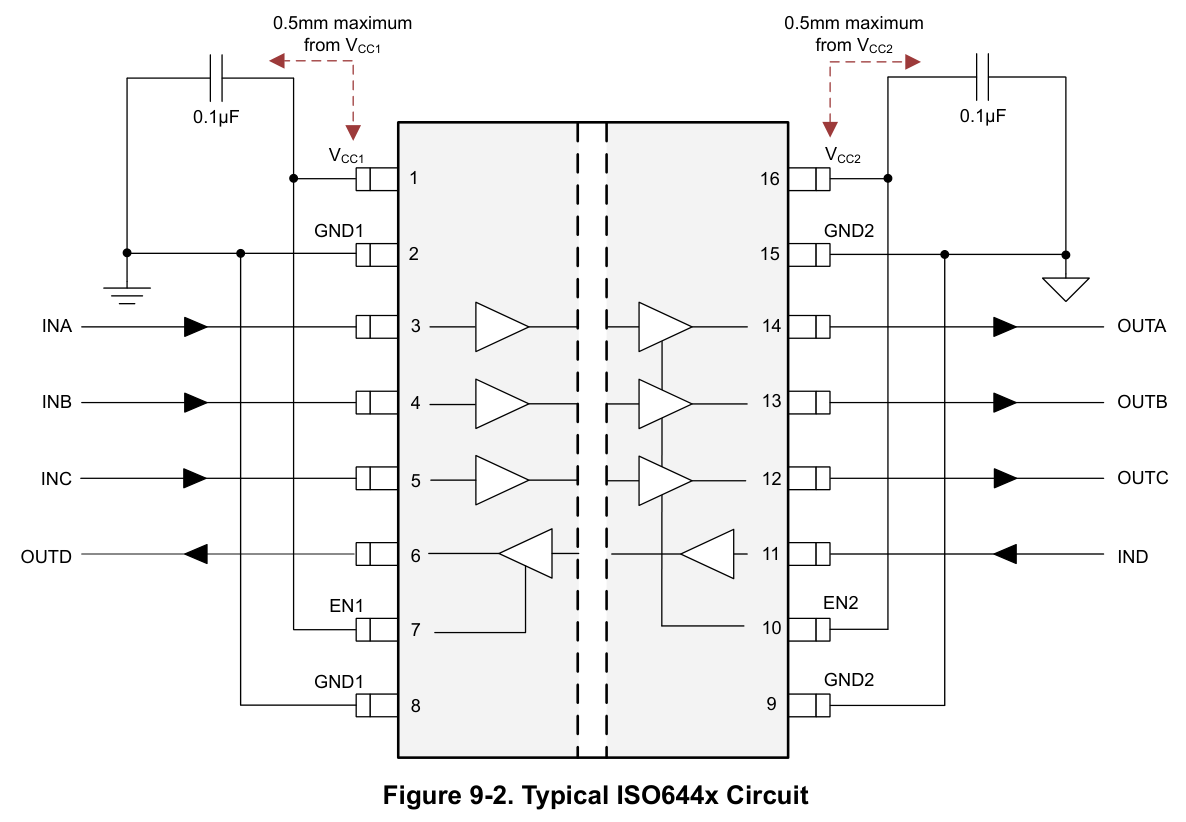
Figure 2. Original TI typical circuit from the ISO644x datasheet revised in May 2026. This configuration has three forward channels, one reverse channel and separate supplies on either side of the barrier.
The 150Mbps and 100Mbps figures distinguish maximum data rates. A particular interface also determines how many signals travel each way, the acceptable delay and the required output state when an input fails. TI's industrial devices and NOVOSENSE's automotive family have different positioning, so this comparison does not establish direct interchangeability.
NSM2311 makes conductor heating part of the measurement design
An integrated current sensor introduces conduction loss because the measured current passes through its internal conductor. Resistance therefore affects the heat generated at the measurement point.
The NSM2311 EN1.0 datasheet, revised on November 21, 2025, specifies typical primary-conductor resistance of 100μΩ. NOVOSENSE's June 2026 material continued to describe the device in isolated current-measurement applications including industrial drives, photovoltaic inverters, power supplies and power-distribution units.
NSM2311 uses a DIP-5L package. Two wider leads carry the measured current; the remaining leads provide supply, ground and signal output. Its 13mm×10mm body requires a layout that accommodates the current path, thermal needs and insulation distances.
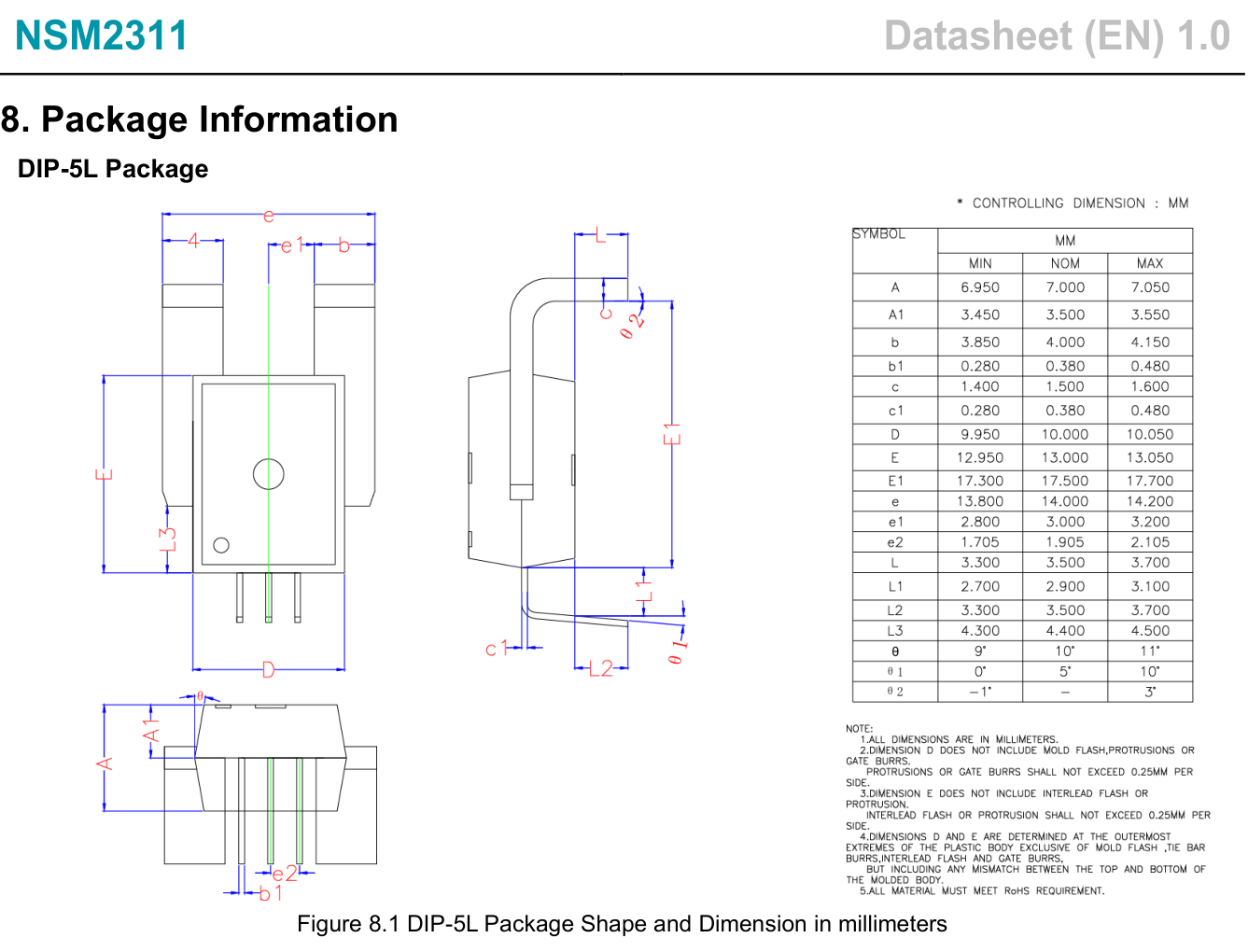
Figure 3. Original DIP-5L package drawing from NOVOSENSE's NSM2311 datasheet EN1.0, dated November 21, 2025. Dimensions are in millimeters.
The ordering code defines the measurement version. NSM2311-100B5R-DDIET specifies a ±100A range, 5V supply and sensitivity of 20mV/A. The sampling interface and current calculation need to match that version. Sensitivity error and zero-current offset are separate specifications, and both contribute to measurement accuracy. The stated measurement range also needs to be distinguished from continuous-current capability under the actual cooling conditions.
The June material describes NSM201x products covering AC and DC measurement requirements from 2.5A to 200A. This is coverage across different products in the family; the range of an individual device depends on its particular ordering code.
Allegro provides a comparison of loss and assembly choices
Allegro announced ACS37200 in January 2026. It also measures current through an integrated conductor with electrical isolation, and lists 50μΩ conductor resistance in a PSOF8 surface-mount package.
At an assumed current of 100A and fixed conductor resistance, the calculation P = I²R gives 1W for NSM2311's 100μΩ conductor and 0.5W for ACS37200's 50μΩ conductor. The calculated half-watt difference provides one reference for the thermal burden at the sensing point.
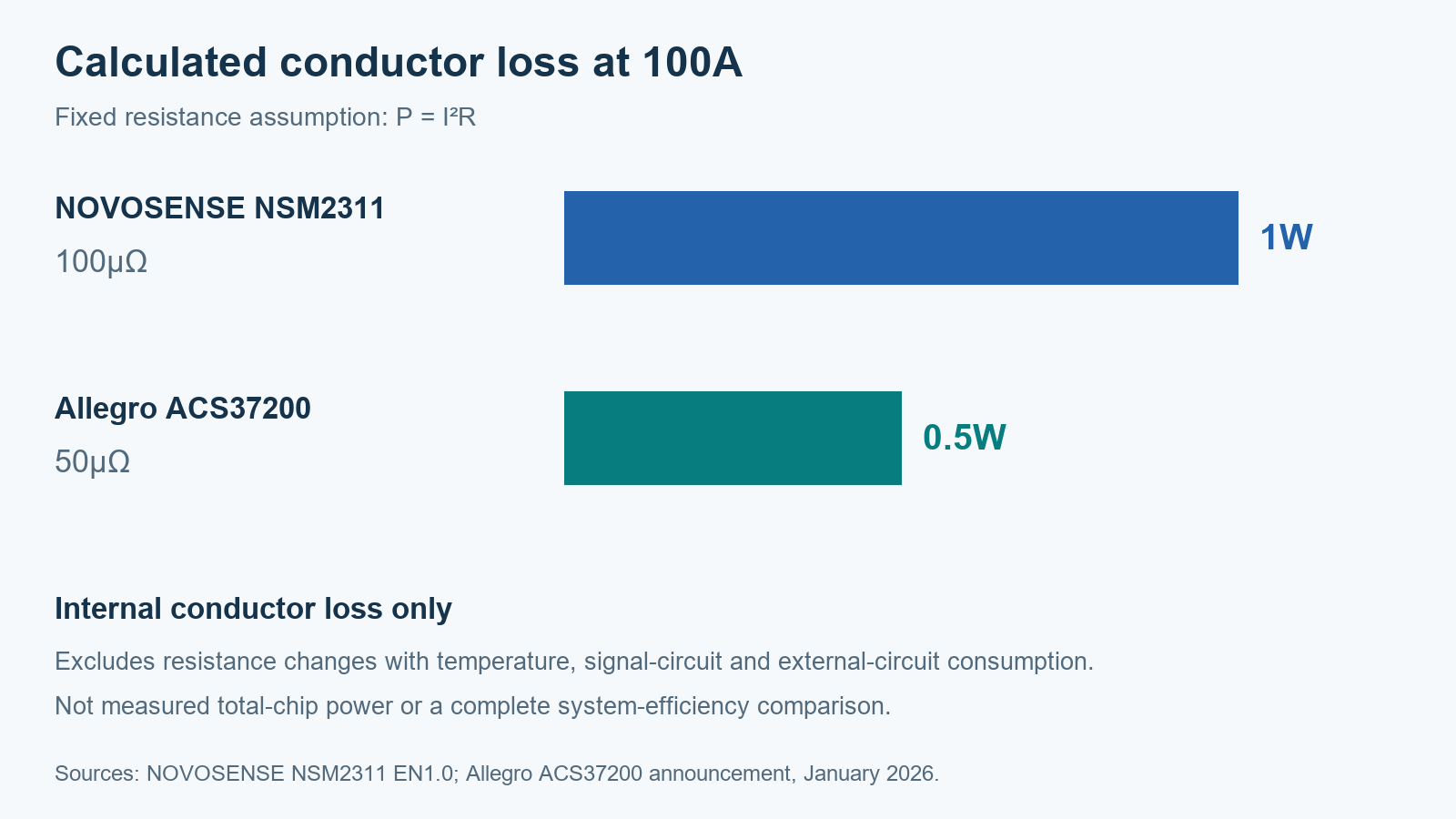
Figure 4. Conductor losses calculated using P = I²R. The calculation excludes resistance changes with temperature and consumption in the signal circuitry. These are not measured total-chip power figures or an overall performance ranking.
Package choice also changes the implementation. NOVOSENSE's through-hole package and Allegro's surface-mount package require different assembly and current-path layouts. Measurement error over temperature, response speed and insulation requirements then need evaluation on the target board.
On September 4, NOVOSENSE disclosed a portfolio covering AC-DC conversion, 800V high-voltage DC systems and different DC-DC stages. NSM201x remained part of its current-measurement and protection discussion. Together, the June and September disclosures show how NOVOSENSE is organizing devices around power applications. Those publication dates do not establish that every family was first launched in 2026 or that a particular device has completed customer qualification and volume substitution.
For power-supply and industrial-control teams, these products identify concrete choices for transmitting signals between domains and measuring high current. Comparing purchase cost and development effort can then focus on the required channel configuration and measurement range, necessary board changes, and availability of samples, documentation and application support for the selected version.