
Ceramic Capacitors from China: 13 Suppliers Across High-Capacitance MLCCs, Safety and RF
A ceramic capacitor storing tens or hundreds of microfarads beside a power rail serves a very different purpose from a few-picofarad device in an RF matching network. For engineers and sourcing teams assessing Chinese suppliers, that difference is a useful starting point: identify the circuit function, then compare the relevant product families.
Following our survey of aluminum electrolytics, this article examines 13 ceramic-capacitor suppliers across four areas: high capacitance and miniaturization; resonant, RF and high-voltage products; safety-rated ceramic discs; and high-reliability components for boards and microassemblies. The companies are CCTC, VIIYONG, EYANG, Sunway's MLCC business, YUNZHONG, Fenghua, Dalicap, Nanjing Huiju, Songtian, Hongyuan, Hongming, Torch and Hongda. Related subsidiaries are discussed with their parent groups.
Three descriptions recur throughout their catalogs. MLCC and SLCC describe multilayer and single-layer construction; C0G, X5R and X7R describe dielectric characteristics; high voltage, RF and automotive describe performance or application requirements. These categories overlap. A single part can be a multilayer C0G capacitor intended for high-voltage service.
Keeping those dimensions separate makes the supplier comparison more useful than a ranking by nominal capacitance alone.
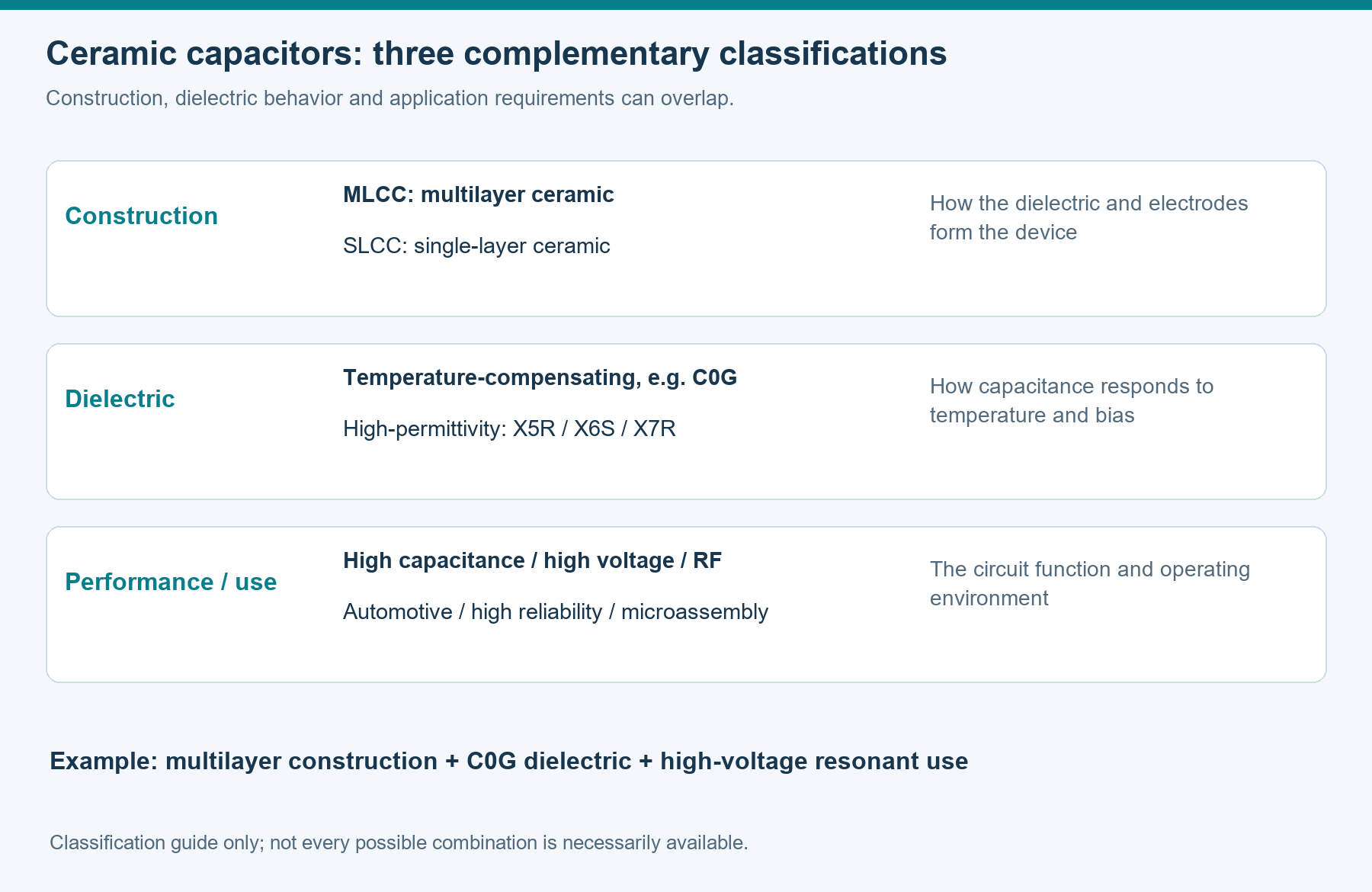
Figure 1. Construction, dielectric characteristics and application requirements are separate dimensions. The examples illustrate classification, rather than availability of every possible combination.
1. High capacitance and miniaturization: five approaches to size, voltage and capacity
CCTC, or Chaozhou Three-Circle Group, offers MLCCs spanning several electrode and structural approaches. Its 2025 annual report, released in March 2026, described sizes from 0201 through 2220, including general-purpose, medium- and high-voltage, and automotive products. It also identified the M3L and S series, flexible terminations and high-frequency products with copper internal electrodes.
For data centers, CCTC reported high-capacitance MLCCs in several sizes and high-capacitance offerings for 48 V power systems. Its August interim report continued to discuss MLCC sales and capacity expansion for high-capacitance products. Low-voltage decoupling and a 48 V power architecture impose different component requirements; the applicable voltage remains a property of the particular part.
VIIYONG illustrates the high-capacitance route with specific size, dielectric and voltage combinations. Its May 2026 application material listed 0402 X6S 22 μF at 4 V, 0805 X6S 100 μF at 2.5 V, and 1206 X6S 220 μF at 2.5 V for filtering and decoupling applications including AI servers.
These combinations address the need for substantial nominal capacitance in limited board area. VIIYONG also described 01005 and 0201 miniature products and technical progress at the 008004 size, with applications in wearables, miniature modules and chip packaging.
The 220 μF example belongs to the specified 1206 product; 008004 represents a separate miniaturization effort. Keeping size, capacitance and rated voltage together avoids combining achievements from different product families into a specification that the supplier has not stated.
EYANG separates general-purpose high-capacitance products from high-frequency offerings. Its C-series selection guide, effective April 17, 2026, includes 0402 X5R 22 μF at 6.3 V. That differs from the VIIYONG 0402 example in both dielectric classification and rated voltage, so the two require assessment under their intended operating conditions.
For high-permittivity ceramics such as X5R and X6S, nominal capacitance is the starting point. DC bias can reduce effective capacitance; temperature and aging also affect it. The useful comparison is the capacitance retained under operating conditions, together with impedance behavior.
EYANG's U-series guide, effective July 30, 2026, covers copper-internal-electrode products for RF applications including phones, routers, power amplifiers and associated modules. Its 0402 C0G 100 V group spans 0.1 to 100 pF. Within one supplier, the engineering task therefore ranges from microfarad-scale decoupling to picofarad-scale high-Q components.
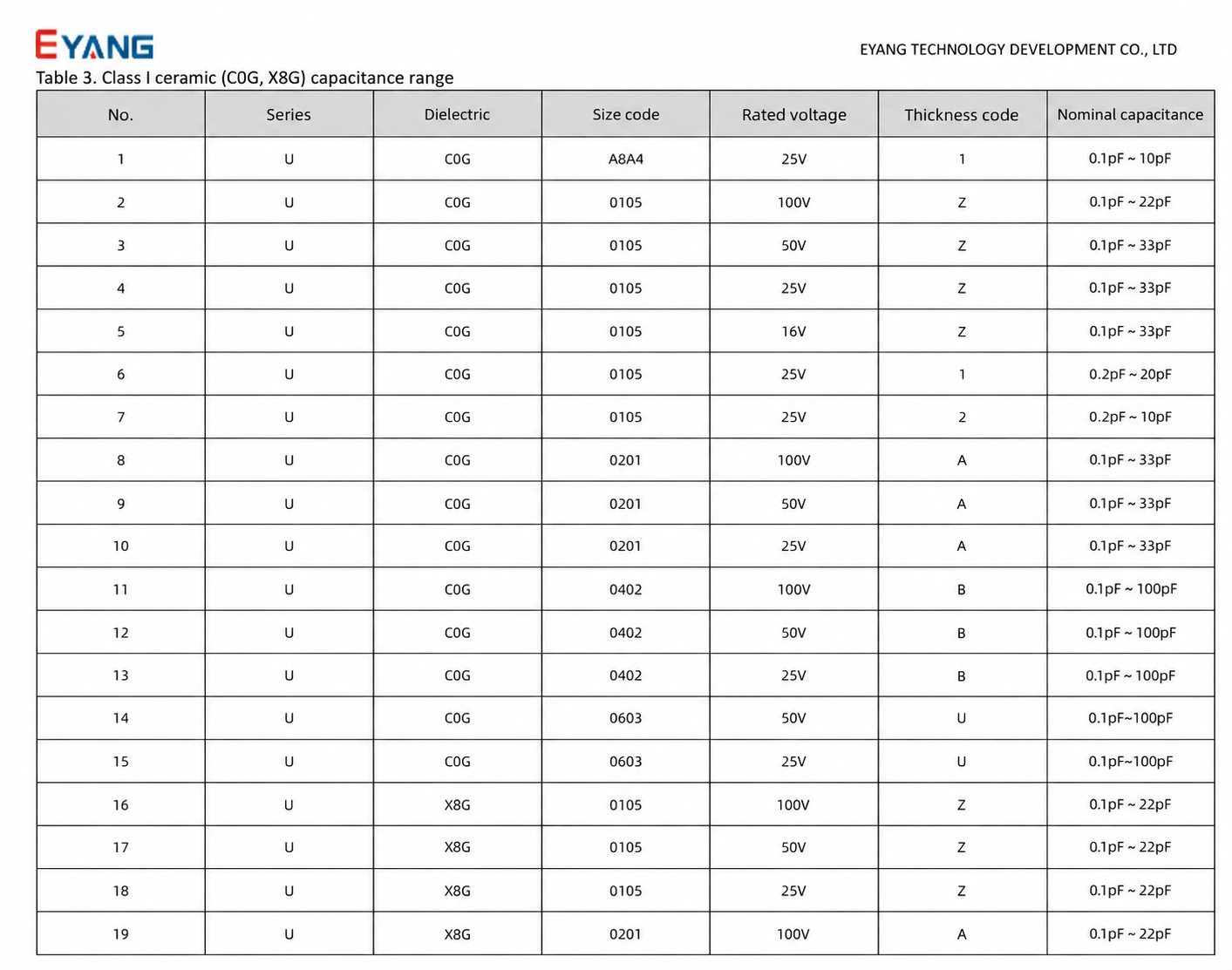
Figure 2. English-localized excerpt from EYANG's U-series selection guide, effective July 30, 2026. The original row values and manufacturer size and thickness codes are retained; each row specifies a particular combination.
Sunway's MLCC business distinguishes products already shipping from higher-capacitance products still at the validation stage. Sunway Communication's August 2026 interim report stated that several high-capacitance MLCC specifications were being supplied in volume to leading domestic customers. Its higher-end products target AI chips, servers and automotive applications. Xinwei Electronic Technology (Yiyang) is one of the group's MLCC operating entities.
The same report said that larger-size, ultra-high-capacitance products had completed core-technology validation. For sourcing teams, those are two different milestones: volume supply of identified products and technical validation of a further product group. Availability needs to be confirmed at specification level.
YUNZHONG uses the MC, IC and AC series to address consumer, industrial and automotive electronics. Its 2026 interim report listed new products including 0201 X5R 100 nF at 10 V, 1206 X5R 10 μF at 50 V, and 1206 X7R 10 μF at 25 V. Its MLCC operations, including Chizhou YUNZHONG, cover multiple sizes from 0201 to 1206.
The 0201 example serves compact layouts, while the two 1206 combinations offer different dielectric and voltage choices for power circuits. DC-bias curves, temperature characteristics and package dimensions provide the next level of comparison.
2. Resonant, RF and high-voltage products: different demands on loss and construction
Power resonant circuits and RF matching networks both depend on loss characteristics. Their operating frequencies, voltage and current stresses, and assembly methods lead to different product families.
Fenghua's resonant MLCC offering is oriented toward power conversion. Its May 2026 material described C0G products in consumer, flexible-termination, industrial and automotive groups. Typical specifications included 1210 C0G 33 nF at 630 V and, in the same size, 22 nF, 15 nF and 10 nF at 1,000 V. AM10CG333J631 was given as an automotive example.
Capacitance stability affects the operating point of a resonant circuit, while loss and current affect component heating. C0G's temperature stability and DC-bias behavior make it relevant to these applications. The inclusion of different termination structures and product grades also brings assembly and reliability requirements into the comparison.
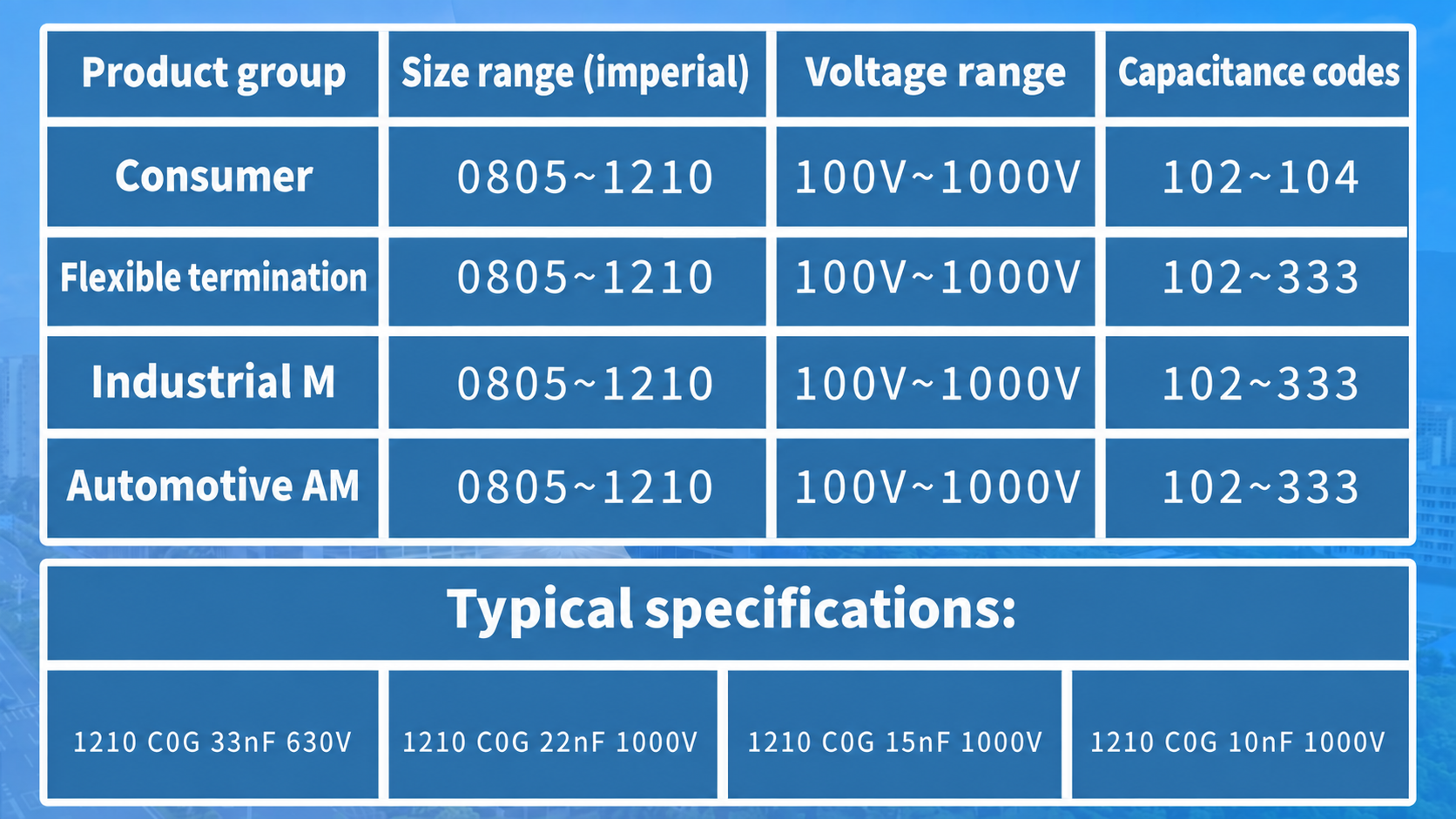
Figure 3. English-localized Fenghua resonant-MLCC material from May 2026. The upper table preserves the manufacturer's capacitance codes; the lower table gives specific examples. Range endpoints do not imply availability of every size, voltage and capacitance combination.
Dalicap's DLC70 families concentrate on RF and microwave applications. The DLC70H specification published on its website in July 2026 lists 0402 parts from 0.1 to 33 pF for tuning, coupling, DC blocking and impedance matching. Rated voltage varies across the capacitance table: 10 pF is listed at 200 V, while 30 pF and 33 pF are listed at 50 V.
The larger DLC70E, in a specification published in April 2026, covers the 3838 size and 0.5 to 5,100 pF. Applications include semiconductor RF power supplies and MRI equipment, with chip, microstrip, axial-lead and radial-lead configurations.
These families differ in the operating conditions and assembly arrangements they address, as well as size and capacitance. Q, ESR and resonance behavior at the target frequency complement the available voltage-capacitance combinations in the selection table. Size designations in this article follow the respective manufacturers' documentation.
Nanjing Huiju New Materials organizes several MLCC families by voltage and also offers open-mode products. Its current catalog lists NM medium-voltage products at 100 to 630 V, NV high-voltage products at 1,000 to 3,000 V, and NH ultra-high-voltage products above 3,000 V. The OP open-mode family uses X7R dielectric and addresses power and high-current circuits.
NM includes power-filtering applications; NV and NH extend into high-voltage coupling. Alongside Fenghua's resonant products and Dalicap's RF families, these ranges show how a ceramic-capacitor catalog can be organized around voltage, frequency, loss or electrode construction.
3. Safety-rated ceramics and high-voltage discs
Guangdong Songtian adds safety-rated interference-suppression products to the comparison. Its current catalog lists the CY series with X1-760 VAC, Y1-500 VAC and 1,500 VDC specifications; CD with Y1-500 VAC and 1,500 VDC; and CE as a Y2 product family. Selection follows the applicable safety class, operating voltage and certification, for functions including power-supply noise suppression, bypassing and coupling.
High-voltage discs form another product line. The HV series covers 500 VDC to 6.3 kVDC for applications including high-voltage bypassing and coupling. The SV series covers 10 to 15 kV for applications such as high-voltage DC supplies.
Safety-rated families are selected against X/Y classification and insulation requirements; DC high-voltage families require attention to voltage rating, loss and physical dimensions. Lead spacing and component thickness add practical assembly considerations. These families broaden the ceramic options beyond miniature surface-mount MLCCs.
4. Reliability and microassembly: terminations, materials and single-layer parts
Ceramic bodies are brittle. Board flexure, temperature changes and assembly stresses influence reliability, making flexible terminations, metal brackets and leaded structures meaningful product differences.
Hongyuan Electronics has reported progress in ultra-high-voltage multilayer ceramics. Its 2026 interim report said it had completed development of a series covering chip, bracket-mounted and leaded structures, while also advancing applications for flexible-termination products.
Its broader ceramic range includes conventional multilayer chips, single-layer chips, gold-terminated products and RF/microwave capacitors. These address board assembly, microassembly and high-frequency circuits. Completion of series development is the disclosed milestone; voltage, capacitance and delivery status remain part-specific questions.
For the assembly designer, chip, bracket-mounted and leaded parts place solder joints and mechanical stresses differently and occupy different amounts of space. Mechanical construction warrants comparison even at the same rated voltage.
Hongming links electronic ceramic materials and electrode pastes with finished components. Its 2026 interim report listed multilayer ceramic capacitors, chip ceramic capacitors and microwave components, covering dielectric formulations, electrode pastes and device manufacturing. Its Hongke subsidiary works in electronic ceramic materials, high-reliability MLCCs and chip ceramic products.
The materials, internal and external electrodes, and manufacturing process all contribute to component behavior. Hongming and Hongke are treated here as one supplier group, reflecting that connection between materials development and finished devices.
Moving from the PCB into a module also brings single-layer ceramic capacitors, or SLCCs, into view. Their construction differs from a multilayer stack, and their common microwave and microassembly uses make connection method, parasitic behavior and the installation environment central to selection.
Torch Electron covers its own ceramic capacitors and microwave products from its Tianji subsidiary. Torch's 2026 interim report described ceramic capacitors as one of its mature product lines. Tianji's portfolio includes microwave chip capacitors, thin-film circuits, thin-film integrated passive devices and microwave dielectric frequency components, with applications in 5G and optical communications.
The report discussed SLCCs and thin-film circuits in the RF signal paths of high-speed optical modules, including impedance matching, signal decoupling and noise suppression. Torch's board-level multilayer components and Tianji's devices for internal module assembly therefore merit separate product comparisons within the group.
Hongda Electronics also pursues both multilayer and single-layer ceramics. Its 2026 interim report listed both capacitor types; Hongda Hengxin undertakes single-layer ceramic and thin-film-circuit activities. Single-layer products serve DC blocking, bypassing, filtering, tuning and matching in microwave, millimeter-wave and optical-communications applications.
Hongda reported that products including single-layer ceramic chip capacitors and ceramic thin-film circuits had helped it enter the qualified-supplier systems of several optical-module manufacturers. That describes supplier qualification; it does not quantify volume shipments for individual parts.
For single-layer devices, die or package dimensions, end metallization, interconnection processes and performance at the target frequency need to be considered with the module design. Nominal capacitance alone says little about the assembly task.
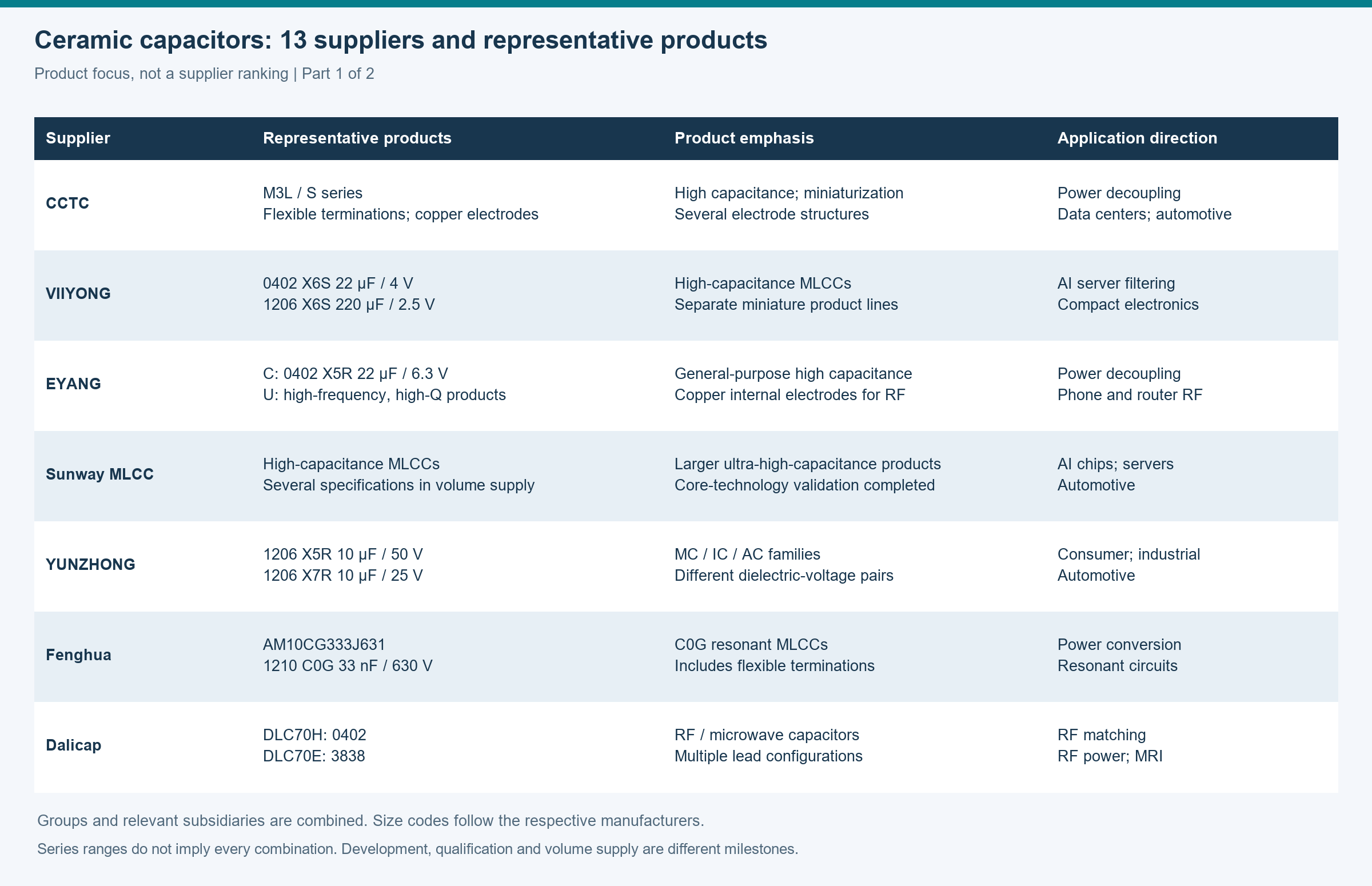
Figure 4. Representative products from seven of the 13 suppliers, covering high capacitance, miniaturization, resonant and RF applications. Specifications belong to the combinations shown.
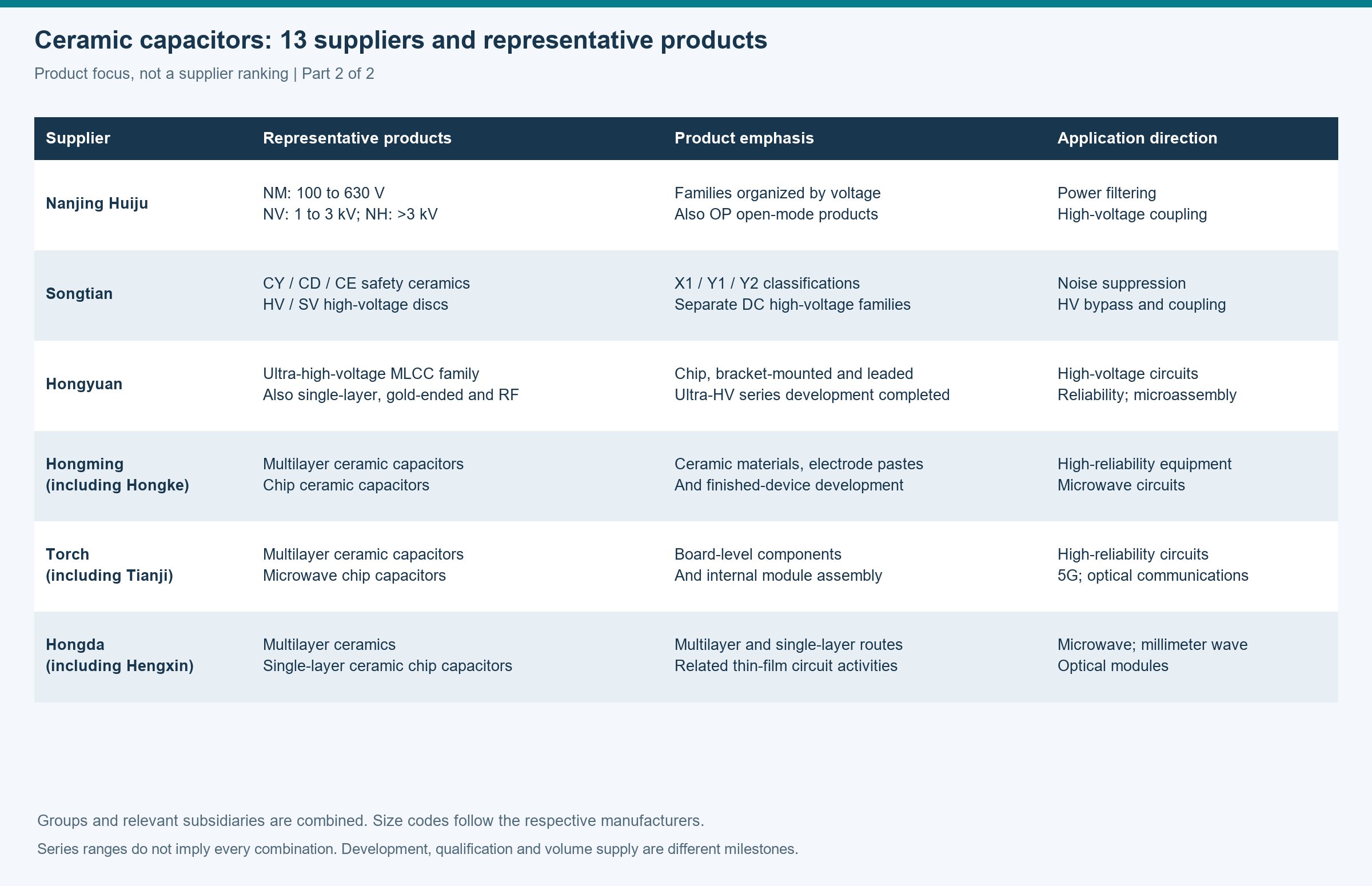
Figure 5. The remaining six suppliers, covering high voltage, safety, high reliability and microassembly. Parent groups and their relevant subsidiaries are listed together; the tables are not rankings.
Across these suppliers, high-capacitance MLCCs address power decoupling, resonant and RF families emphasize loss and frequency behavior, safety-rated ceramics support interference suppression, and high-voltage parts provide the required bypass or coupling capability. Single-layer devices extend the comparison into microwave and optical modules.
A useful supplier shortlist starts with the capacitor's job in the circuit, then narrows to the series, construction and complete specification. Procurement's voltage and capacitance requirements must meet the engineer's bias, loss, temperature and assembly constraints in the same part. That is what turns a broad supplier survey into practical selection work.