
Beyond aluminum electrolytics: Tantalum, niobium and emerging materials
A capacitor catalog can make the electrolytic family look larger than it is. Solid tantalum, polymer tantalum, wet tantalum, niobium oxide, multi-anode and mixed-dielectric devices appear under different headings, although those names describe different aspects of a component.
The first distinction is between the anode material and the electrolyte or conductive cathode system. A polymer tantalum capacitor belongs to both the tantalum family and the polymer category. Polymer aluminum remains an aluminum electrolytic. Treating those labels as separate families counts the same device twice.
Electrolytic capacitors use an oxide film formed on the anode as their dielectric, together with a conductive cathode system. Most are polarized; purpose-designed bipolar products also exist. This guide follows the branches beyond aluminum and places Chinese manufacturers alongside the material and structural choices they describe in their catalogs.
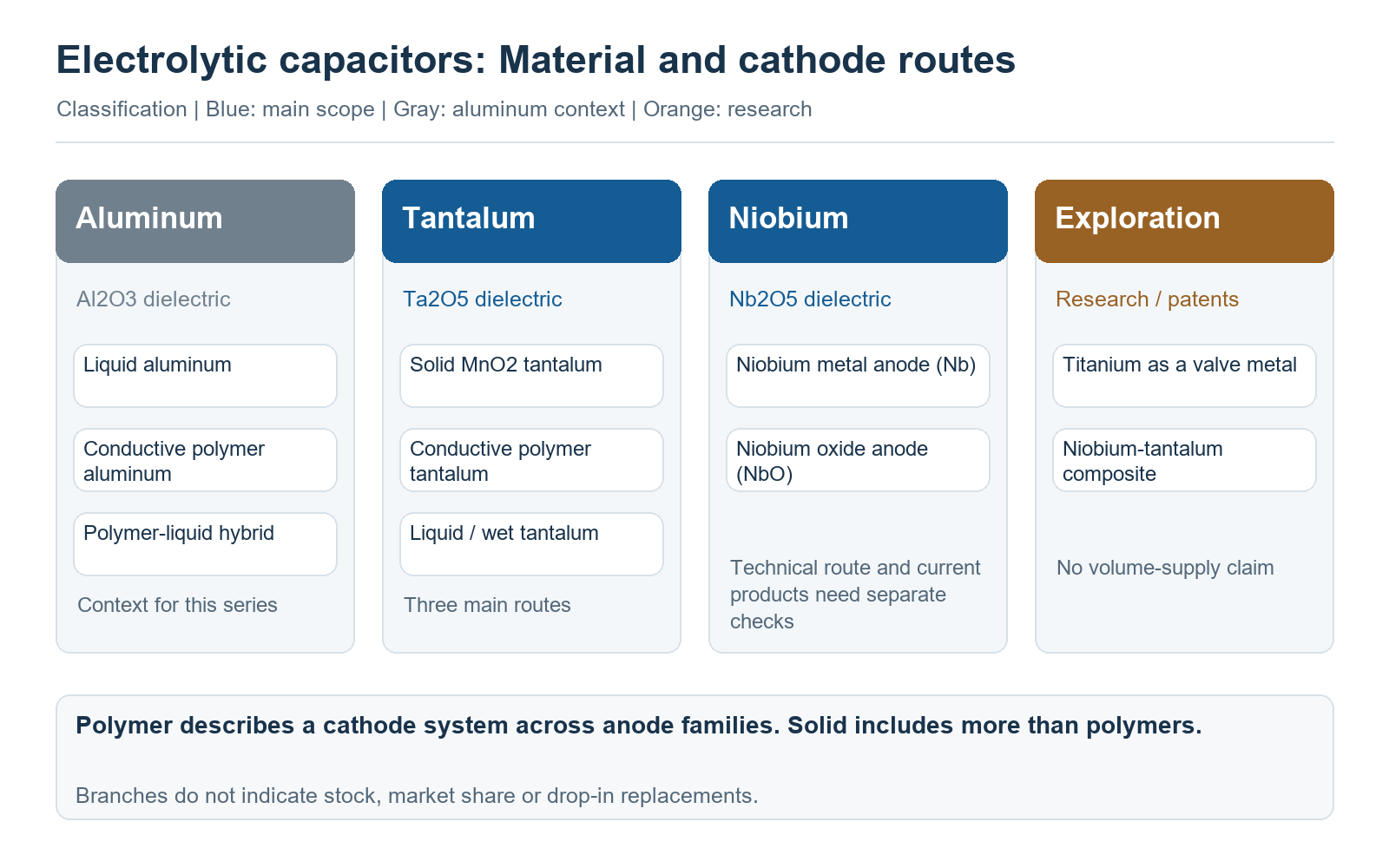
Figure 1. Anode materials and electrolyte systems are separate classification dimensions. Aluminum provides context; emerging materials are shown as research directions. The diagram does not indicate availability or interchangeability.
1. Solid tantalum: Cathode materials and product design
A typical tantalum anode is a porous body made by pressing and sintering tantalum powder. Its surface carries a tantalum pentoxide dielectric. The porous structure increases effective surface area, allowing substantial capacitance in a small volume. Manganese dioxide and conductive polymers then provide two different solid cathode routes.
Manganese dioxide tantalum remains an established branch. KEMET's T489 datasheet, revised on July 8, 2026, identifies it as a low-DC-leakage MnO2 series for uses including filtering and decoupling. Leakage matters in circuits that spend long periods in standby, where the capacitor's own current contributes to the power budget. Case color alone does not identify the cathode material.
Polymer tantalum retains the tantalum anode and oxide dielectric but uses a conductive polymer cathode. Its conductivity helps lower equivalent series resistance, or ESR. ESR contributes to loss under ripple current and affects the voltage response to changing loads. Capacitance, parasitic inductance, PCB layout and the power supply's control loop also influence the result, so comparisons need the relevant frequency and temperature conditions.
KYOCERA AVX's August 2026 update lists new specifications in the TCJ, TCN and TCM polymer families. One TCM multi-anode addition is rated at 47μF and 35V, with a maximum ESR of 30mΩ at 100kHz. Multi-anode construction is a structural option within the polymer tantalum route. Panasonic's POSCAP is a polymer tantalum brand, rather than a generic name for the whole category. Vishay's January 2026 T51 material also distinguishes available specifications from those under development or on its roadmap. A comparison table identifies candidates; it does not establish a validated replacement or current stock.
Chinese manufacturers offer several routes within the same family. Hongda Electronics' 2026 interim report identifies Hunan Xiangyee Zhongyuan as a wholly owned subsidiary. Hunan Xiangyee Electronics belongs to Xiangjun Electronics, another wholly owned Hongda subsidiary. These company names should therefore be read within their group relationships. Xiangyee Electronics' catalog separates conventional solid tantalum, low-ESR solid tantalum, polymer tantalum and high-temperature categories.
Hongda's report also describes protection features in its polymer tantalum category: a conductive polymer cathode, a molded surface-mount structure and an internal fuse design intended to isolate a capacitor that shorts. Protection architecture is another distinction to investigate at the series and full-part-number level; the description should not be assumed to apply to every polymer capacitor.
Torch Electron identifies tantalum capacitors among its mature products in its 2026 interim report. Its catalog distinguishes surface-mount polymer tantalum, fully sealed high-energy composite tantalum and combined high-energy composite tantalum. Those names incorporate cathode material, sealing and internal construction, so they need to be read on separate classification levels.
YMIN provides an example aimed at automotive power design. In a May 9, 2026 application article about ADAS domain controllers, it describes a 470μF, 16V TQD42 specification for hold-up on a 12V rail, and a 10μF, 63V TQD19 specification for the output of a 48V-to-12V converter. Both are polymer tantalum, but their circuit roles differ. Hold-up starts with the load and required duration; converter output selection also depends on ripple and the power supply loop. These are manufacturer application examples, rather than configurations that every domain controller can adopt unchanged.
Polymer cathodes can reduce combustion risk under certain failure conditions, while the devices still have operating limits. MnO2 tantalum should likewise not be reduced to a blanket claim that it catches fire. Derating and startup conditions belong to the relevant series documentation.
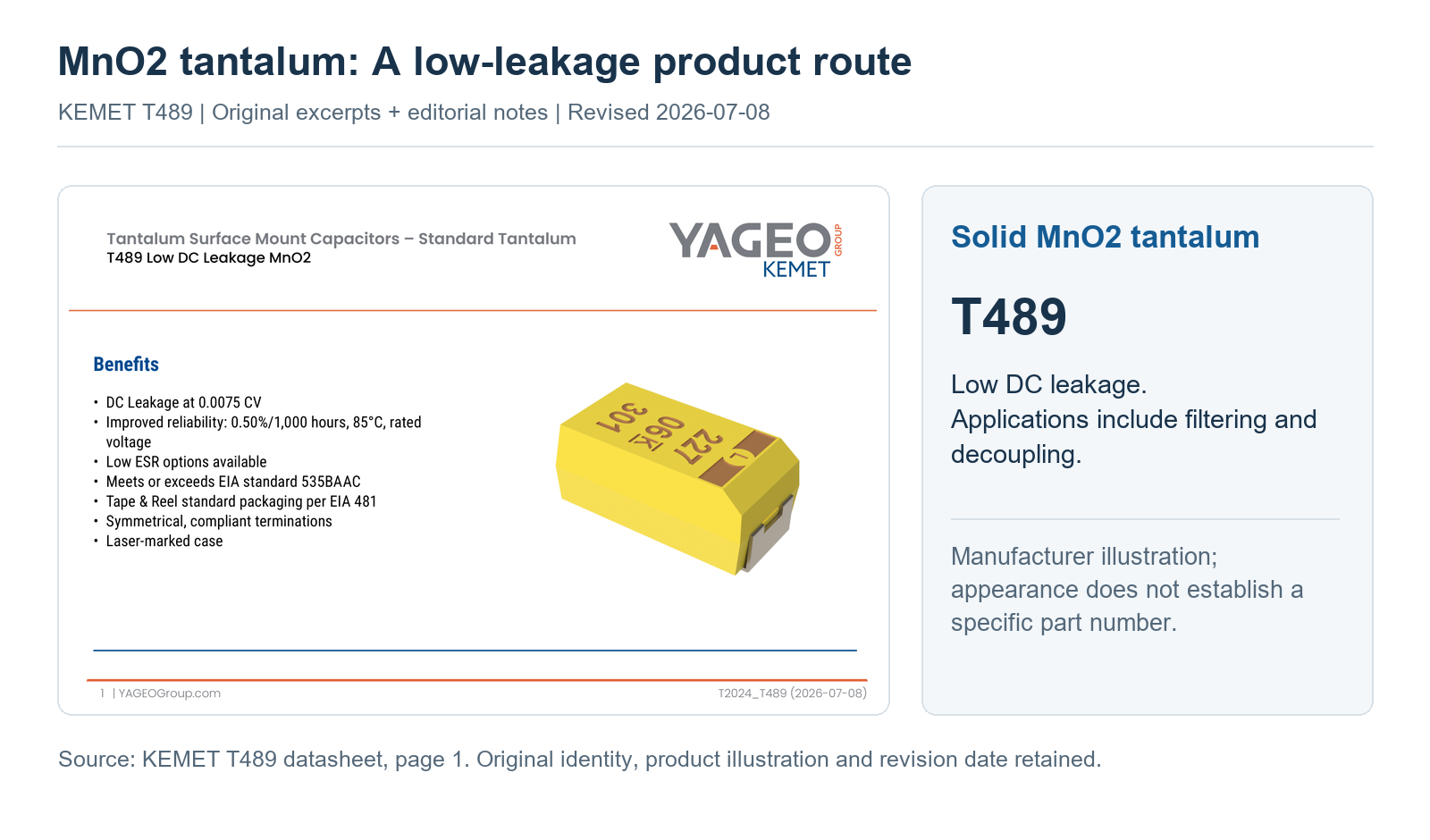
Figure 2. Excerpts from page 1 of KEMET's T489 datasheet, revised July 8, 2026, with editorial notes. The source retains the manufacturer identity and product illustration; the pictured appearance does not identify a specific part number.
2. Wet tantalum, energy storage and integrated structures
Wet tantalum, also called non-solid tantalum, uses a liquid electrolyte on the cathode side while retaining the tantalum oxide dielectric. Together with MnO2 and polymer tantalum, it forms the three main tantalum routes. KYOCERA AVX's classification includes hermetic axial-lead devices and modules; Vishay also maintains a wet tantalum category. These structures differ from the small molded surface-mount parts familiar on many circuit boards.
Hongda's 2026 interim report separates non-solid tantalum from polymer tantalum. It describes energy storage and power hold-up for the former, and filtering, decoupling and ripple suppression for the latter. The report also discusses high-energy hybrid tantalum and lists production lines for non-solid, surface-mount solid, solid-electrolyte and high-energy hybrid tantalum. The group spans several manufacturing routes, rather than a single package format.
Hongda reported first-half 2026 revenue of CNY74.871 million from its civilian tantalum business, up 51.06% year on year. It also said its tantalum products qualified for supply to several leading Chinese server and solid-state-drive manufacturers. The growth rate concerns that civilian segment. The disclosure does not identify the device position or complete bill of materials of a particular server or SSD.
For a hold-up requirement, the starting conditions are load power, required duration and the permitted voltage change. Those determine the storage requirement. Decoupling near a processor starts from a different problem, while package, temperature and reliability requirements influence both decisions.
Zhenhua Newcloud, a subsidiary of Zhenhua Technology, offers an integration example. Its January 2026 introduction of the TAC45/TAC55 combines tantalum and ceramic capacitors in one package for broadband filtering, decoupling and DC/DC output applications. The manufacturer describes an array substrate as the termination structure. In its stated example of a 28V circuit and E-case package, the integrated solution saves approximately 20% to 30% of board area compared with the conventional arrangement. That figure belongs to the reported layout example, rather than every circuit using the device.
The development problem is practical: a circuit may need filtering across low and high frequencies, with tantalum and ceramic capacitors placed in parallel on the PCB. The spacing between separate components consumes area. Moving that combination inside a package changes both layout and assembly. Newcloud says the internal ceramic capacitors are soldered before shipment, reducing the external board's pad count. Actual filtering performance still depends on impedance behavior and circuit testing.
Mixed dielectric, high-energy hybrid, multi-anode, multi-core and module describe different combinations or structures. They do not all create new anode-material families. A tantalum-plus-ceramic package also differs from the polymer-plus-liquid electrolyte used in hybrid aluminum electrolytics. The word "hybrid" needs its material or structural context.
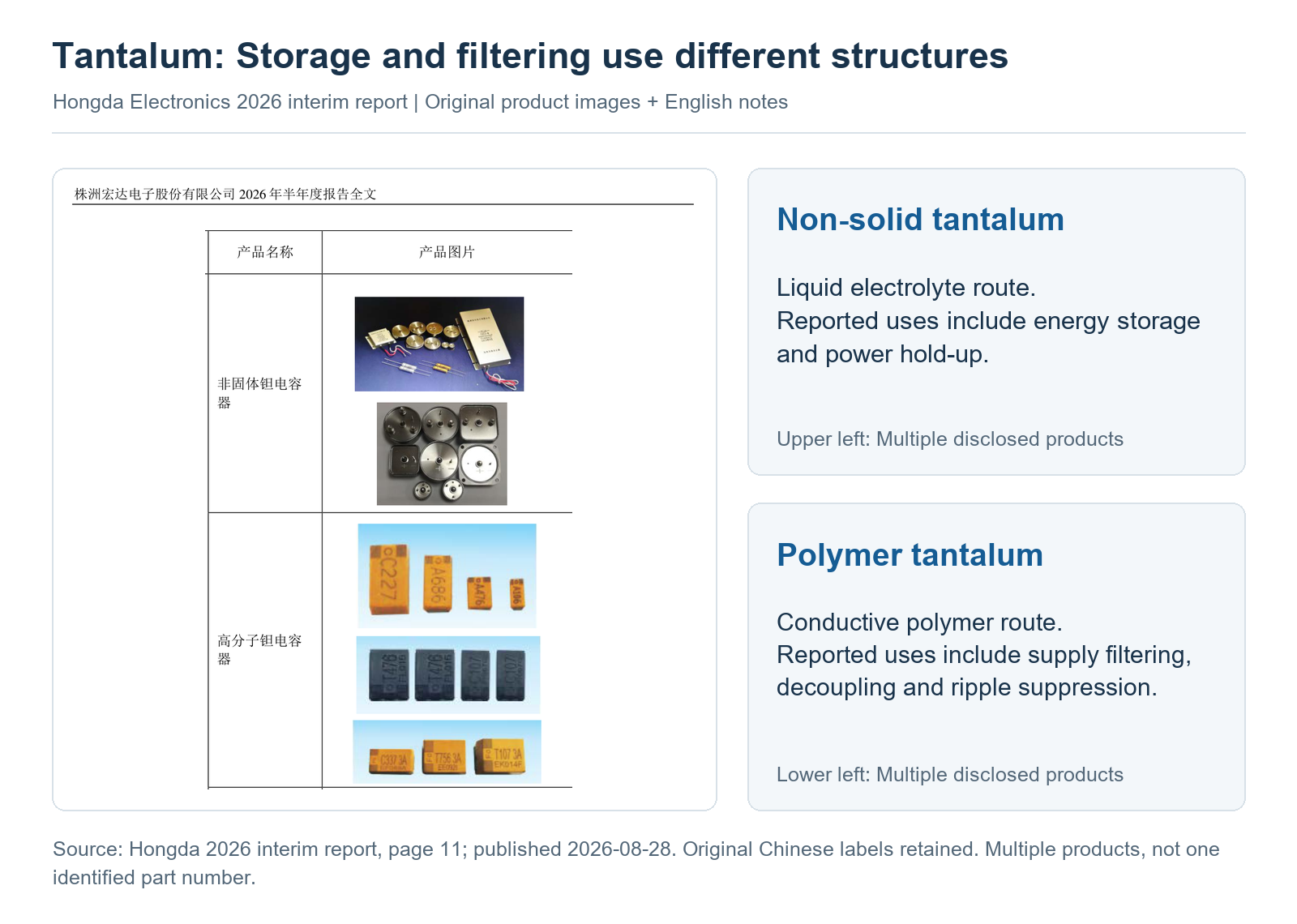
Figure 3. Product-image excerpts from page 11 of Hongda Electronics' 2026 interim report, published August 28, 2026, with English editorial explanations. Original Chinese company and product labels are retained. The report shows multiple products, rather than one identified part number.
3. Niobium metal and niobium oxide require separate checks
The niobium family includes metal-niobium and niobium-oxide anode routes. A metal-niobium anode forms a niobium pentoxide dielectric. The oxide route uses conductive niobium monoxide, NbO, as the anode material, while the insulating dielectric is still niobium pentoxide, Nb2O5. Similar chemical names therefore describe different electrical functions.
KYOCERA AVX's OxiCap is a recognizable niobium-oxide product family. Its documentation discusses a non-burning failure mode under specified conditions and provides different product-category entries. Evaluating it for a circuit position still requires working voltage, leakage, impedance and temperature requirements as well as failure behavior.
Chinese catalogs also contain a niobium-oxide entry. Xiangyee Electronics identifies a high-reliability surface-mount niobium-oxide capacitor with niobium monoxide as the anode base material. That establishes the NbO route, rather than a metal-niobium device. Its catalog places solid tantalum, polymer tantalum and niobium oxide within the same supplier portfolio. The material and electrolyte dimensions still need to be kept separate: "solid" is broader than "polymer."
The Xiangyee directory does not state a recent revision date, so it is used here to identify the category, without treating it as a 2026 product launch or quoting old specification limits. A usable catalog entry also needs a current full part number. AVX's niobium pages provide both product navigation and end-of-life notices, illustrating why lifecycle status must be checked separately from the technical description.
Metal niobium belongs in the technical taxonomy. A current supplier list, however, needs evidence of current commercial series. The same applies to polymer niobium: the sources reviewed for this article do not establish a commercial branch comparable in maturity to polymer tantalum.
4. Emerging materials and the labels that cross families
Titanium and niobium-tantalum composite anodes extend the material discussion. A 2026 review of solid aluminum electrolytics includes titanium among valve metals, alongside aluminum, tantalum and niobium. That supports its place in material research; it does not establish stable supply of a standalone titanium electrolytic capacitor series.
A material containing titanium is not automatically a titanium-anode capacitor. A 2025 study introduced TiO2 into aluminum powder anode foil. The research concerns an aluminum-based composite modification, which should remain within the aluminum system.
The December 2025 publication of patent CN120637109B describes mixing niobium and tantalum powders, pressing and sintering them, and forming a dielectric film. This combines anode materials. It is distinct from connecting finished capacitors together, and the patent alone does not establish a finished commercial series, volume supply or a particular end use.
Electrolyte classifications also extend beyond liquid, MnO2 and conductive polymers to polymer-liquid hybrid systems and research involving organic semiconductor materials such as TCNQ. "Solid" covers more than polymer electrolytes. Polymer aluminum and hybrid aluminum belong within this broader scheme, although aluminum is outside this article's main scope.
Surface mount, radial, axial, snap-in, screw-terminal and module identify mounting or connection structures. Low impedance, high ripple, long life and high temperature describe performance directions. Multi-anode and multi-core describe internal construction. Automotive and high-reliability positioning require the relevant quality evidence. A component can carry several of these labels at once.
Bipolar electrolytics are a polarity and structural category. Their AC operating conditions still need to follow the particular product documentation. Supercapacitors should be treated separately because electric-double-layer and related storage mechanisms differ from an anode-oxide-film dielectric. A manufacturer selling both tantalum capacitors and supercapacitors does not make them the same family.
For supplier research beyond aluminum, the established tantalum routes are MnO2, polymer and wet tantalum, with niobium metal and NbO distinguished in the material taxonomy. Hongda and the Xiangyee businesses, Zhenhua Newcloud, Torch Electron and YMIN illustrate different parts of China's product portfolio. The next step from a category name is a current series, its structure and its lifecycle; a research paper or patent answers a different question.
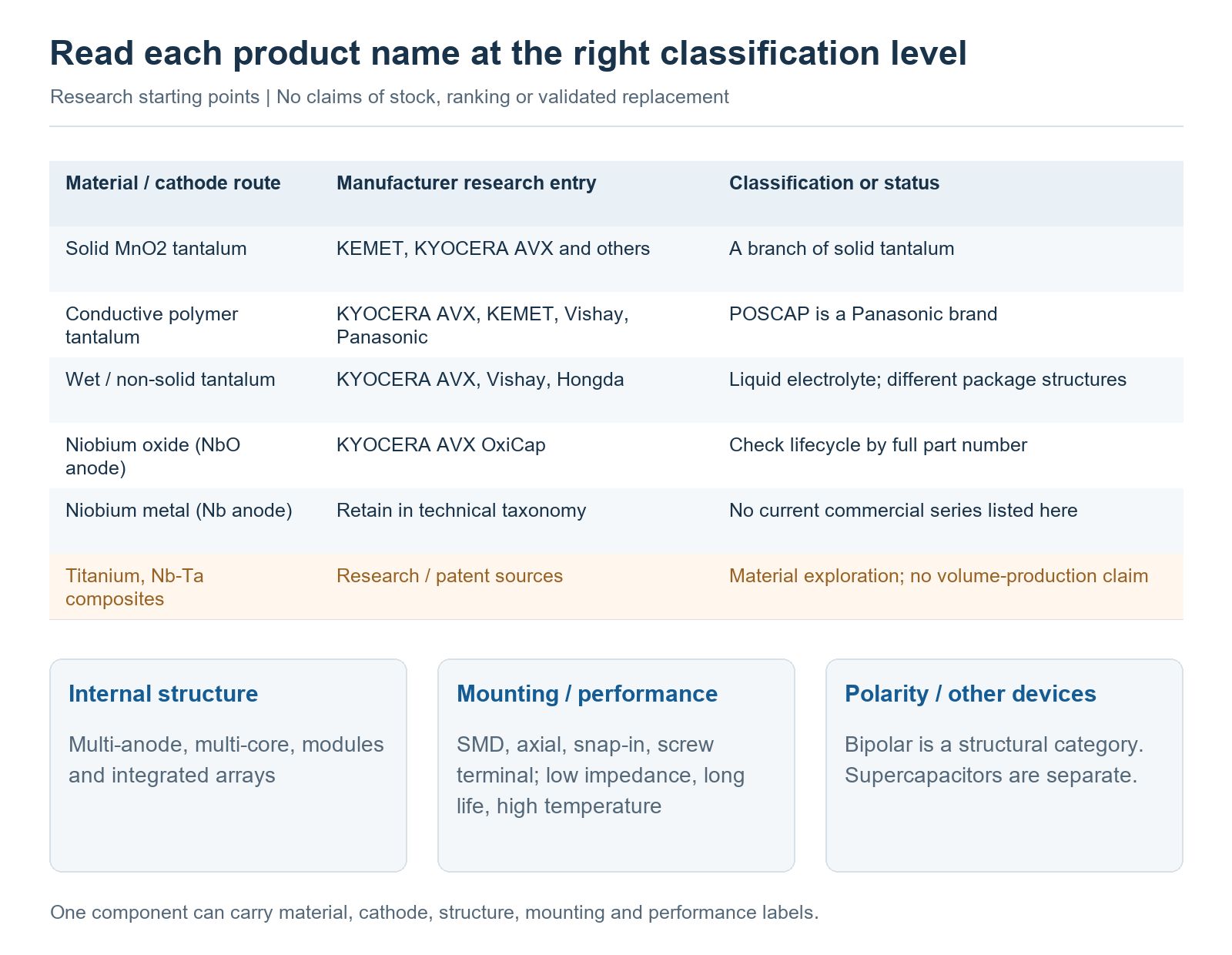
Figure 4. Material and electrolyte routes, structural terms and other classification dimensions. Manufacturer names identify research starting points, rather than stock, rankings or validated replacements.
This article draws on public manufacturer documentation, company disclosures, research and patents for industry discussion. Current specifications, lifecycle status and application limits should follow the manufacturer's current documents and project validation.