
High-Capacitance MLCCs: From Ceramic Powder to Production Yield
Two power rails, two product designs
AI server power systems use high-capacitance multilayer ceramic capacitors (MLCCs) at several points in the circuit. TDK's September 2026 introduction describes a 3225-size, 10 µF, 100 V X7R component with a low-impedance soft termination for a 48 V supply line. Viiyong has disclosed an 0805-size, 100 µF, 2.5 V component for decoupling and filtering near a low-voltage rail. The two parts occupy different electrical positions. Their nominal capacitance alone cannot indicate which one will work in the other's place.
An engineer selecting either part will check the capacitance that remains at the intended DC bias, space on the board, thermal exposure, board-bending stress and long-term electrical behavior. A good sample begins the qualification process. Production then has to hold those properties across many lots. This article follows the chain from dielectric powder and electrode paste through equipment settings, defect tracing and the product ranges of Chinese manufacturers.

Figure 1 | Public specifications from TDK's September 2026 announcement and Viiyong's 2026 disclosure. The parts serve different supply positions and voltage conditions.
1. The circuit sees effective capacitance, not a catalog number
An MLCC alternates ceramic dielectric layers with internal electrodes. To raise capacitance within a fixed package, a maker can thin the dielectric, stack more active layers or improve the material system and electrode overlap. Each route narrows the available margin for insulation, firing and long-term reliability.
A thinner dielectric raises the electric field at a given operating voltage. Powder agglomerates, pinholes in the cast ceramic tape and rough printed-electrode edges are then more likely to produce insulation faults. A higher layer count magnifies accumulated alignment errors and can reduce effective electrode area. The 100 µF low-voltage design must fit more active structure into a compact package; the 10 µF, 100 V design has to preserve voltage withstand and reliability margin. TDK's soft termination reduces stress from board flexure, while termination changes must also be checked for their effects on series resistance and high-frequency loss.
Class II ceramic MLCCs generally lose some effective capacitance under DC bias. During a processor load transient, nearby decoupling capacitors help supply current, and their remaining capacitance affects rail movement. A 48 V line brings voltage margin, impedance, temperature stability and mechanical reliability into the same selection decision. Engineers therefore need bias-capacitance curves, impedance by frequency and reliability results for the exact part they intend to use.
The production challenge is to keep those curves and insulation results within a narrow distribution, lot after lot. If the tail of the distribution is wide, a customer may add incoming inspection or reserve more electrical margin in the design. Near the low-voltage load, the capacitor also has to sit close enough to limit parasitic inductance; at the power input, voltage and board-flex performance carry more weight. A supplier earns a place on the bill of materials by delivering the complete operating-condition record, not merely a peak nominal value.
2. Powder and paste variation travels into thin dielectric layers
High-capacitance MLCCs depend on barium-titanate powder with tightly controlled particle size, purity and dispersion. Agglomerates in slurry can leave raised spots or pinholes in the green tape. Changes in firing shrinkage between powder lots can alter finished dimensions and insulation. For sub-micrometer dielectric layers, a material supplier's value lies in supporting repeatable tape casting, printing and co-firing over continuous production.
Nickel inner-electrode paste faces a related constraint. It must form a thin, complete printed pattern while leaving room for more active dielectric layers. Powder shape and dispersion, paste binder, printed-edge quality and the shrinkage match between metal and ceramic all affect the finished capacitor. An improvement to one material property can still require a fresh process qualification if it changes printing or firing behavior.
Sinocera participates on several sides of this supply chain: dielectric powder, electronic paste and zirconia beads used in grinding. Its first-half 2026 report says sales volume of MLCC dielectric powder and electronic paste increased. Powders for AI server and automotive applications were still in development and customer validation, while some capacity expansion had been completed. The company was also working with customers on pastes for high-capacitance, automotive and RF products. The practical test of this broader material portfolio is how powder dispersion and paste printing perform together in continuous casting and co-firing.

Figure 2 | Unaltered excerpt from page 10 of Sinocera's 2026 interim report. The Chinese table lists “MLCC dielectric powder” and “electronic paste” among its principal products and uses.
Boqian New Materials supplies metal powders for internal electrodes. Its first-half 2026 report describes higher nickel-based product volume and revenue, work on powder sphericity and lot stability, and evaluation of medium- and high-end specifications by domestic customers. The company also approved projects for fine classification of nanoscale nickel powder, including powder at 200 nm and below. Finer particles can support thinner electrodes, but the capacitor maker still has to validate slurry preparation, printing and co-firing with its dielectric. Variation from the ceramic and metal sides meets inside the same device.
Viiyong's prospectus reports that overseas suppliers accounted for 39.48% of its spending on core materials including paste, ceramic powder and PET release film in the first half of 2026. A new domestic material source will be evaluated alongside tape casting, printing and co-firing settings. Engineers then follow capacitance distribution, insulation, lifetime results and failure morphology over repeated lots. The opportunity for a material maker is to make this joint qualification reproducible at production scale.
3. Equipment spending shows where a line must hold precision
MLCC production moves through mixing, tape casting, printing, stacking, firing, termination, plating and testing. A defect made early can travel through several expensive steps before it is detected. Viiyong's prospectus describes 16 manufacturing processes and discloses the original cost of machinery by process at 30 June 2026. Stacking equipment accounted for about RMB 858 million, followed by firing at RMB 318 million, testing at RMB 310 million and printing at RMB 248 million. These figures describe its installed equipment at original cost; they are not current-period capital spending or a measure of technical difficulty at each step.
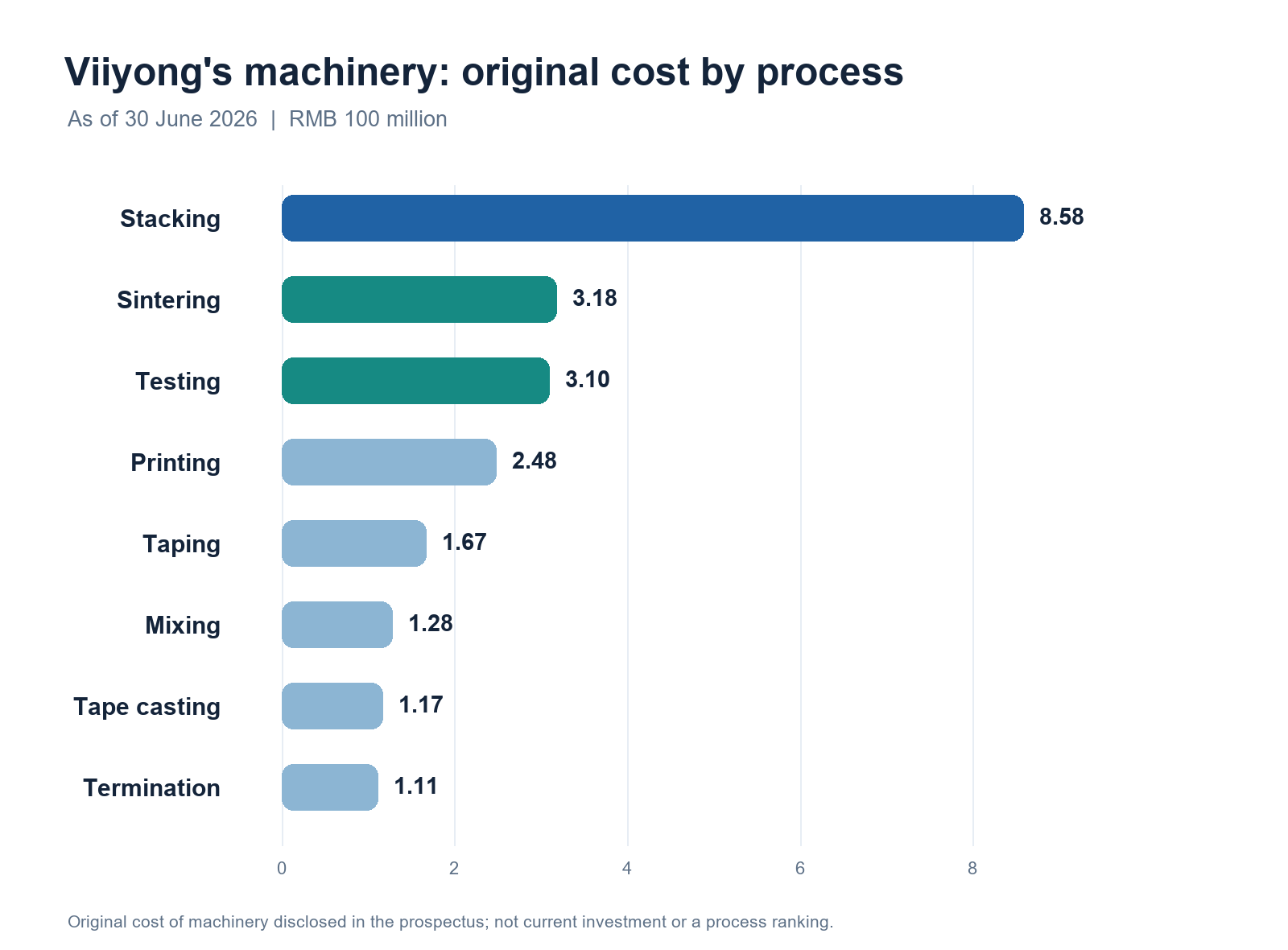
Figure 3 | Redrawn from Viiyong's September 2026 prospectus. Values are original machinery costs at 30 June 2026, in units of RMB 100 million.
Other manufacturers are at different expansion points. Fenghua said in September 2026 that the remaining Xianghe Industrial Park project had reached full operation; an earlier second-phase investment focused on small-size MLCCs had been terminated. Its existing resources were being directed toward higher-end products. CCTC's first-half 2026 report put its high-capacitance MLCC expansion project at 49.91% of planned investment as of June, with the scheduled date for usable condition moved to 31 May 2027. Both manufacturers now have to connect equipment deployment to qualified part numbers and sustained deliveries.
Sunway Communication reported batch supply of several high-capacitance MLCC specifications in its first-half 2026 report. An October investor response described improving high-end MLCC capacity and yield, with equipment purchases tied to customer demand. The immediate production work is to build stable multi-lot records for supplied parts, then extend the line to larger ultra-high-capacitance specifications.
Line accuracy must persist through long runs. A stacker compensates for green-tape expansion and printed-pattern distortion. Furnaces have to control atmosphere and temperature across different loads and positions; testers have to identify electrical faults at high throughput. Powder or paste changes may call for a new equipment setup. Plants therefore track film-thickness distribution, electrode coverage, alignment, restart drift and maintenance recovery time. A machinery supplier that stays involved during trial production and fault tracing is better placed to convert nominal machine precision into usable output.
4. Yield improves when a failed part can be traced back
Pinholes can form during tape casting and show up later as insulation faults. Insufficient lamination pressure may create internal separation that becomes visible only after firing or temperature cycling. Figure 4 places these defects within a simplified multilayer structure and points to the records an engineer would review.

Figure 4 | General MLCC process schematic showing possible defect locations and trace-back steps. It does not describe the defect rate of a named company.
Viiyong's prospectus indicates that yield is still being improved for some advanced high-capacitance products. The useful measure for customers is the joint improvement of saleable output and long-term reliability, observed over consecutive lots.
Specialty ceramic-capacitor makers bring experience with demanding environmental requirements. In a recent investor response, Zhenhua Technology listed high-voltage, pulse, high-Q and flexible-termination MLCC ranges for applications including aerospace. It also said its MLCC business had not yet reached scale in AI applications. A move into server power would bring DC-bias behavior, high-volume consistency and cost into a new qualification process.
Torch Electron reported about RMB 832 million in revenue from its self-manufactured components in the first half of 2026; civilian products represented 63% of that broader segment, which includes ceramic capacitors. Its own MLCCs serve both specialty and civilian applications. A subsidiary cited in its report focuses on resistors. Hongyuan Electronics reported about RMB 415 million in ceramic-capacitor revenue over the same period, down 22.56% year on year. It completed development of an ultra-high-voltage multilayer ceramic-capacitor series and continued research on nickel-electrode products for space applications. These companies have useful design, screening and qualification experience, though each application still requires its own production evidence.
When final testing finds an insulation anomaly, a plant can link it to the furnace run, powder lot, tape thickness, printing settings and stack position. Engineers then monitor electrical screening, temperature cycling, lifetime tests and the number of saleable parts. Server and automotive customers will ask for reliability records from multiple production lots. Those records also help a manufacturer extend a stable process to adjacent voltage and package specifications.
5. Chinese product portfolios have to scale across part numbers
Viiyong reported 110 patents, including 37 invention patents, at 30 June 2026. Its prospectus also describes stacking beyond 1,200 layers and batch supply of certain industrial high-capacitance specifications. That combination shows an engineering platform beginning to produce deliverable part numbers. The question for each new package and voltage is how much of the validated process can be carried over.
Fenghua is shifting its existing lines toward a higher-end MLCC mix. Companywide revenue in the first half of 2026 was about RMB 3.50 billion and net profit attributable to shareholders about RMB 290 million, up 74.01% year on year. Its September investor record says high-capacitance, automotive and medium- to high-voltage MLCCs together represented about 40% of MLCC revenue, while new products were passing customer qualification. That 40% is the combined high-end group. Broadening the catalog for server power and automotive electronics will require stable delivery across voltage ratings, temperature grades and termination structures.
CCTC combines ceramic-material and component-manufacturing capabilities. Its 2025 annual report lists high-capacitance MLCCs in multiple sizes, products for 48 V power systems, and an automotive range from 0201 to 2220. Companywide first-half 2026 revenue was RMB 6.423 billion and attributable net profit RMB 1.932 billion, the latter up 56.18% year on year. Its high-capacitance expansion project was still under construction, so the product portfolio and the added capacity will meet at a later commissioning stage.
Sunway's first-half 2026 report says multiple high-capacitance specifications are already supplied in batches to leading domestic customers. The company cited more than 60 related patents, while larger ultra-high-capacitance products had completed core technical validation. As additional parts enter customer circuits, bias-capacitance curves, lot distribution and long-term reliability records will determine how far that line can expand.
The three manufacturers are working at different production points: Fenghua is adjusting installed capacity, CCTC is constructing a high-capacitance expansion, and Sunway is widening a set of supplied part numbers. Their next specifications will be judged on working voltage, temperature, termination and multi-lot yield. Reusing material recipes, machine settings and failure-analysis methods across adjacent parts can shorten development time.
Zhenhua, Torch and Hongyuan have accumulated experience in reliable ceramic devices. Sinocera and Boqian control material inputs to the dielectric and internal electrode. The next product advance has to bring those inputs together inside one component that performs consistently in a customer's circuit at an acceptable production cost. Raising rated voltage within a fixed package, adding a soft termination or changing a powder lot each creates a fresh set of measurements. Stable performance and repeat orders will show which process improvements have carried through to production.