China's Film Capacitor Suppliers Expand, but Margins Diverge
China's film capacitor industry now offers several routes for buyers seeking suppliers: established component specialists, manufacturers extending from dielectric materials, diversified capacitor groups and companies developing custom power-electronics assemblies. The practical question is how those capabilities translate into qualified products, repeat deliveries and sustainable returns.
Film capacitors use plastic-film dielectrics for functions such as filtering and DC-link support. Requirements differ substantially between appliances, electric vehicles, solar and storage converters, and grid equipment. Voltage, temperature rise, lifetime and packaging constraints influence both engineering effort and the economics of an order.
First-half 2026 results show why revenue alone is an incomplete guide. Faratronic's revenue rose 10.58%, while net profit attributable to shareholders rose 2.23%. Shengye Electric reported revenue growth of 32.38%, but attributable net profit fell 64.35%. These are company-wide figures, and Shengye's results also reflect acquisition-related consolidation. They cannot serve as a direct comparison of film-capacitor profitability, but they establish the need to examine what sits behind growth.
1. Applications create different commercial requirements
Appliance and general-electronics customers prioritize cost, batch consistency and dependable delivery. Automotive drives, solar inverters and storage converters need DC-link and filtering performance within simultaneous thermal, ripple-current, space and lifetime constraints. Grid and industrial equipment bring their own voltage levels, duty cycles and project qualification requirements.

Figure 1. Application and business-analysis schematic. Categories overlap and do not represent market shares.
Expanding end markets do not remove competition, price pressure or changing input costs. Automotive programs can provide volume and strong purchasing pressure at the same time. An industrial customer's orders may be smaller, while application-specific experience can help a supplier defend its pricing.
Eagtop's June 2026 IPO filing illustrates this variation. For 2025, it reported gross margins of 8.78% in new-energy vehicles, 22.40% in wind power, solar and storage, and 30.39% in industrial automation. These application categories include capacitors, inductors and busbars. They are not industry margins for automotive film capacitors. They do show why participation in a growing application does not automatically deliver better returns.
Evaluating demand therefore requires attention to both additional sales opportunities and the profit a supplier can retain. Vehicle sales, storage installations and capacity announcements describe only part of that picture.
2. The supplier base extends beyond the largest familiar names
The following 13 companies or business groups represent the principal samples reviewed. They are grouped by business direction, not ranked by size. Parent companies and relevant subsidiaries are shown together; planned capacity is not treated as established supply capability.
| Supplier or business group | Position and points to assess |
|---|---|
| Faratronic | A film-capacitor specialist covering PCB, AC and power-electronics products, with in-house metallized-film and busbar capabilities. Assess scale, product mix and profit growth together. |
| Jianghai / Xinjianghai Power | Expanding film capacitors alongside aluminum electrolytics, with separately disclosed film-capacitor revenue. Assess the durability of its gross-profit contribution. |
| Tongfeng Electronics | Operates both electronic-grade film materials and capacitors. Analyze the two businesses separately before assessing integration benefits. |
| Eagtop | Combines film capacitors with inductors and busbars for automotive, renewable-energy and industrial applications. Custom engineering, customer concentration and project returns matter. |
| Shengye Electric | Combines film capacitors and power-quality solutions, including motor and power-electronics applications. Its 2026 acquisition of Huajia New Materials extends its materials presence. |
| Wangzi New Materials / Ningbo Xinrong | Addresses power-electronics and specialty applications, with custom development and metallization capabilities. Cost improvement following revenue expansion is a key issue. |
| Aihua Group / Aiyuanda and Aihua New Power | Developing film capacitors as a second core business, including production lines and automotive customer introduction. Construction, ramp-up and realized results remain distinct stages. |
| Hongfa / Hongfa Wufeng | Covers appliance, renewable-energy, power-electronics and automotive film capacitors. Group financial performance does not establish the profitability of this business. |
| Gree Xinyuan | Gree's electronic-components platform includes metallized-film capacitors for appliance and renewable-energy applications. Assess the expanding portfolio alongside actual customer mix. |
| Foshan Xinyuan / Sunstone Development | Has a capacitor business that should be separated from the parent's prebaked-anode and battery-anode-material activities. |
| Sun.King | Offers DC-link, AC-filter, shunt and pulse capacitors. Grid and power-electronics applications provide relevant comparison points. |
| CRE | Recent product presentations address automotive, solar, storage and industrial drives. Displays establish portfolio direction, not customer volume production or revenue. |
| Anhui Safe | Works on film capacitors and metallized film, with research into coating, failure mechanisms and equipment. Research progress and commercial supply scale require separate evidence. |
Based on 2026 interim reports, Eagtop's IPO filing and recent institutional materials. This is a reviewed sample, not an exhaustive list of Chinese manufacturers.
These businesses follow different paths: scaling a specialist capacitor operation, moving from materials into devices, entering from other capacitor categories, or engineering around a customer's system. Samples, design wins, production starts and sustained profitability are separate milestones. Treating all of them as completed import substitution obscures the investment still needed.
3. System integration and materials capability require separate assessment
Automotive film-capacitor development involves packaging, busbars, current distribution and heat removal. Eagtop's recent filing describes laminated busbar structures intended to reduce parasitic inductance and improve current and heat distribution among capacitor elements. That is evidence of work at the system-integration level, beyond general-purpose capacitor manufacture.

Figure 2. English conceptual summary based on Eagtop's June 2026 prospectus: film capacitors, boost inductors and busbars are related product areas in automotive power electronics. This diagram is not a wiring schematic or a confirmed customer BOM.
Materials capability needs a finer distinction. Base dielectric film, metallized film and finished capacitors involve different processes. Having metallization equipment does not establish self-sufficiency in every base film. Acquiring a materials company does not mean that all demanding products can immediately switch to its output.
Faratronic reports in-house metallized-film and busbar capabilities. Tongfeng operates in both electronic-grade film materials and capacitors. Shengye has extended into materials through acquisition. These approaches can improve control over supply and costs, but the practical benefit depends on product validation, yields and production economics.
For customers, internal materials production matters through measurable results: performance within a given volume, consistency between batches and behavior over extended operation. Building a production line is one step toward those outcomes.
4. Similar revenue can produce very different gross margins
In the first half of 2026, Jianghai's film-capacitor business generated approximately RMB311 million in revenue at a 15.21% gross margin. Tongfeng's disclosed capacitor category generated about RMB302 million at 20.48%. Wangzi's film-capacitor products generated about RMB305 million at just 0.32%.
The product mixes are not identical. Nevertheless, the figures show markedly different gross returns at similar revenue scale in the same reporting period.
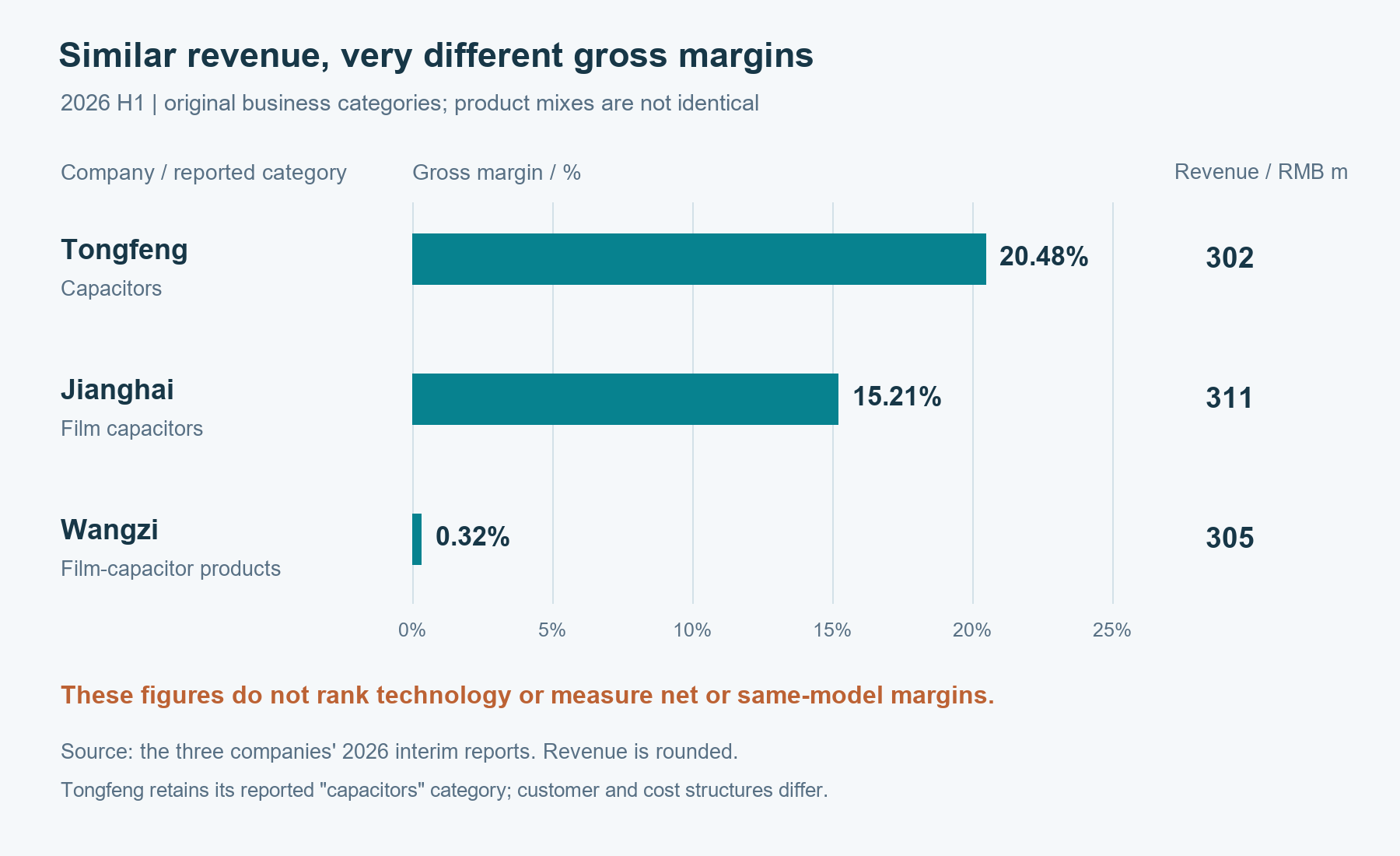
Figure 3. Reported first-half 2026 business figures. Tongfeng retains its original “capacitors” category. Gross margins are not net margins, same-model margins or a ranking of technology.
Jianghai's film-capacitor revenue grew 33.56% year on year but still represented only 9.88% of company revenue. Total capacitor revenue would therefore overstate the scale of its film business. At Wangzi, film-capacitor revenue rose 21.11% while related costs increased 31.35%. Costs outpaced sales, limiting the conversion of growth into gross profit. This table alone cannot attribute the result entirely to pricing pressure or a production ramp.
Tongfeng reported a 13.13% decline in capacitor revenue and a 6.01% decline in electronic-grade film-material revenue. The materials business nevertheless had a 29.85% gross margin, above the capacitor business's 20.48%. The company cited competition and raw-material cost pressure. Businesses in adjacent parts of the same supply chain can experience different profit trends.
Company-level net profit adds further variables. Faratronic reported first-half revenue of RMB2.764 billion and attributable net profit of RMB582 million. Net finance income in the prior-year period became a finance expense, mainly because of foreign-exchange losses, according to its report. Slower net-profit growth does not by itself establish a sharp deterioration in product gross margins.
Shengye's revenue growth included acquisition consolidation, while its overall gross margin fell from 24.00% to 19.63%. Order growth alone cannot explain the result. Eagtop has also described changes to profitability requirements when accepting orders and adjustments to customer mix as measures to improve automotive returns.
The commercial questions are specific: whether prices cover materials, manufacturing and project work; whether greater scale improves unit costs; and whether customer concentration limits bargaining power. Shipment growth is insufficient to distinguish suppliers on these issues.
5. Overseas product developments provide specific benchmarks
Recent international product launches offer useful comparison criteria. TDK's B3272*A/G/T series, announced in September 2026, uses a mixed polypropylene and cyclic olefin copolymer dielectric. It supports continuous case temperatures up to 135°C, with no voltage derating required up to 105°C. The 135°C figure must not be read as permission to operate at rated voltage throughout that temperature range. SPICE models and CLARA lifetime-calculation support accompany the series.
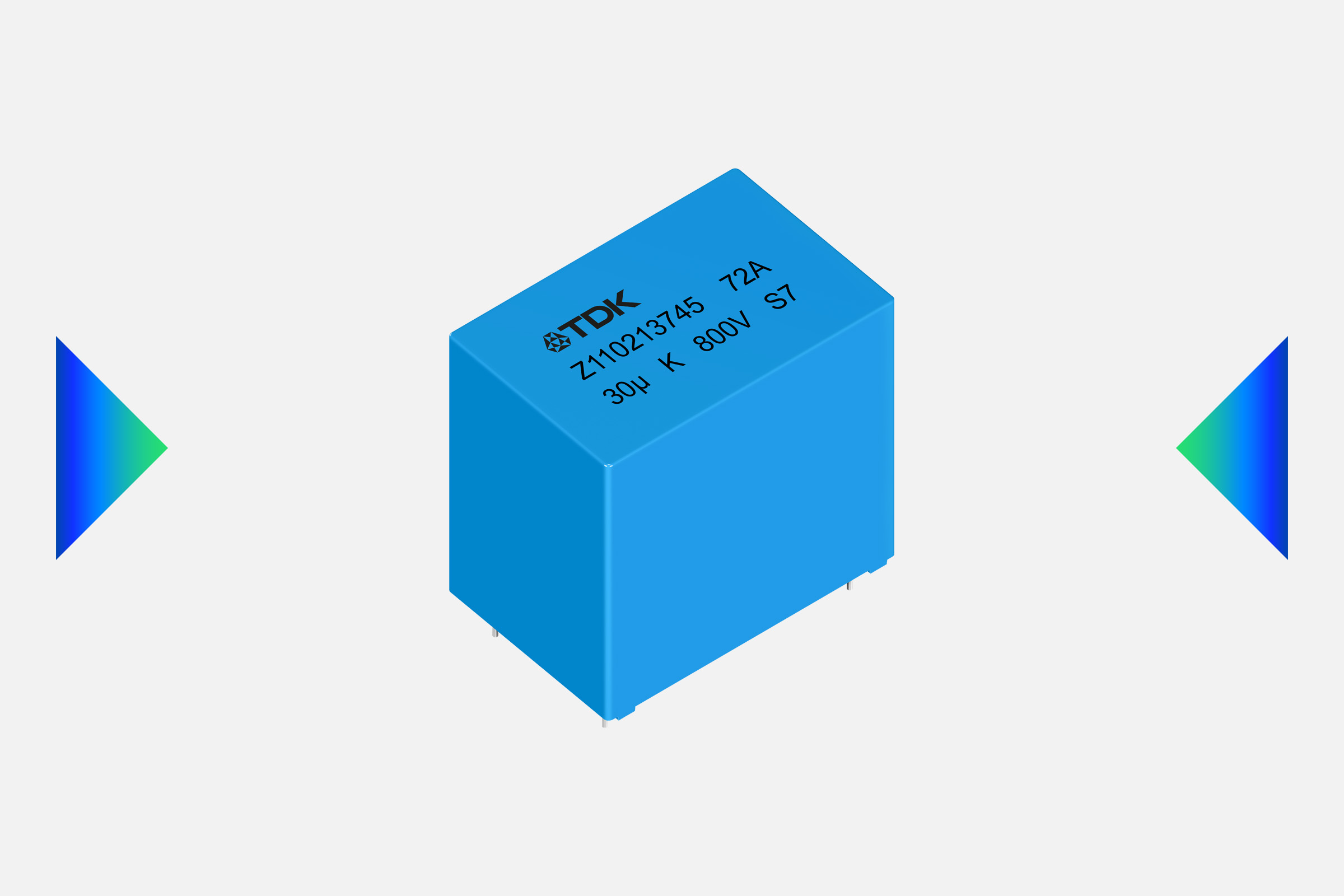
Figure 4. Official TDK product image from its September 30, 2026 announcement. Ratings must be checked against the selected device and its operating conditions.
The relevant comparisons involve materials that extend the operating-temperature range, ratings linked to derating and lifetime conditions, and usable design models. A single maximum-temperature or minimum-inductance claim cannot establish equivalent performance.
Panasonic's 2026 activity illustrates product-family development. After introducing EZPV-D in April, it added 600 V versions in May and 1,000 V and 1,100 V versions in July. Broadening a family gives customers more options across equipment platforms.
Assessment of Chinese suppliers should follow their stage of development. Companies with automotive packaging and materials-processing capability can be compared on temperature rise, lifetime and consistency under matched conditions. Suppliers introducing products to customers still need to demonstrate volume delivery. Those addressing overseas customers also need repeatable validation documentation, selection support and technical service.
These are evaluation criteria drawn from the available materials. They do not establish that all Chinese manufacturers lack the capabilities, or that overseas film-capacitor suppliers necessarily earn higher gross margins.
6. Repeatable commercial results will distinguish the next group of leaders
For Faratronic, the issue is maintaining returns as scale grows. Jianghai's film expansion needs to make a durable contribution. Tongfeng faces competition in both materials and devices. Custom businesses such as Eagtop and Ningbo Xinrong depend particularly on cost control, customer mix and the profitability of products after introduction.
Aihua and other expanding suppliers must bridge production-line construction, qualification and commercial scale. Specialists such as Sun.King, CRE and Anhui Safe should be assessed through their applications and technical work, rather than dismissed because comparable financial disclosures are limited.
Three outcomes offer a useful basis for tracking progress: new products becoming repeat deliveries; revenue growth producing gross profit and cash; and a technical platform serving more customers. These reveal more about commercial development than the number of new catalog entries or announced production lines.
China has developed a broad film-capacitor supplier base. The next distinctions will become clearer as material and structural advances turn into consistent products, customers adopt them repeatedly, and manufacturers retain sufficient profit under continuing cost-reduction demands.
Information cutoff: October 22, 2026. Financial figures mainly cover the first half of 2026. Eagtop's application-level margins refer to 2025 and were disclosed in June 2026.