Chinese Bridge Rectifier Suppliers: Lower Losses, Manufacturing Costs and Margins
For engineers and buyers evaluating Chinese rectifier suppliers, a broad catalogue is only the starting point. A bridge must meet the power supply's thermal limits, survive startup stress and fit the intended assembly process. The supplier must then reproduce that performance across production batches at an acceptable cost.
Recent Chinese disclosures offer evidence of progress at different stages: a low-forward-voltage planar bridge project has reached mass production, while a new thermally optimized package remains in development. These developments matter even in a mature silicon device category. Their commercial value, however, depends on the customer's circuit architecture and the manufacturer's ability to turn design improvements into reliable output.
1. Power supply architecture determines the opportunity
A rectifier diode is an individual device; a conventional single-phase bridge integrates four diodes in a bridge connection. Current normally passes through two series-connected diodes, so their forward-voltage drops add along the conducting path.
Conventional bridges remain relevant to appliances, adapters and industrial power supplies. As designs become more compact, heat that was once manageable can constrain component placement. Less board area and heat from adjacent power devices make the bridge's mounting arrangement and thermal path more consequential.
Lower forward voltage and better packaging can help. Yet growth in electric vehicles, solar, energy storage or computing power supplies cannot be converted directly into a forecast for ordinary bridge rectifiers. The front-end topology determines which devices are required.
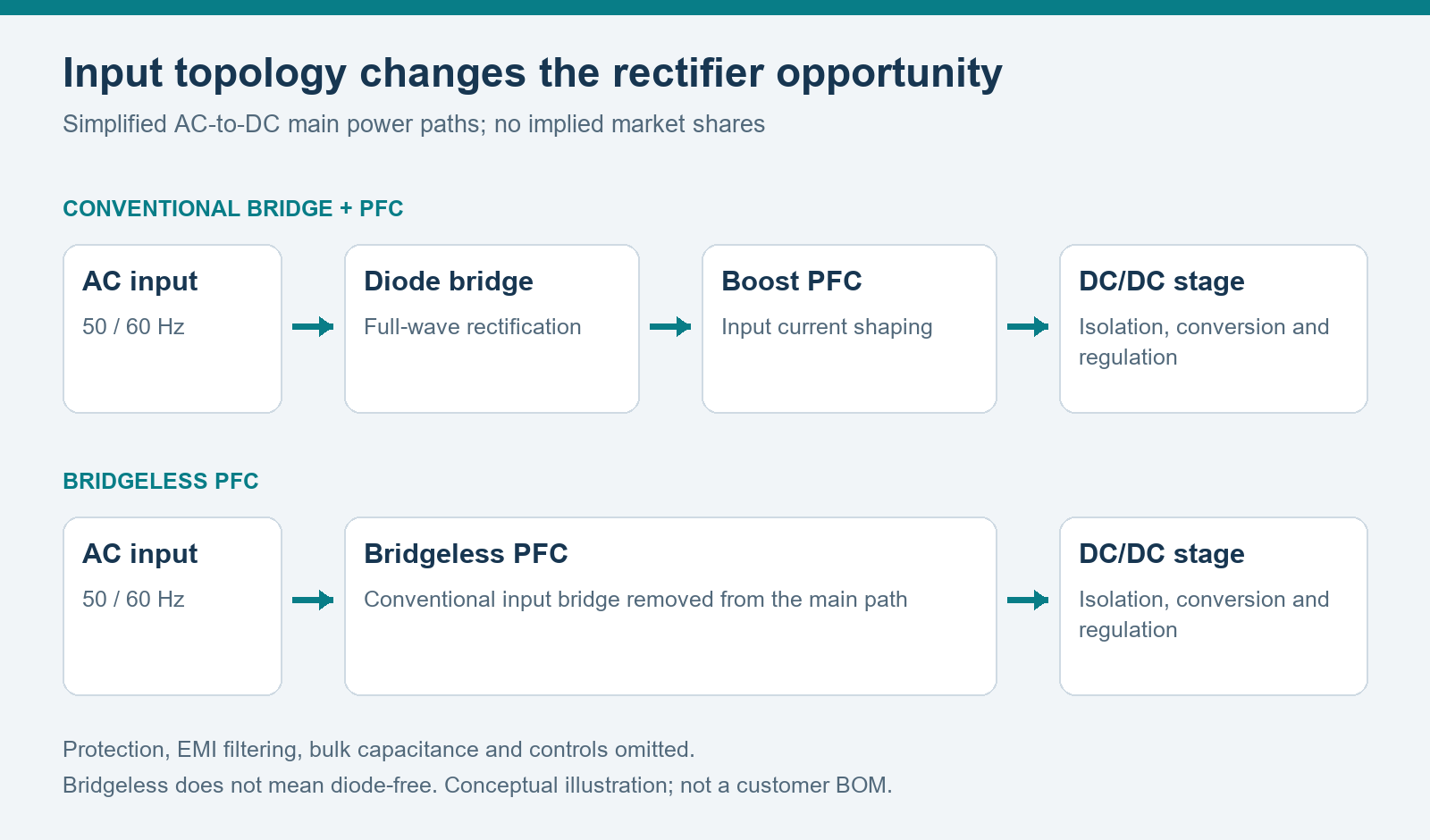
Figure 1. Simplified main power paths. Protection, EMI filtering, bulk capacitance and controls are omitted. Bridgeless does not mean that a circuit contains no diodes. This diagram is not a customer bill of materials.
A conventional bridge-PFC design retains the input diode bridge. A bridgeless PFC topology changes that path and may create opportunities for other switching, rectifying or protection devices. Assessing a supplier's exposure therefore requires evidence about the customer's architecture and the products actually supplied.
The circuit position also matters when comparing diodes. Line-frequency input rectification and high-frequency rectification or freewheeling place different demands on recovery behavior. Similar voltage and current ratings alone do not make two devices suitable for the same task.
2. Chinese suppliers offer different manufacturing strengths
For overseas readers, the following seven manufacturers provide a useful, verifiable sample of China's rectifier supply base. Their recent disclosures cover product portfolios, production integration and customer qualification, rather than a common measure of market share.
| Manufacturer | What recent materials support | What buyers should evaluate |
|---|---|---|
| Yangjie Technology | Rectifier devices and dies, packaged products, application support and manufacturing coordination | Coordination between die, package and application engineering; production efficiency |
| Suzhou Good-Ark Electronics | Rectifier dies, miniature bridges, and discrete/IC assembly and testing | Assembly processes, product families and OEM capabilities; separation of semiconductor and materials results |
| WeEn Semiconductors | A mass-produced project for 15 A and 25 A low-forward-voltage planar bridges in GBU packages | Integration of die structure and leadframe soldering; production cost after ramp-up |
| Perfectway | May 2026 listings for bridge products including GBU2508L and GBJ2508L | Complete test conditions, package details and product-specific supply status |
| Jiangsu Changjing Electronics (JSCJ) | Rectifier diode and bridge families presented in July 2026 | Portfolio fit and the commercial status of individual devices |
| Jiejie Microelectronics | Rectifier diodes and bridges; a full-chain IDM model for diode and protection product lines | Integration efficiency within the relevant product line |
| Galaxy Microelectronics | Power diodes and bridges; disclosed design wins and volume supply for some automotive bridges | Customer qualification and conversion of new package development into shipments |
Table. Based on recent company materials, 2026 interim reports and regulatory disclosures. This is a selected supplier sample, not a complete national directory or a revenue ranking.
Broader portfolios may allow a supplier to offer several devices to one customer. Manufacturing integration may help translate die and package changes into consistent production. Neither advantage removes the need to compare the actual operating current, voltage, temperature rise and mounting method.
Perfectway's listings identify candidate parts, but the recent entries reviewed do not supply complete electrical test conditions. Specifications cannot be inferred from a suffix. Similarly, JSCJ's portfolio presentation establishes product coverage without establishing purchasing volumes or mass-production status for every series.
3. Lower forward voltage reaches production; packaging work continues
A verification opinion published in July 2026 identifies WeEn's 15 A and 25 A GBU low-forward-voltage planar bridge project as in mass production. The disclosed work includes leadframe soldering, planar termination structures and passivation processes.

Figure 2. English summary of the project entry on page 62 of the July 2026 verification opinion. The source identifies product scope and project status, but does not provide complete forward-voltage curves for a comparison between suppliers.
The improvement spans both die and package. Die structure affects electrical behavior, while interconnections and packaging influence current flow, heat removal and manufacturing. A lower voltage drop can ease thermal constraints if the benefit persists at the customer's operating current and temperature.
A hypothetical calculation illustrates the scale. Assume each conducting diode's forward drop falls by 0.1 V at the same operating conditions. The two-diode path then loses 0.2 V less. At an average current of 2 A, treating the drop as approximately constant, conduction loss falls by about 0.4 W. This is an illustrative calculation, not a measured saving for a particular product. A capacitor-input circuit requires calculation using its pulsed current waveform.
Galaxy's 2026 interim report places a thermally simulated, high-performance GBJ package project in the R&D stage, with objectives involving thermal paths, internal resistance and reliability. That status is compatible with shipments of existing bridges: current products and a new package project are separate matters.
For customers, the relevant results are temperature rise, heatsink requirements and usable board space. A mass-production disclosure establishes development progress; product-specific validation establishes whether the improvement solves a particular design problem.
4. Compare ratings together with their conditions
The January 2026 datasheet for Diodes Incorporated's GBU25L08 provides a concrete international reference. It specifies an 800 V repetitive peak reverse voltage and a 25 A average rectified output-current rating with a heatsink. The maximum forward voltage is 0.90 V at a test current of 12.5 A and a junction temperature of 25°C.

Figure 3. Page 2 of the original Diodes GBU25L08 datasheet, January 2026 revision. Current ratings, forward voltage and surge capability use different conditions; thermal values include mounting notes.
The same page gives two non-repetitive surge ratings for a single half-sine pulse at an initial junction temperature of 25°C: 400 A for 8.3 ms and 800 A for 1 ms. The shorter pulse permits a higher current rating. Comparing its 800 A figure with another device's 8.3 ms rating would compare different stresses.
Thermal conditions also govern current capability. The datasheet distinguishes heatsink and non-heatsink arrangements in its thermal information and derating treatment. A 25 A rating is not a promise of continuous 25 A operation on any PCB. Rated output current, actual application current and the current used to test forward voltage are distinct quantities.
Chinese suppliers have broad bridge coverage and disclosed low-forward-voltage production projects. Those facts do not establish overall performance leadership or drop-in compatibility. Such judgments require matched current, temperature, thermal and surge conditions, followed by evaluation of batch consistency and delivery performance.
5. Financial results need the right business scope
WeEn's July 2026 verification opinion reports a 24.66% gross margin for its power diode category in 2025. That category includes several types of power diode; it is not a bridge-rectifier-only margin. It nevertheless demonstrates that mature silicon devices can support a profitable business.
Suzhou Good-Ark's 2026 first-half results illustrate why consolidated figures need care. Group revenue was approximately RMB 2.573 billion. Semiconductor revenue was about RMB 508 million, or 19.76% of the total, while new-energy materials generated about RMB 2.038 billion, or 79.22%.

Figure 4. Year-on-year growth calculated from the underlying revenue amounts in Good-Ark's 2026 interim report: 29.10% for the group and 10.22% for semiconductors. Group revenue includes the semiconductor business; these growth rates cannot be added.
Consolidated growth reflects a business mix that includes materials, devices and assembly/testing. It cannot all be attributed to bridge upgrades. An assessment of rectifier economics needs the revenue, costs and product mix of the relevant operation.
Customers may value a supplier that meets thermal limits in the available space, reduces assembly problems and maintains consistency. The resulting price and margin still depend on order volume, bargaining power, material costs and manufacturing performance. The disclosures reviewed do not quantify a price premium for these improvements.
Working capital adds another constraint. Galaxy describes inventory risk associated with many specifications, small batches and customized products. Customer schedule changes, cancellations or product transitions may leave stock that requires impairment. This is a disclosed risk, not evidence that a particular loss has already occurred. Production and purchasing plans must remain aligned with customer demand for an order to produce an attractive return.
6. Manufacturing integration must improve yield and unit cost
Rectifier costs include dies, leadframes, joining materials, molding, processing, testing and manufacturing overhead. A smaller die can save material while changing current density and thermal behavior. Changes to the leadframe or joining process must also satisfy electrical, mechanical and production requirements.
Yangjie's 2026 interim report describes R&D support across dies, packages and applications, alongside measures to reduce defects and improve manufacturing consistency and efficiency. For a mature product supplied repeatedly, fewer rejects, less rework and lower quality losses can make a meaningful cost difference.
Jiejie identifies a full-chain IDM model for its diode and protection lines. Integration can help coordinate design and manufacturing, but investment must still be supported by productive capacity and a suitable order mix.
WeEn's verification opinion describes higher allocated unit costs for some power diodes during the ramp-up of in-house packaging capacity. Bringing a process inside the company does not eliminate ramp costs. Higher qualified output and a stable process are needed before that investment can improve unit economics.
For overseas buyers, the Chinese supply base offers multiple candidates for conventional rectifiers and bridges. Qualification should connect the device's thermal and mounting performance with the supplier's production consistency and ability to deliver at an acceptable price. For manufacturers, lower forward voltage helps win consideration; die design, packaging and production execution determine whether those opportunities become repeat orders and sustainable profit.