China's inductor industry spans distinct products and competitive positions
For international engineers and buyers assessing Chinese inductor suppliers, the application is a better starting point than the industry label. Smartphone miniaturisation, AI server power delivery and automotive electronics all create demand, but they call for different manufacturing capabilities and economics. RF circuits need controlled high-frequency losses, processor power rails must accommodate changing current, and automotive cameras require impedance performance across a broad frequency range as well as long-term reliability.
Chinese suppliers have developed several routes into these markets. Some operate across materials and manufacturing processes; others extend from magnetic powders and cores into finished inductors, or specialise in custom magnetic components. Their competitive positions depend on the circuit served, the ability to deliver consistently, and the financial returns from new business.
Circuit requirements distinguish RF, power and automotive applications
Even within a smartphone, RF and power inductors perform different tasks. RF inductors support matching and filtering, where quality factor, self-resonant frequency and losses within the operating band affect performance. A smaller package saves space, but that advantage may not secure a design win if high-frequency performance deteriorates.
Power inductors contribute to energy storage and current regulation. DC resistance affects conduction loss; core loss depends on operating frequency and magnetic-flux variation. Inductance retention under increasing current and acceptable temperature rise both matter to a power design. AI servers add pressure for higher current, power density and response to dynamic loads.
The applications overlap. Smartphone processors also require power inductors, while servers contain communication and signal-processing circuits. Treating all consumer electronics as low-end and all server components as high-end hides differences within each system.
Manufacturing terms are not performance rankings either. Wirewound, multilayer and moulded describe processes, whereas RF, power and electromagnetic compatibility (EMC) largely describe uses. Moulded inductors can serve several end markets, and multilayer construction is not limited to one function. Current, frequency, size, loss and cost determine the appropriate trade-off.

Figure 1. An application guide based on Sunlord's first-half 2026 report and recent international manufacturer materials. The rows describe different circuit requirements, not an upgrade or substitution sequence.
End-product shipments alone therefore cannot explain the inductor market. Smartphones and wearables emphasise functionality within limited space; AI server power delivery stresses efficiency and response at high current; automotive electronics combine power, signal-integrity and reliability requirements. Suppliers winning orders in these markets may need entirely different production lines.
Chinese suppliers combine broad platforms, materials expertise and custom magnetics
China's supplier base includes listed groups and specialist manufacturers. Their business boundaries are more informative than a single league table.
| Supplier or business | Inductor-related activities | Business characteristics |
|---|---|---|
| Sunlord Electronics | RF, signal and power products across materials and processes | Broad coverage requiring process coordination and manufacturing scale |
| Microgate Technology | Wirewound, multilayer, moulded and TLVR products | Smartphone and computing applications; group also includes RF and display businesses |
| Fenghua Advanced Technology | Chip inductors, EMI components and moulded inductors | Miniaturisation and automotive moulded products; new processes introduced in stages |
| POCO | Metal soft-magnetic powders, powder cores and AI-chip power inductors | Materials capabilities extending into finished devices, with internal use and external sales |
| Longci Technology | Magnetic materials and chip inductors | New inductor business entering volume delivery and production ramp-up |
| Mentech | Power and communication magnetics, including inductors and transformers | Product mix shaped by customers' power architectures and custom requirements |
| Zhenhua Fu | Chip-inductor business within Zhenhua Technology | Component development and manufacturing carried out by a subsidiary |
| Yuechen Technology, formerly Cenker | Power, high-frequency and common-mode components, plus transformers | Products for energy storage, EMC and RF functions |
| Jinlai Technology | Moulded and power inductors, transformers and other magnetics | Moulded and wirewound products, including custom manufacturing |
This is a non-exhaustive view of mainland Chinese suppliers based on recent disclosures and company business information. It is not a market-share ranking. Group revenue is not equivalent to inductor revenue.
Sunlord and Microgate both extend their platforms in response to different end-market needs, but their portfolios and commercialisation stages are not interchangeable. Sunlord's first-half report describes multilayer, wirewound and several forming processes. Microgate also operates RF-device and display businesses, which must be separated from inductors when interpreting group performance.
Fenghua's April 30 disclosure illustrates different stages within one company. Its 155°C automotive-grade moulded inductors had reached volume supply, while a hot-pressed TLVR technical solution had received customer recognition. These statements describe different manufacturing and customer-adoption stages, rather than volume production across all advanced inductor products.
POCO and Longci offer a materials-to-device perspective. Formulations, powder processing and core manufacturing can support inductor production, but finished devices also require conductors, insulation, forming, packaging and circuit compatibility. Materials expertise is one part of the capability; performance under the customer's operating conditions remains decisive.
Mentech, Jinlai and other suppliers broaden the landscape to power and custom magnetics. Their businesses depend on customers' power architectures, installation space and manufacturing coordination. Transformers, magnetic cores and finished inductors nevertheless need separate accounting; combining them would distort comparisons of supplier size and industry concentration.
AI power delivery creates opportunities at different commercial stages
The additional demands of AI servers originate in their power systems. When a high-performance chip's load changes rapidly, the regulator must adjust its output. Multiphase power delivery distributes current across phases, while inductor losses, magnetic paths and winding structures affect efficiency and dynamic behaviour. Trans-inductor voltage regulation, or TLVR, uses coupled inductors and associated circuitry to improve transient response, adding constraints to component design.
TLVR and vertical power delivery describe different aspects of a system. TLVR concerns regulator topology and coupling; vertical delivery concerns the power path and physical arrangement. Neither term establishes that every AI server uses the same inductor or that component value per system can be generalised from one platform.
POCO's first-half 2026 report states that TLVR accounted for more than 30% of its AI-chip inductor sales revenue. The denominator is that business alone. This indicates a change in its product mix, not a 30% contribution to total group revenue or a global market share.
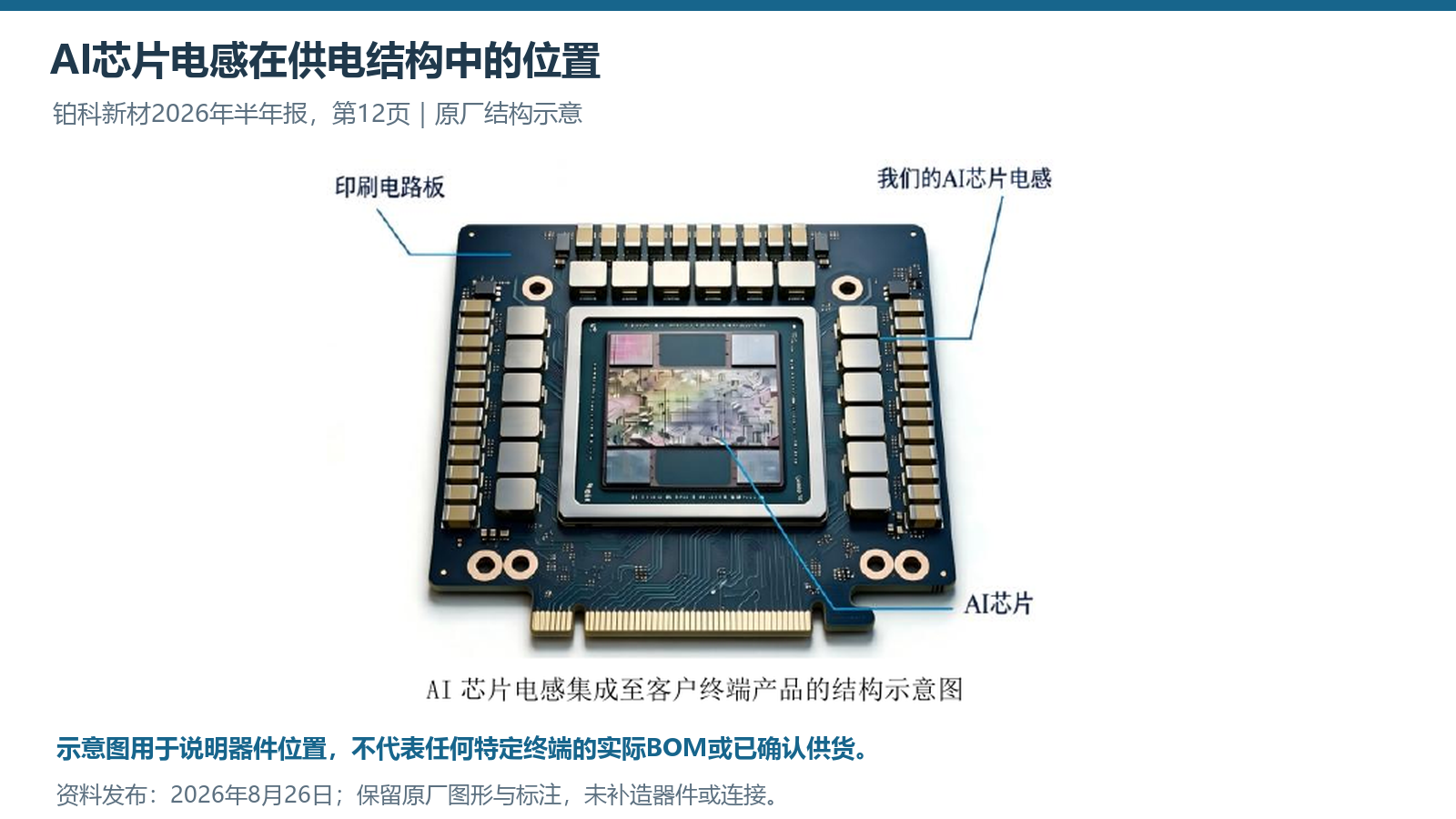
Figure 2. Original structural illustration from page 12 of POCO's first-half 2026 report. The Chinese graphic is preserved. Reading guide: the labels identify the printed circuit board, POCO's AI-chip inductors and the central AI chip. It illustrates device placement, not a verified bill of materials or supply relationship for a particular end product.
Microgate's first-half report describes its MTVM TLVR series as having completed sample development and undergoing customer production-line testing. Longci's investor record disclosed on October 30 states that relevant chip-inductor products had completed customer validation and were gradually entering volume delivery, with scale increasing as production ramped.
The disclosures come from different dates and cannot establish a current ranking between the companies. They do show how much the phrase “AI inductor investment” can encompass. Samples demonstrate technical feasibility, customer tests assess a particular design, volume delivery tests manufacturing and lead-time performance, and recurring purchases provide evidence of commercial stability.
Equipment, line commissioning and staffing commonly precede revenue, which arrives according to customer programme schedules. Capacity added ahead of orders can increase fixed-cost and working-capital pressure. Conversely, insufficient manufacturing capability may prevent a validated design from becoming meaningful sales.
The practical test is whether a few new parts can develop into a consistently deliverable range across customer programmes. Shipment scale, production cost and repeat purchasing will distinguish the commercial outcomes.
Recent international products highlight loss reduction and broadband impedance
TAIYO YUDEN's LSEL products announced on October 5 target power circuits in equipment including AI PCs. The LSELC2016KKTR24M0N measures 2.0 × 1.6 × 1.0 mm and has a DC resistance of 0.01 Ω. The manufacturer's existing comparison product, with the same dimensions, has a DC resistance of 0.0197 Ω. Mass production of the new products began in September.
This shows scope for reducing resistance without enlarging the device. Conduction loss depends on current squared and resistance, so lower DC resistance can reduce that component of loss. Total inductor loss also includes AC and core effects; the resistance reduction cannot be presented as an equivalent reduction in whole-system energy consumption.

Figure 3. Original English specification table from TAIYO YUDEN's October 5, 2026 announcement. Saturation-current and temperature-rise-current criteria and all footnotes are retained. Matching footprint dimensions do not establish interchangeability between part numbers.
TDK's additions to the MLJ1608-G series, announced on October 6, address automotive camera power-over-coax (PoC) circuits. PoC carries power and data through the same coaxial cable, with inductors working within a filtering network to separate power and signals. The new device measures 1.6 × 0.8 × 0.8 mm; TDK highlights high impedance from 300 MHz to 2 GHz.
The priority here is impedance across the working band rather than simply high current. Automotive camera PoC and automotive power converters present different requirements. Inductance or package size alone cannot establish a substitute.
Chinese suppliers participate in these areas, and disclosures indicate volume delivery for some products. The available evidence does not support one quantified gap covering all Chinese and international inductors. Meaningful comparisons need aligned inductance, dimensions, frequency, DC bias, temperature rise and reliability conditions, followed by evidence of production consistency.
Suppliers consequently face specific tests: maintaining loss and current performance while shrinking the device, delivering the required impedance across the target band, and reproducing sample performance in volume production. A company can compete strongly in one product category while retaining gaps elsewhere.
Costs and investment determine how revenue growth reaches profit
A richer mix of high-performance products can support profitability, but financial results show whether that potential is being realised. Sunlord reported revenue of RMB 6.334 billion for January–September 2026, up 25.87% year on year. Net profit attributable to shareholders was RMB 798 million, up 3.79%; attributable net profit excluding non-recurring items was RMB 779 million, up 6.28%. R&D expenses rose 30.95%. Business expansion therefore did not translate proportionately into net profit.

Figure 4. Sunlord's year-on-year growth for January–September 2026, on a consolidated group basis. These are growth rates, not profit margins or measures of a single inductor product or the industry.
The third-quarter report discusses higher metal-material purchasing prices and changes in labour costs, alongside continued R&D investment in AI inductors and new materials. Materials and labour affect production costs, while R&D affects current expenses. More detailed disclosure would be needed to assess individual products' prices, costs and yields; the entire profit movement cannot be attributed to AI inductors.
POCO's first-half report provides another view. Revenue increased 37.46% year on year and attributable net profit rose 17.95%, while net cash from operating activities fell 46.49%. The company identifies factors including expenses from a new equity-incentive programme affecting profit growth. Customer cash receipts still increased, but cash payments for purchases, compensation, taxes and other operating needs increased faster.
Materials procurement, hiring and capacity preparation can support future orders while absorbing cash first. Revenue growth is more likely to produce sustained profit and cash flow when deliveries continue, production efficiency improves and collections keep pace. Rising R&D or falling operating cash flow alone does not establish whether a new business has succeeded or failed.
Longci also attributed part of its revenue–profit divergence in late October to chip-inductor R&D, personnel costs and foreign-exchange effects. Entry into volume delivery still leaves a period of production ramp-up and expense absorption before an immediate improvement in group profit can be assumed.
China's inductor industry has several competitive paths. Smartphones and wearables emphasise miniaturisation and manufacturing efficiency; AI servers require power performance and responsiveness to custom requirements; automotive electronics combine circuit-specific performance with long-term reliability. These markets can grow together without producing the same returns for every supplier.
The durable advantage is the ability to repeat design, validation, manufacturing and delivery within a chosen product line. Materials and process strengths must become products customers continue to buy, and rising orders must eventually support sustained profit and cash returns.