
Automotive inductors serve distinct power, communication and noise-control requirements
An automotive inductor may store energy in a lighting supply, isolate high-frequency signals on a camera power branch, or suppress common-mode noise at a wiring interface. All use magnetic materials, but different operating conditions determine their value.
Recent Chinese supplier disclosures cover wirewound power, moulded, power-over-coax (PoC) and communication-filter products. Electrification and additional electronic functions create circuit opportunities while extending competition into losses, signal integrity and long-term consistency. For buyers, supplier progress needs to be assessed through circuit function, customer validation, manufacturing investment and financial returns.
Power inductors combine electrical, thermal and structural constraints
Cockpit controllers, lighting and cameras use local DC-DC circuits in which inductors store energy and smooth current. Onboard chargers and high-to-low-voltage conversion introduce other power levels, topologies and insulation requirements. They do not form one interchangeable category of electric-vehicle inductors.
Inductance is only a starting parameter. Saturation current refers to a specified decline in inductance under DC bias; temperature-rise current refers to a defined heating criterion. A peak below saturation does not establish continuous-current capability inside a hot enclosure. Copper and core losses, together with PCB heat dissipation, must be assessed.
Two parts with similarly low DC resistance may have different total losses at different switching frequencies. Thicker conductors can reduce DC resistance while competing for core, package and board space. Loss curves and their test conditions provide more useful evidence than an isolated current rating.
CODACA's VSRUX27 series, described in April 2026, uses a low-loss alloy-powder core, flat-wire windings and a three-terminal soldering structure. The manufacturer reports AEC-Q200 reliability testing and volume production. This combines electrical performance with thermal and solder-joint considerations; manufacturer volume production remains distinct from adoption in an individual customer programme.

Figure 1. Original CODACA product image associated with its April 2026 disclosure. Relevant design features are flat-wire windings, an alloy-powder core and a three-terminal soldering structure. No customer bill of materials is implied.
Microgate's first-half 2026 report lists automotive centre-console and lighting applications for moulded inductors and reports volume supply of automotive power wirewound inductors to vehicle manufacturers and Tier 1 suppliers. The report does not disclose every vehicle or part number and cannot reconstruct an end-product BOM.
Fenghua reported volume supply of 155°C automotive-grade moulded inductors in April 2026. Comparisons still need to establish whether the temperature range includes self-heating and which conditions define rated current. A maximum temperature alone cannot establish operating margin in a controller.
Longci's first-half report identifies onboard chargers and DC-DC conversion among its soft-magnetic product applications and discusses high-frequency, low-loss materials development. Material supply and finished-inductor production occupy different supply-chain levels; one cannot substitute for the other's customer-delivery evidence.
Camera PoC inductors require broadband isolation and network compatibility
PoC carries power, video and control information through one coaxial cable. Inductors in the power-injection or extraction branch pass DC while presenting high impedance to high-frequency signals, reducing leakage into the supply branch. This differs from energy storage in a DC-DC converter.
PoC filters often need broad frequency coverage. Parasitic capacitance, self-resonance, DC bias and the impedance of the combined network affect transmission. Higher camera current adds voltage-drop and heating constraints. Smaller inductors therefore do not automatically reduce total solution cost.

Figure 2. Conceptual device placement. The supply-filter branches are separate from the main signal path. This is neither a complete circuit nor a customer BOM; component count, damping and protection depend on the design.
Mentech's March 2026 technical material reports mass production of PoC inductors in 2012, 3225 and 4532 sizes, using combinations to cover different frequency ranges. Multiple sizes and current options help address camera-module and layout requirements. Production of these families does not establish that all three sizes serve the same vehicle manufacturer.
Sunlord's May 2026 PoC solution based on ADI GMSL2 lists different current levels and inductor combinations. Such material provides a starting point for network selection and validation, rather than proof that a particular camera project has obtained customer approval.
TDK expanded its MLJ1608-G series in October 2026. The new device measures 1.6 × 0.8 × 0.8 mm and emphasises high impedance from 300 MHz to 2 GHz, with production beginning that month. Its specification table provides rated current at different temperatures, connecting broadband performance with size and thermal derating.
Chinese suppliers already offer PoC products and combinations. A meaningful comparison needs matched supply current, temperature and target frequency range, followed by impedance, voltage-drop and board-level transmission results. The cited disclosures do not provide a unified test basis for ranking overall domestic and international performance.
Communication filters must suppress noise while preserving differential signals
CAN and automotive Ethernet carry differential signals. Interface common-mode components suppress common-mode interference while limiting their effect on useful differential signals. Common-mode impedance, differential insertion loss, parasitic capacitance and winding symmetry need assessment against the protocol and frequency band. A component effective on a power line may not suit a high-speed interface.
Microgate's first-half report identifies automotive CAN as a common-mode-inductor application. Meixin Technology's corresponding disclosure includes automotive CAN-Bus inductors among signal magnetics and states that automotive-grade chip inductors are in mass production. CAN progress cannot be extrapolated to multi-gigabit automotive Ethernet validation.
Murata's July 2026 automotive Ethernet article explains that IC characteristics and wiring imbalance can still generate common-mode noise when multi-gigabit links use shielded twisted pair. Cable shielding does not eliminate the need to assess the complete link. Whether to fit common-mode components, and their effect on signal quality, depends on system conditions.
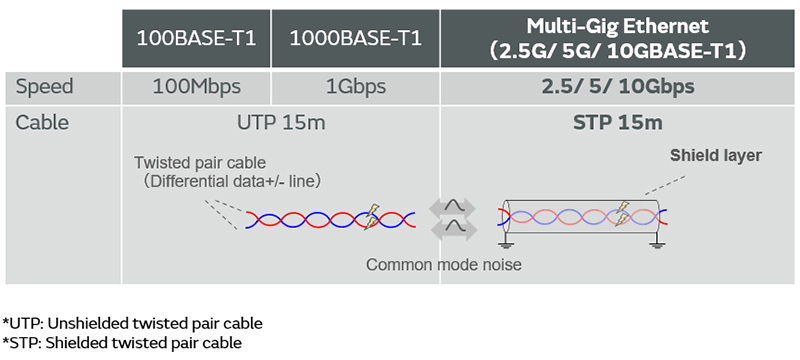
Figure 3. Original public illustration from Murata's July 2026 technical article. UTP denotes unshielded twisted pair; STP denotes shielded twisted pair. The comparison does not establish that every interface must use a common-mode choke.
Power-filter integration is a different opportunity. CODACA's July 2026 VSDN0650A disclosure describes common-mode and differential-mode noise suppression within one component, potentially reducing separate filter parts in suitable topologies. Evaluation requires the noise spectrum, operating current and complete filter network. Sharing the common-mode label does not make it directly comparable with a high-speed data-interface component.
Communication filtering must retain sufficient transmission margin, while power filtering also balances current, loss and structure. Protocol coverage, models with explicit test conditions and application support affect customers' validation workload and broaden the comparison beyond a single parameter table.
Qualification, customer approval and sustained delivery establish different capabilities
IATF 16949 concerns quality-management systems. AEC-Q200 defines stress-test qualification requirements for passive components; AEC does not issue a universal product certification certificate. Customers use processes such as PPAP to approve production parts and manufacturing processes for their projects. These functions are not interchangeable.
AEC-Q200 also distinguishes device qualification from approval for a particular application. Stress testing does not automatically establish compliance with an individual controller's EMC, thermal or service-life requirements. Actual cables, PCBs and enclosures still require design validation.
CODACA describes in-house AEC-Q200 testing capabilities and PPAP documentation support. These can help it participate in validation, failure analysis and change management. A test report nevertheless covers only its applicable products and conditions; factory-level credentials cannot establish approval for every product.
Mentech's first-half report describes onboard-charger transformers and inductors, together with magnetics for cockpit, lighting and communication systems. This breadth creates cross-project opportunities and varied winding, insulation, assembly and test requirements. BMS signal transformers perform signal-transfer and isolation functions and should not be added to the automotive-inductor market.
After approval, material and process stability remain important. Changes to magnetic powder, wire, terminations or manufacturing locations may require notification and requalification, depending on the change and customer requirements. Second sourcing also entails retesting, inventory transition and quality-management costs. Local support is valuable when it resolves these issues effectively.
Product mix and manufacturing efficiency determine business returns
Automotive validation can require substantial investment and support long customer relationships, without guaranteeing high margins. R&D, testing, automation and inventory precede or accompany production. Shipment scale, pricing and yield determine how quickly these costs are absorbed.
Meixin's first-half 2026 signal-magnetics revenue was approximately RMB 141 million, at a 28.02% gross margin. Power magnetics and other products generated approximately RMB 132 million, up 143.48%, with an 8.50% gross margin. Similar revenue scale therefore coexisted with different profitability. Both segments include several products and applications; the comparison does not establish that communication inductors outperform automotive power inductors financially.

Figure 4. First-half 2026 segment gross margins are shown separately from January–September company results. Neither scope isolates automotive inductors.
For January–September 2026, Meixin reported approximately RMB 440 million in revenue, up 41.22%, and an attributable net loss of approximately RMB 22.57 million. Disclosed growth drivers included capacity release on key projects and volume deliveries of megawatt flash-charging products. Inventory write-downs, expenses and foreign-exchange losses also affected results. Growth alongside a loss cannot be attributed solely to automotive inductors or used to infer industry profitability.
For suppliers spanning consumer, communication and automotive markets, reuse of manufacturing platforms and combined demand across programmes can affect utilisation and returns. Materials companies extending into finished inductors must carry their advantages through winding, packaging and production consistency. Broader portfolios also increase the complexity of managing processes and customer requirements.
Chinese automotive-inductor progress is visible in specific circuits and volume products. The stronger evidence will be validation under defined conditions, stable lots and continuing shipments that cover development and manufacturing investment. Power conversion, camera PoC and communication interfaces each require suppliers to demonstrate those capabilities in the circuits they serve.
Based on public information, for industry discussion only. Not an investment, procurement or part-selection recommendation. Applicable conditions and supply status remain subject to the latest manufacturer and customer confirmation.