
Competing in China's capacitor market: MLCCs, aluminum electrolytics and film capacitors
For an equipment maker sourcing capacitors in China, the supplier shortlist changes with the circuit. A high-capacitance MLCC for a smartphone board, an aluminum electrolytic for a server power supply and a DC-link film capacitor for a traction inverter demand different manufacturing skills. Even within one category, a strong supplier in one application may have less experience in another.
Some Chinese manufacturers have built their position around ceramic materials and precision processing. Others have gained automotive design wins, integrated electrode-foil production or developed film capacitors alongside busbars and mechanical assemblies. Revenue gives an indication of business scale, but product-level evidence is needed to understand those differences.
China's domestic electronics industry provides a substantial market. VIIYONG's September 2026 prospectus, citing Frost & Sullivan, puts the Chinese MLCC market at RMB 61.54 billion in 2025. Which suppliers capture that demand depends on the specifications they can deliver, production consistency and customer acceptance.
This article examines eight mainland manufacturers: Chaozhou Three-Circle Group (CCTC), VIIYONG, Fenghua, EYANG, Jianghai, Aihua, Faratronic and Tongfeng. It covers MLCCs, aluminum electrolytics and film capacitors. Tantalum and silicon capacitors have different competitive structures and fall outside this comparison.
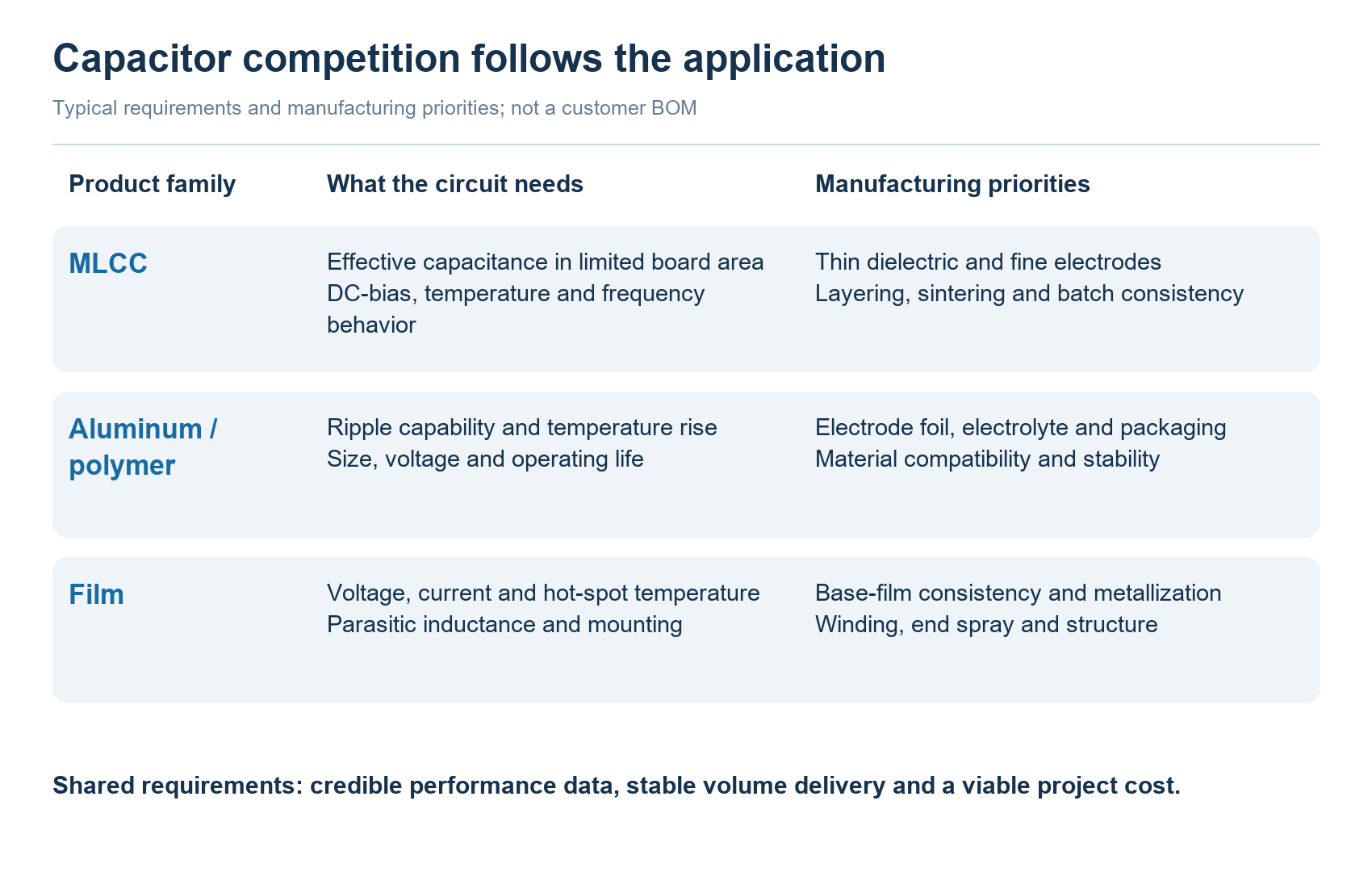
Figure 1. Typical performance requirements and manufacturing priorities. The diagram does not represent a customer's bill of materials or establish substitution between components.
1. High-capacitance MLCCs: CCTC's manufacturing base and VIIYONG's customer progress
Increasing capacitance within a limited package requires control of insulation, reliability and production variation. Thinner dielectric layers and more layers place greater demands on powder dispersion, printing, sintering shrinkage and defect control. Capacitance under operating bias also matters: two parts with the same nominal capacitance may contribute different effective values in a circuit.
CCTC: disclosed products and the expansion timetable
CCTC's 2025 annual report provides a firmer starting point than a supplier ranking. It describes conventional, medium- and high-voltage, and automotive MLCC ranges from sizes 0201 to 2220, alongside M3L, S-series, flexible-terminal and high-frequency copper-electrode development. The company's own technical material describes ceramic formulation, forming and sintering capabilities. These disclosures establish a product and process platform; they do not quantify the yield, unit cost or competitive lead of any one high-capacitance part.
The annual report also says CCTC introduced high-capacitance MLCCs in several sizes, including specifications for 48 V power systems. It describes an automotive range spanning 0201 to 2220 and 0.1 pF to 47 µF, with parts being introduced into electric-vehicle power, drive and infotainment systems. A published range and a statement of gradual application are distinct from approval of every part by a named vehicle maker or adoption by an undisclosed GPU customer.
There is a measurable timing constraint. CCTC's 2026 interim report moved the planned ready-for-use date of its high-capacitance MLCC expansion project from May 10, 2025 to May 31, 2027. That indicates a slower buildout of the new project than originally scheduled. It does not, by itself, establish shortages in existing products, a change in yield or lost customer orders. A buyer should still compare effective capacitance under working bias, temperature and reliability data for the relevant part number, then assess consistency over successive lots.
Powder self-supply ratios, equipment-development shares, dielectric thickness and layer counts need a defined product, period and test basis before they can support a ranking against overseas suppliers. Named-customer relationships likewise need evidence at the part-number and qualification stage; they cannot be inferred from a catalogue range.
VIIYONG: specific products and automotive sales
VIIYONG's June 2026 trade-show promotional material lists high-capacitance examples including 0402 at 22 µF / 4 V and 0805 at 100 µF / 2.5 V, together with production progress in 008004, 01005 and 0201 miniature series. These are imperial package codes. Suitability still depends on dielectric, DC bias and temperature conditions.
Its prospectus describes entry into vehicle and component supply chains including BYD and Leapmotor. Automotive-category revenue was approximately RMB 141 million in the first half of 2026, up 109.20% year on year and accounting for 14.02% of principal-business revenue. Consumer-category revenue was approximately RMB 734 million over the same period. Automotive sales had therefore become a growing business, while consumer applications remained the larger revenue base.
Customer adoption creates application, validation and supply experience. Changing a qualified supplier can require substantial work, which can support continued use of an established part. That advantage belongs to the relevant products and applications; it does not qualify every series in a manufacturer's catalog.
The VIIYONG prospectus gives a time-specific explanation for the decline in its automotive-category gross margin in 2025: some large, high-capacitance products with demanding manufacturing requirements entered volume supply while their yields and economies of scale were still improving. Their margins were below the automotive category average that year. This 2025 account does not establish that the same products remained at the same stage in 2026. Passing a specification and delivering it consistently at scale are separate achievements.
For an overseas sourcing team, CCTC's disclosed product range and project timetable, and VIIYONG's published specifications and automotive sales, offer different starting points for due diligence. Any ranking still needs matched part-level tests and delivery evidence.
2. Fenghua and EYANG: resonance and RF applications use different measures
Capacitance is only one route to a more capable MLCC. Resonant circuits need capacitance stability and low loss. RF circuits also depend on quality factor, ESR and self-resonant behavior at the operating frequency.
Fenghua's 2026 resonant MLCC material uses C0G dielectric and distinguishes consumer, flexible-termination, industrial IM and automotive AM categories. The published series spans sizes 0805–1210 and voltage ratings of 100–1,000 V. Each category has its own capacitance range; the extremes of separate columns cannot be assembled into one implied product.

Figure 2. Original Fenghua table published in May 2026, preserved unchanged. English reading guide: the columns give category, imperial size, voltage range and capacitance code. The rows are consumer, flexible termination, industrial IM and automotive AM. All show 0805–1210 and 100–1,000 V; the consumer row gives codes 102–104, while the other rows give 102–333. The examples below are 1210 C0G at 33 nF / 630 V, 22 nF / 1,000 V, 15 nF / 1,000 V and 10 nF / 1,000 V. Read each actual specification as a combination.
This product structure gives power designers choices across dielectric stability, voltage and mechanical reliability. C0G addresses capacitance stability; flexible terminations reduce the effects of mechanical stress such as board bending. A broader selection can help a supplier serve several positions on one customer's platform.
Fenghua's 2026 interim report also describes medium- and high-voltage, safety, flexible-termination, industrial and array MLCC offerings, together with ceramic-powder and electronic-paste activities. This creates opportunities to coordinate materials and device processing. Series-specific AC voltage limits, temperature rise at frequency and long-term reliability determine how useful that capability is in a resonant circuit. A high DC voltage rating does not establish an equal permissible high-frequency AC amplitude.
EYANG's high-frequency, high-Q selection guide, effective in July 2026, describes the U series with copper internal electrodes. Its overall range includes 008004, 01005, 0201, 0402 and 0603 sizes and nominal capacitances from 0.1 pF to 100 pF. Target applications include mobile phones, routers, power amplifiers and related RF modules.

Figure 3. Original excerpt from EYANG guide SPEC-CBE20260729, effective July 30, 2026. English reading guide: the scope covers RF uses in wearables, phones, routers, PA modules, Wi-Fi, 5G base stations and IoT modules. It lists Class 1 temperature-compensating X8G and C0G characteristics, the package families and the overall 0.1–100 pF range. In the illustrated code U 0201 C0G 330 J 500 N T A, the fields identify application, size, temperature characteristic, nominal capacitance, tolerance, rated voltage, termination, packaging and thickness. U denotes the high-frequency, high-Q family with copper internal electrodes. The overall range does not apply to every package.
These parts are evaluated for low loss and predictable small-signal behavior. Useful comparisons match size, capacitance and frequency, then examine Q and ESR curves, temperature behavior, tolerance and production consistency. Offering size 008004 alone says little about the rest of that performance.
The Chinese MLCC market therefore contains several overlapping development paths: high capacitance, miniaturization, automotive reliability, high-voltage resonance and low-loss RF. Product-series evidence is more informative than a single aggregate measure of “high-end domestic MLCCs.”
3. Jianghai and Aihua: materials, operating life and engineering support
An aluminum electrolytic must keep working through years of electrical and thermal loading. Parts with the same nominal capacitance and voltage may differ in volume, ESR, ripple-current capability, temperature rise and life. As power supplies become more compact, manufacturers have less thermal margin to work with.
Jianghai combines materials, devices and application support for power electronics. Its aluminum electrolytic revenue was approximately RMB 2.498 billion in the first half of 2026. Film capacitors and supercapacitors extend its discussions with power-supply and industrial customers, although the three families perform different functions.
The company reports continued development of electrode foil with higher specific capacitance, strength and consistency, supported by etching and forming processes. Specific capacitance affects the capacitance obtainable from an area of foil. Strength and consistency influence processing and reliability. Improvements must work together; higher foil capacitance does not automatically improve the completed capacitor's loss or service life.
Jianghai's interim report also describes gradual commercialization of N-type conductive-polymer material, new and upgraded automated snap-in capacitor lines for data-center applications, and technology and capacity work on hybrid and MLPC products. These are developments beyond its established aluminum electrolytic base. Material commercialization, construction of a production line and large-scale adoption of a finished product remain distinct stages.
Its application support reaches into customer design, testing and improvement. For a power-supply engineer, the value lies in resolving trade-offs between ripple loading, cooling, mechanical space and life during development.
Aihua's 2026 interim report identifies high-voltage snap-in, hybrid and laminated aluminum capacitors for applications including server power supplies, on-board chargers, renewable energy, storage and charging equipment. It reports broader use of laminated aluminum capacitors in 5G base stations, data centers and industrial control. Industrial-control and new-energy products contributed 54% of principal-business revenue. This combined category cannot be treated as a server-only or automotive-only sales share.
The products address different constraints. High-voltage snap-in parts provide voltage, energy-storage and ripple capability in the relevant power positions. Hybrid products balance impedance, leakage and temperature behavior. Laminated structures support low impedance and compact designs. Grouping them all as “new-energy capacitors” obscures the actual product progress.
Aihua's annual report describes development across products, materials, applications, equipment and processing. Its website provides series-based life calculations using conditions such as ambient temperature and ripple, along with 3D models for several packages. These tools reduce selection and mechanical-design work for customers.

Figure 4. Selected capabilities and progress from the companies' 2026 interim reports, Aihua's 2025 annual report and official design material. Their activities overlap; this is not a technology ranking or evidence that every new product is already widely adopted.
Both companies are developing materials and addressing demanding applications. A product-level comparison should hold volume, voltage and temperature conditions constant before comparing ripple current, life data and qualification results.
Internal material production can improve control over incoming quality and process changes, while adding energy use, consistency requirements and the work of introducing new materials. Aihua identifies the electricity intensity of electrode-foil production. Jianghai's newer materials are progressing through commercialization. A longer manufacturing chain provides more ways to solve a problem and more operations to manage.
4. Faratronic and Tongfeng: device engineering and base-film production
Film capacitors in traction inverters, solar inverters and industrial equipment often have to be developed with the system's physical structure. Voltage, ripple and loss requirements sit alongside busbar connections, cooling and installation space.
Faratronic's 2026 interim report covers PCB, AC and power-electronics film capacitors, and internal development and production of metallized film and busbars. Capacitor-business revenue was approximately RMB 2.665 billion in the first half. Its materials and structural capabilities are relevant to how it develops the finished component.
Metallization patterns affect current distribution and self-healing behavior. Busbars and connections influence parasitic inductance and assembly. Winding and end-spray processes affect internal connections and consistency. Coordinating those operations can help address coupled design problems early in a customer project. It does not, by itself, establish superior performance for every specification.
The extent of integration also needs careful definition. Producing metallized film does not establish internal supply of every base film. Custom design capability still requires project-specific testing for damp heat, hot-spot temperature and long-term operation.
Tongfeng extends further upstream into capacitor base film. Its 2025 annual report describes an integrated chain covering polypropylene base film, metallized film and film capacitors, with polyester film also in the portfolio. Capacitor and film-material revenue in the first half of 2026 was approximately RMB 302 million and RMB 276 million respectively. It participates in material supply as well as finished-device manufacturing.
This gives Tongfeng a way to connect material changes with device results. Base-film thickness, uniformity and defect control affect dielectric performance and processing; metallization and winding influence the finished component. Keeping these stages within one company can assist joint development and fault tracing.

Figure 5. Activities disclosed in Faratronic's 2026 interim report and Tongfeng's 2025 annual report. Arrows within the Tongfeng row show processing stages. The diagram does not establish a supply relationship between the two companies or complete internal sourcing of all materials.
Materials expertise still has to be converted into successful devices. Base-film operations require continuous-production control, thickness consistency and defect management. A power-electronics capacitor also needs connection design, thermal engineering, customer qualification and field-failure analysis. Tongfeng must carry its material experience through that work. Faratronic must maintain coordination between material selection, manufacturing and custom delivery.
Their operating requirements differ as well. Tongfeng describes balancing film-line operation through a combination of safety stock and production to order. Continuous material production must be coordinated with potentially fragmented downstream orders. Custom capacitor development brings a separate challenge: managing product variety without slowing qualification and manufacturing.
For customers needing joint material and component development, participation in the material stages is relevant. For a compact DC-link assembly, coordination of structure, electrical performance and reliability may be more decisive. The appropriate comparison follows the engineering problem.
5. A competitive position depends on products and sustained delivery
The following table summarizes the areas to investigate across the eight manufacturers. It is a selected supplier map rather than a complete directory or market-share ranking.
| Manufacturer | Capability discussed | Evidence that would establish its continuing value |
|---|---|---|
| CCTC | Ceramic forming, sintering and precision manufacturing; MLCC sales growth | Delivery performance of specific high-capacitance and miniature products |
| VIIYONG | High-capacitance and miniature specifications; automotive adoption and sales | Yield of demanding new products, batch consistency and wider customer coverage |
| Fenghua | Multiple MLCC families and materials; differentiated resonant series | Specification coverage within customer platforms and measured behavior in high-frequency operation |
| EYANG | Published high-frequency, high-Q and miniature series | Loss, tolerance and consistency at matched capacitance and frequency |
| Jianghai | Aluminum electrolytic scale, materials and application support | Progress from new materials and structures to sustained customer use |
| Aihua | Aluminum-capacitor and materials development; snap-in, hybrid and laminated products | Life, ripple capability and qualification in demanding applications |
| Faratronic | Film devices, metallized materials, busbars and engineering support | Performance validation, consistency and delivery of custom projects |
| Tongfeng | Base film, metallization and capacitor integration | Translation of material expertise into devices and coordination between production stages |
Qualification is followed by the practical test of volume supply. AEC-Q200-related component testing, an IATF16949 quality-management system and a customer's approval of a particular production part are different forms of evidence. Traceability, change control and failure analysis remain part of the supplier's responsibility after adoption.
Local proximity can make communication easier, but responsive service needs supporting experience. Early engineering involvement, timely resolution of failures and advance notice of material changes are observable capabilities. Jianghai's early technical involvement, Aihua's design tools and Faratronic's busbar integration illustrate different forms of support.
Price and cost influence the decision alongside those capabilities. A lower component price may be offset by additional validation, inventory or failure-handling work. A higher company margin does not demonstrate technical leadership. Stable yields, a suitable product mix and financing support continued development and delivery, but each has to connect to the product under consideration.
Mainland suppliers have developed several distinguishable manufacturing and product positions. The relevant evidence changes across fine-layer ceramic processing, RF loss, aluminum-capacitor life and custom film assemblies. Competitive strength becomes clearer when a specific capability survives customer testing and remains consistent through repeated orders.
Source basis: manufacturer product material, prospectuses and periodic reports. Company disclosures and analysis are distinguished in the text. The selected companies do not represent all mainland suppliers. Unsupported numerical and customer assertions from the earlier draft have been removed from the supplier comparison.