The economics of capacitor makers moving upstream: external sales, component margins and capital returns
For an international buyer, two suppliers may both claim to make their own capacitor materials, yet offer very different commercial propositions. One sells film or foil to multiple capacitor manufacturers. Another uses its materials mainly inside its own components. Both may have valuable technology; only the first necessarily reports a separate stream of external materials revenue.
The distinction is visible in Chinese capacitor companies' first-half 2026 accounts. Tongfeng Electronics reported about RMB344 million in revenue for its electronic-grade film materials segment, including about RMB68 million eliminated between segments. Jianghai reported about RMB79 million in consolidated electrode-foil revenue. Dongyangguang spans electronic light-gauge foil, etched foil, formed foil and aluminium electrolytic capacitors, yet the gross margin of its combined “electronic components and materials” business fell 5.62 percentage points year on year. A longer supply chain does not produce the same financial result for every company.
These figures are not interchangeable. Tongfeng reports a segment and an elimination, Jianghai a product line in its consolidated accounts, and Dongyangguang a broader business that includes both materials and devices. The useful question is where each material goes. Material consumed by an affiliated capacitor plant creates value through the finished component; material sold outside the group creates independent consolidated revenue. Adding internal transfers to the component sale would count the same supply chain twice.
Moving upstream can secure supply, shorten joint development between material and capacitor, and create a market for capacity beyond the manufacturer's own factories. It also brings equipment, energy, environmental compliance, process engineers, qualification work and working capital. Producing a material and earning an attractive return on the material line are separate achievements.
1. External sales and captive use produce different revenue
Tongfeng's segment disclosure offers an unusually clear starting point. Its electronic-grade film materials segment recorded approximately RMB344 million of main-business revenue in the first half of 2026. Approximately RMB68 million was eliminated between segments, leaving roughly RMB276 million after consolidation. The report does not assign every eliminated yuan to a particular in-house capacitor line. The remaining consolidated materials revenue nevertheless shows the significance of customers outside the group. Their orders help determine the film line's utilization, pricing and cash collection.
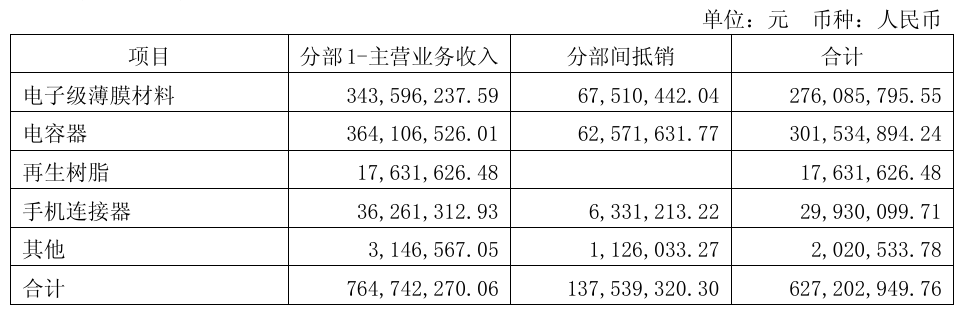
Figure 1 | Original segment table from Tongfeng Electronics' 2026 interim report; amounts in RMB. Intersegment elimination cannot be treated as the amount of film consumed by a specific group capacitor line. The source exhibit remains in its original Chinese.
An internal film transfer may appear as a sale in one subsidiary's accounts, then disappear on consolidation. The group can still benefit through a lower component cost, a higher yield or more reliable delivery. None of those benefits automatically creates an equal amount of materials revenue. For an overseas customer assessing supply resilience, the relevant questions therefore include both the external film business and the stability of Tongfeng's own capacitor production.
Jianghai illustrates a different structure. Its electrode-foil revenue was about RMB79 million in the first half of 2026, representing 2.50% of group revenue, at a gross margin of 21.88%. Aluminium electrolytic capacitor revenue was about RMB2.498 billion over the same period. The foil line's reported external size does not measure all foil used in Jianghai's own capacitors. Its interim report does not disclose internal foil volume or isolate the contribution of captive materials to capacitor margins, so it would be unsound to derive a materials return from the finished-product sales figure.
Jianghai's upstream capabilities extend beyond electrode foil. Its report describes etching and forming processes for high-capacitance foil, associated environmental processes, vacuum coating, supercapacitor electrodes and the gradual industrialization of N-type conductive polymer materials. Downstream it sells aluminium electrolytic, film and supercapacitor products. First-half film capacitor revenue was about RMB311 million, up 33.56% year on year; supercapacitor revenue was about RMB249 million, up 54.18%. Materials processes, specialist equipment, testing and application development support these businesses. The public data do not isolate how much of either revenue increase came from making a particular material in-house.
Jianghai also says its technical service enters customers' design, testing and improvement processes. Its products address industrial automation, data centers and server power, and energy-storage applications. A supplier with three capacitor technologies and relevant material processes may be able to serve different points in a power system. Whether that becomes cross-category purchasing depends on customer qualification and repeated deliveries; the interim report does not disclose cross-selling revenue.
The distinction matters to investors and procurement teams alike. A film materials supplier with a large external business must prove consistent quality to multiple customers and absorb the film market's price cycle. A diversified capacitor maker may recover upstream spending through component performance and long-term project wins. External material revenue is visible immediately; the value of captive materials requires a longer view of component orders, margins and capital expenditure.

Figure 2 | Tongfeng's electronic-grade film materials segment, first half 2026, RMB100 million. Figures are rounded. The orange portion is the reported intersegment elimination, not a disclosed measure of material used by the group's own capacitor lines.
2. Foil and chemicals occupy different profit positions
Dongyangguang's chain runs from electronic light-gauge foil through etched and formed foil to aluminium electrolytic capacitors. Its interim report says it supplies materials to overseas capacitor manufacturers, including Nippon Chemi-Con, Rubycon, Nichicon and TDK. Sales to such customers give the materials operation a revenue path beyond the group's own component market. The report does not disclose each named customer's purchases, so the customer list should not be converted into a revenue ranking.
Nor does an integrated chain guarantee a rising margin. Dongyangguang's “electronic components and materials” business generated approximately RMB1.902 billion in first-half 2026 revenue, up 6.48% year on year. Cost rose 14.24%; gross margin was 17.21%, down 5.62 percentage points. The segment includes foil, capacitors and other materials, preventing a calculation of formed foil's standalone profit. The faster increase in cost still makes a useful point: energy, input materials, depreciation and downstream selling prices continue to matter after production has moved inside the group.

Figure 3 | Original business table from Dongyangguang's 2026 interim report; amounts in RMB. “Electronic components and materials” covers foil, devices and other materials. The source exhibit remains in its original Chinese.
Dongyangguang separately reported roughly RMB213 million in first-half revenue from a combined category of stacked formed foil and stacked-foil capacitors. The category establishes that this direction is generating sales, but it combines material and finished-device revenue. It cannot reveal how much either side earned independently. This is precisely the point at which an apparently attractive materials opportunity can be overstated by adding overlapping numbers.
Capchem participates primarily as a specialist chemicals supplier. Its 2026 interim report lists liquid electrolytes, conductive-polymer materials, electronic pastes for stacked aluminium capacitors and aluminium-foil chemicals among capacitor-related offerings. Its public financial line, however, is “electronic information chemicals,” which also includes semiconductor chemicals. That broader business generated about RMB956 million in first-half revenue, with a 51.68% gross margin and 55.69% capacity utilization. None of those three figures represents capacitor chemicals alone.
Capchem's position shows why a component producer cannot assume that replacing a chemical supplier will capture the supplier's published margin. A specialist sells formulations across customers, shares development and qualification work with them, and spreads certain fixed costs over a larger addressable market. An in-house producer has to compare the delivered purchase price with its full production and validation cost at its own realistic volume. Capchem's broad segment margin describes the supplier's mixed business; it is not an available saving per capacitor.
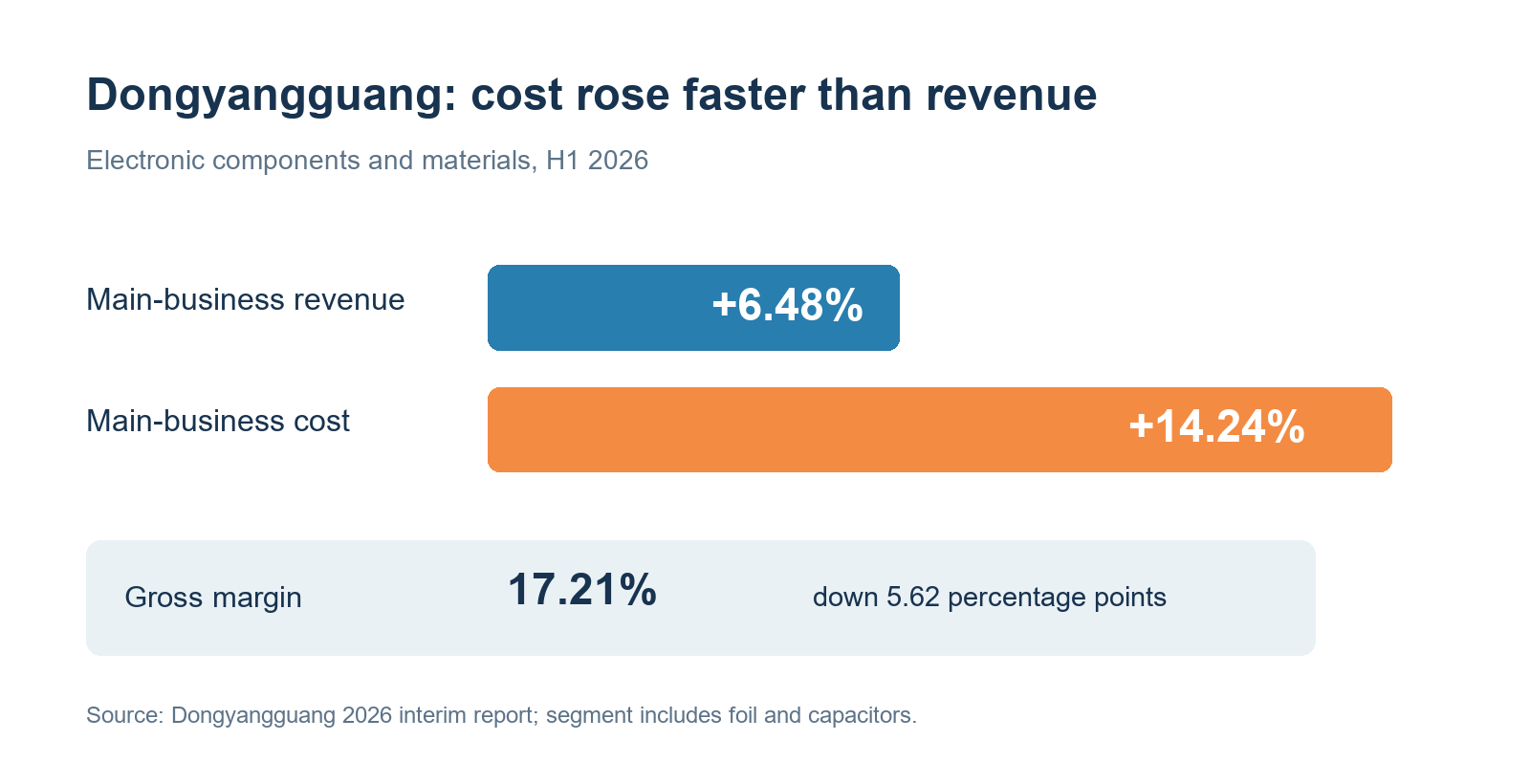
Figure 4 | Dongyangguang's electronic components and materials business, first half 2026. Revenue and cost are year-on-year changes; gross margin is the current-period level. The reported segment includes foil and capacitors.
3. Film and MLCC materials still need qualified customers
The film-capacitor route differs even among companies that produce their own materials. Faratronic says in its 2026 interim report that it develops and produces metallized film materials and busbars, while building material and equipment supply through in-house work and partnerships. First-half capacitor main-business revenue was about RMB2.665 billion. The report does not separately state external metallized-film revenue or savings from captive film. For Faratronic, the materials and structural components are best examined as part of its finished capacitor proposition; the return ultimately depends on component orders.
Tongfeng also makes both film materials and capacitors, but its substantial disclosed external materials revenue gives it another market to serve. Tongfeng's interim report mentions higher raw-material costs and intensified competition; group first-half revenue fell 10.57% year on year. Having an upstream line can provide sourcing options. It cannot, by itself, cancel changes in feedstock prices or prevent customers from negotiating lower component prices.
Aihua Group now has two material-to-device chains: aluminium foil to aluminium electrolytic capacitors, and metallized film to film capacitors. Its interim report also lists capacitor-manufacturing equipment among actual operating activities. Aluminium foil is already an operating business. Aihua's major subsidiary Xinjiang Rongze Aluminium Foil recorded about RMB633 million in first-half 2026 revenue and RMB39 million in net profit. Some subsidiary revenue may be internal to the group. It should neither be added to Aihua's RMB2.270 billion consolidated revenue nor presented as entirely external foil sales.
The second chain is at a different stage. Following the acquisition of Aihua New Power, Aihua has been integrating it with Aiyuanda in technology, production and marketing, while advancing metallized-film and film-capacitor lines and automotive customer introductions. Industrial control and new-energy products made up 54% of first-half main-business revenue, a category that also spans automotive and data-center applications. It is not a film-capacitor revenue share. The company describes its overall film business as still small, so the existing electrolytic customer base cannot yet be treated as proof of large-scale film orders.
Its project disclosures clarify the timing of investment. The Zejin Electronics aluminium-foil project had a budget of RMB312 million and was 95% complete; a film-capacitor and new-materials project had a budget of RMB222 million and was 35% complete. Construction progress is neither plant utilization nor project profit. The new film line must still absorb depreciation, qualify with customers, ramp output and win repeat production orders. Its capital payback may therefore differ markedly from the established foil operation.
Jianghai and Aihua both cross the boundary between materials and devices, yet their evidence differs. Jianghai publishes revenue and growth for three capacitor categories, while its externally reported foil revenue is relatively small. Aihua has a sizable foil subsidiary, while film materials and film capacitors remain in integration, construction and customer-introduction stages. Ranking them by the number of upstream links would miss the commercial question: can mature products fund the new capability, and can the new line eventually earn enough on the capital committed?
MLCC materials bring another set of constraints. Fenghua Advanced Technology says in its 2026 interim report that the in-house production rate of high-end ceramic powders and copper, nickel and silver pastes is rising. It does not disclose the production rate or profit for each material. Powder and internal-electrode paste affect the consistency of high-capacitance, high-reliability MLCCs. An early benefit may be a tighter performance distribution or better yield, with financial returns arriving only when qualified devices are repeatedly ordered. The public report does not establish a stand-alone cost saving from these materials.
International peers also use partnerships rather than building every line alone. In April 2026, TDK and Nippon Chemical Industrial announced a venture to develop MLCC ceramic materials and manufacturing processes, with TDK holding 51% and Nippon Chemical Industrial 49%. The announcement emphasized shorter development and evaluation cycles, without reporting product revenue for the venture. Joint development can align material characteristics with device design while sharing specialist research work. It remains a route to qualification; the venture has yet to report product revenue.
These material families occupy different commercial positions. Electrode foil and metallized film have more observable external markets. Capacitor chemicals depend heavily on formulations and customer validation, while their reported financial lines may include unrelated electronic chemicals. Ceramic powders and pastes may first support a manufacturer's own high-end MLCC development. A single claim that “upstream has a higher margin” obscures those differences in asset intensity, customer base and how profit reaches the consolidated accounts.
4. Returns depend on full cost, usable capacity and repeat orders
An upstream investment should be assessed against the alternative use of the same capital. Captive supply can replace a purchase, but the factory must pay for inputs, energy, process loss, depreciation and compliance. External sales can spread the line's fixed cost over more units, but they bring separate qualification, quality-service and collection obligations. If a customer's design change strands a material specification, inventory and equipment modifications may consume earlier savings. An internal transfer price only reallocates profit among subsidiaries; the group's gain depends on final sales and real cost.
For planning, the potential return can be divided into three streams: the avoided delivered purchase cost on captive volume, net of in-house variable production cost; the contribution from material sold to outside customers, net of its variable production and selling cost; and incremental finished-capacitor profit attributable to improved material performance or new orders. From that total, subtract research, qualification, depreciation, environmental expense and working-capital cost. Keep the three streams mutually exclusive. If a finished capacitor's higher price already captures a material improvement, that same value cannot be counted again as a full “captive saving.” The final comparison is with what the same investment might earn in higher-end component capacity, customer qualification or another materials partnership.
Full cost. Compare material of equivalent performance, yield and delivery reliability. The relevant external benchmark is the delivered purchase cost; the internal benchmark includes all production costs, not merely the raw inputs. Dongyangguang's segment cost rose faster than revenue, and Tongfeng reported rising input costs. Both show that integration leaves exposure to feedstock prices and factory expenses. A blended segment margin is a clue, not a product-level cost calculation.
Usable capacity. A manufacturer's own capacitor orders can provide a base load without filling a materials line to its economic operating level. Tongfeng's consolidated film revenue demonstrates the role of external demand. Jianghai's foil sales and captive foil use should be assessed separately; Aihua's subsidiary revenue cannot be added to external group revenue. Capchem's 55.69% utilization covers multiple products, so it cannot establish the rate for capacitor chemicals. A project announcement, construction completion, designed capacity, stable shipment and cash collection are successive stages, not synonyms.
Repeat customers. An external materials supplier must fit another manufacturer's process window, maintain batch consistency and manage changes over a long product life. Dongyangguang's disclosed overseas capacitor customers are stronger commercial evidence than a product catalogue, even though purchases by customer remain undisclosed. Captive materials must also pass the finished capacitor customer's test. Repeat buying across batches and programs is a better signal of realized value than a laboratory demonstration or an initial qualification alone.
Different companies therefore have different operating tasks. A producer with an established external market must protect quality, utilization and pricing. A component-led manufacturer should look for gains in finished-product yield, delivery and margin. A company still developing a new material should pace fixed-asset commitments against achievable demand. No capacitor maker needs to duplicate every foil, chemical, film and ceramic-powder line to compete effectively. The boundary of integration is set by the volume it can reliably use or sell at an adequate return.
Conclusion
Upstream capabilities are becoming part of capacitor competition, but their returns appear in different places. Tongfeng has sizable external film-material revenue. Jianghai's electrode foil is only one part of a portfolio spanning three capacitor technologies. Aihua already operates a substantial foil subsidiary while investing in film materials and components. Dongyangguang has a broad chain whose combined segment margin nevertheless declined. Capchem reaches capacitor makers as a specialist chemicals supplier. The business case rests on sustained external orders, finished-product volume, line cost and the return on capital committed.
For the next reporting periods, material sales to outside customers, intersegment eliminations, cost growth, utilization, qualified component orders and repeat purchases will provide a firmer basis for judgment than a claim to “full-chain control.” Material performance matters most when it remains stable in a customer's production process and turns into sustained commercial volume.
Based on company interim reports and announcements available through October 2026. Figures from different companies use different reporting scopes and should not be treated as a direct profitability ranking. This article is for industry research, not investment or procurement advice.