
China's supercapacitor market is growing unevenly
For buyers assessing Chinese supercapacitor suppliers, the growing list of products and projects can obscure a basic commercial difference. A company supplying small backup components earns revenue through repeated orders for established equipment. A grid specialist depends on project delivery and acceptance. A supplier entering AI power systems must first secure a place in the customer's electrical architecture. Growth in one market does not automatically improve the economics of another.
Supercapacitors suit rapid charging and discharging, frequent cycling and short bursts of power. Depending on the product and operating conditions, they can provide long cycle life and useful low-temperature performance, often working alongside batteries. Their applications range from regenerative braking in rail vehicles and industrial machinery to wind-turbine pitch backup, grid frequency regulation, data-centre power support, utility meters, communications equipment and specialised aerospace systems. These uses place very different demands on energy, power, qualification and service life.
The commercial question is which of those applications has become a repeatable business. Chinese disclosures provide some useful reference points, although they do not support a comprehensive ranking of suppliers. One terminology trap is worth clearing up: small supercapacitors are sometimes called “farad capacitors” in China, but Faratronic is principally a film-capacitor manufacturer. Its business should not be counted as supercapacitor revenue simply because both products may be used in the same power system.
1. Jianghai's growth is measurable; the application mix is less clear
Jianghai reported supercapacitor revenue of approximately RMB249 million in the first half of 2026, compared with RMB162 million a year earlier. The increase was about RMB87.61 million. Its interim report did not allocate that increase to individual applications or customers, so the total cannot establish how much came from AI, the grid or automotive electronics.

Figure 1. Jianghai's first-half supercapacitor revenue, in RMB million. Values are rounded from the figures disclosed in its 2026 interim report.
Server power is an important development area. In its April 2026 investor communication, Jianghai described testing, qualification and batch trials of both electric double-layer capacitors (EDLCs) and lithium-ion capacitors (LICs) with global power-supply customers. In the context of server UPS and data-centre power applications, it said it was targeting annual revenue above RMB150 million. That was a target, not recognised revenue or a guaranteed order book.
The more concrete figure appeared in a subsequent disclosure: first-quarter supercapacitor revenue was RMB106 million, including approximately RMB12 million from AI server power applications. This gives the new market a measurable starting point, while showing that it was still a relatively small part of the product line. Achieving the annual ambition depended on subsequent deliveries.
Grid frequency regulation and automotive electronics also form part of Jianghai's business. Its disclosures describe growth in established applications and volume deliveries into newer ones. They support a broader market opportunity, but do not justify assigning most of the first-half increase to server power. For a buyer assessing the company's position, the distinction between a product-line total, a disclosed application figure and a management target matters.
2. Small backup components face pressure on price and repeat orders
The smaller-component market has a more dispersed supplier base. Fenghua Advanced Technology lists supercapacitors in its 2026 interim product portfolio without separately reporting their revenue. Kamcap, based in Jinzhou, offers coin, wound, assembled and module products, while BIGCAP, based in Liaoning, serves utility-meter and power-equipment applications.
Publicly transcribed figures from Beryl's 2026 interim report put first-half supercapacitor revenue at approximately RMB36.96 million and gross margin at 33.34%. These figures retain a source limitation: they were checked against a public financial-data transcription, rather than the original report PDF. They should not be used to make a precise technology ranking against Jianghai. Component size, module content, customer mix, production costs and the maturity of manufacturing lines can all affect gross margin; gross margin also differs from net profitability.
Large manufacturers can spread investment across materials, production and customer coverage. Smaller specialists may retain business around a particular package, temperature range or equipment platform. A broad catalogue shows what can be offered, while sustained shipments, returns and repeat purchases show whether that catalogue has become an operating business.
Pricing pressure often arrives early in these applications. Once an equipment platform reaches steady production, its manufacturer may request annual price reductions or qualify another supplier. Expanding capacity will not necessarily reduce unit costs if automation, consistency and yield fail to improve. Aggressive pricing can leave the supplier carrying the cost of screening, warranties and inventory.
Batteries remain a competing option when longer backup duration is required. Supercapacitors can be attractive for brief, frequent duties, but the choice still depends on standby consumption, the task performed after a power failure, available space, temperature and maintenance. Long cycle life alone does not establish that every backup battery should be replaced.
For distributors, small backup components can support recurring demand. The durable source of that demand is the qualified equipment platform. Inventory that grows faster than equipment orders ties up cash, while too many narrowly differentiated products can increase slow-moving stock. A fragmented market can still depend heavily on a small number of customers that keep ordering.
3. Grid projects enlarge the opportunity and the delivery obligation
Frequency regulation requires storage to absorb and release power repeatedly. Supercapacitors can handle brief, intensive duties while batteries provide longer-duration energy. Whether the combination earns its cost depends on system efficiency, regulation performance, dispatch and settlement, as well as component life.
Tigstor reports that its hybrid supercapacitor and lithium-battery project in Pianguan, Shanxi, reached full grid connection in August 2025 and completed commercial-operation procedures in December. In Shunde, Guangdong, a 200 MW/305 MWh demonstration project connected to the grid in December 2025, including 50 MW/5 MWh of supercapacitor capacity supported by Aowei. Dividing the rated energy by rated power gives six minutes; this is a configuration ratio, not a guarantee of full-power operation for six minutes under every condition.
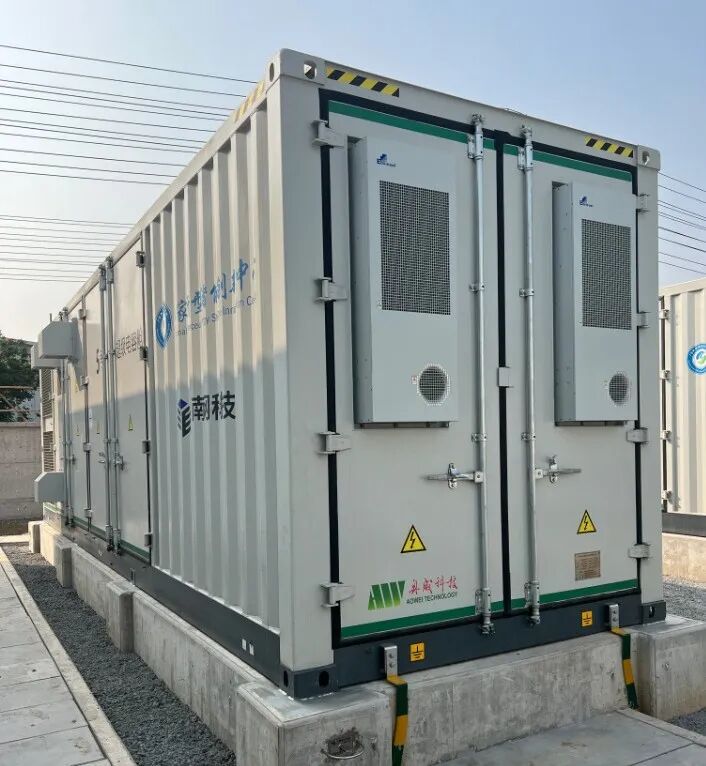
Figure 2. Equipment at the Shunde hybrid storage demonstration project, in a photograph published by Aowei.
There are two distinct revenue relationships. First, a developer or contractor buys a system, and the integrator buys cells, modules, converters and controls. A component supplier recognises revenue according to its contract and acceptance conditions. Second, the plant operator earns payment for services in the electricity market. Project connection, equipment sales and operating income cannot be treated as the same transaction.
China's market arrangements are also changing. Revisions to southern-region frequency-regulation rules in 2026 proposed exploring participation by independent storage in both regulation and spot markets. Zhejiang introduced a daily choice between energy and frequency-regulation participation for eligible grid-side independent storage. Local access, bidding, assessment and settlement rules differ, so a scheme that works in one province does not automatically carry the same economics elsewhere.
Suppliers occupy different positions. CRRC New Energy in Ningbo covers cells, modules and systems. Sieyuan Electric participates through GMCC, but its RMB1.391 billion first-half 2026 revenue for “energy-storage systems and components” includes multiple products and is not a supercapacitor revenue figure. Jinshi Technology disclosed work on carbon materials, devices and capacity, with some containerised systems expected to enter volume production in the second half. HCC Energy announced project awards, while Aowei disclosed strategic and procurement agreements for a 200 MW Shanxi cluster. Signing, winning, delivering, acceptance and payment are different milestones.
Large projects can produce substantial individual orders, but concentrated deliveries also create working-capital demands. One demonstration installation may cause a temporary revenue jump. Repeated designs, standardised modules and acceptance across several projects offer stronger evidence of continuity. A smaller manufacturer can participate as a cell or module supplier without taking on the entire plant's integration and operating obligations.
Technology choice remains open. Longer duties may favour a greater battery allocation; very short power-intensive duties may also invite comparison with flywheels. The relevant comparison includes acquisition, replacement, efficiency losses, maintenance and downtime under the same operating profile. Cycle-count claims and rated power alone cannot settle the economic case.
4. Data-centre demand must pass through power-system qualification
AI workloads can impose rapid changes in power demand. Supercapacitors may be placed in power shelves, adjacent cabinets or the UPS chain to support transients or short backup intervals. Placement determines the customer and the responsibility: a cell manufacturer may sell to a module supplier, the module supplier to a power-supply company, and the completed design must still be accepted by the server or data-centre operator.
Jianghai's approximately RMB12 million in first-quarter AI server power revenue remains a useful disclosed reference point. Its interim report described volume deliveries into applications including data centres, but did not disclose a separate first-half amount. Subtracting figures from the RMB249 million product-line total cannot produce a valid second-quarter AI revenue estimate.
Dongyangguang reported that its supercapacitor business had begun generating revenue at scale, with its first production phase in batch trial production. It also disclosed strategic cooperation with Delta involving server power supplies and UPS products. It did not publish independent supercapacitor revenue or Delta's actual purchasing volume. Sieyuan likewise identified data centres as a market it was developing without a separate revenue figure.
Plannano announced two dry-electrode supercapacitor products for AI data centres in September 2026 and opened sample requests and volume orders. HCC Energy and Tigstor introduced computing-power-related modules and solutions, while Tsingyan Electronics extended its dry-electrode activities into cells and modules. These announcements show suppliers moving closer to power subsystems. They represent different commercial stages: samples, order availability, system qualification and sustained supply should remain separately identifiable.

Figure 3. Plannano's manufacturer product image for its September 2026 AIDC launch. Original branding and product markings are retained.
Integration imposes requirements beyond the cell. Huawei Digital Power's UPS5000-H monitoring-module documentation, revised in September 2026, describes supercapacitor connections for supported equipment and restrictions on sharing banks or mixing cabinets in parallel systems. Charging voltage, discharge cutoff and backup duration must fit the equipment. This documentation does not establish a supply relationship with any manufacturer discussed here; it illustrates the coordination required between a UPS and a storage cabinet.
The power supplier must show that voltage remains within limits during load changes and that usable energy covers a loss-of-power transition. Repeated pulses must not produce unacceptable heating, ageing or imbalance. If a customer already has a battery and power-control solution, adding supercapacitors must justify the additional hardware, controls, space and maintenance. Rack counts multiplied by a single assumed capacitor requirement are therefore a weak basis for estimating demand.
The most useful commercial signals are design acceptance on a named power platform, repeat purchases and separately reported revenue. Selling cells leaves pricing exposed to module and power-supply buyers. Supplying balancing, monitoring and control modules may raise the value of each sale, but also adds qualification, service and inventory commitments. A design position is valuable only if annual shipments justify the engineering work needed to retain it.
5. Materials, yield and funding will determine who retains the gains
China's supplier base now spans materials, cells, modules and systems. Capchem lists supercapacitor electrolytes and sealing components for data-centre supercapacitor applications; Ruitai New Materials supplies supercapacitor electrolytes; Xinsen Carbon supplies supercapacitor carbon. Material quality affects consistency, resistance, leakage and ageing. Material sales are already embedded in downstream costs, so adding every tier's revenue overstates the final market.
Larger or more powerful devices may require more electrode material, tighter sorting and more complex module management. After expansion, depreciation, trial production and stock can build up before customer qualification produces revenue. Jianghai emphasises electrode technology and production investment, while Dongyangguang's first phase remains at a different manufacturing stage. Planned capacity alone cannot rank their future market shares.
Dry electrodes have attracted interest because manufacturers hope to improve power density, production efficiency or cost. Product images and process descriptions establish a development direction, but not superior volume yield, lifetime performance or unit economics. Grid customers still evaluate system returns, and data-centre customers still evaluate compatibility and reliability. Process advances acquire pricing value when they survive those application tests.

Figure 4. Conceptual commercial map. Component sales, module sales, project delivery and plant operation involve distinct transactions and revenue owners; they must not be added together as a single end-market measure.
The emerging supplier groups should therefore be compared on their actual business. Jianghai and Beryl have separately identifiable product revenue. Dongyangguang reports commercial progress without a standalone amount. Tigstor, Aowei and CRRC have project or system capabilities. Other specialists are advancing particular materials, devices or application solutions. Larger companies can fund more product lines and qualification programmes; smaller firms can still build durable businesses around a stable equipment platform, demanding operating condition or system-integrator relationship.
Growth is reaching these groups at different speeds. Small backup components depend on recurring orders and margin after price reductions. Grid suppliers depend on repeatable delivery, acceptance and cash collection. Data-centre suppliers depend on qualification and continuing purchases from specific power platforms. Those records will show which companies turn market interest into sustained earnings.
