Chinese diode suppliers move upmarket, with progress measured in shipments and margins
Chinese diode suppliers now offer products for tasks ranging from power rectification and freewheeling to automotive interface protection. For international engineers and industry readers, the more useful distinction is increasingly the stage a particular product has reached: development, customer qualification, initial production or continuing shipments.
Recent product disclosures and 2026 interim reports show several routes into more demanding applications. Silicon devices continue to improve alongside silicon carbide products, while manufacturers build their assembly, testing and application capabilities. Progress is uneven across companies and projects. A wider catalogue establishes coverage; repeat orders and the economics of production show how much of that coverage has become a durable business.
1. Circuit requirements define the opportunity for each diode family
The diode market needs a narrower definition than the broader power semiconductor industry, which also includes MOSFETs, IGBTs and power ICs. Optoelectronic market figures include products such as LEDs. Applying the size or growth of those larger markets to diodes would overstate the business available to the suppliers discussed here.
This article focuses on power rectifier, small-signal and protection diodes. Power transistors appear where they help explain a manufacturer's portfolio or the devices used together in a circuit.
The commercial demands differ by function. Conventional rectifiers balance price against temperature rise, package choice and manufacturing cost. Fast-recovery diodes must meet the loss requirements of switching circuits. TVS and ESD protection devices compete on transient protection, interface behavior and available board space. Automotive applications add reliability and quality-management requirements to those electrical considerations.
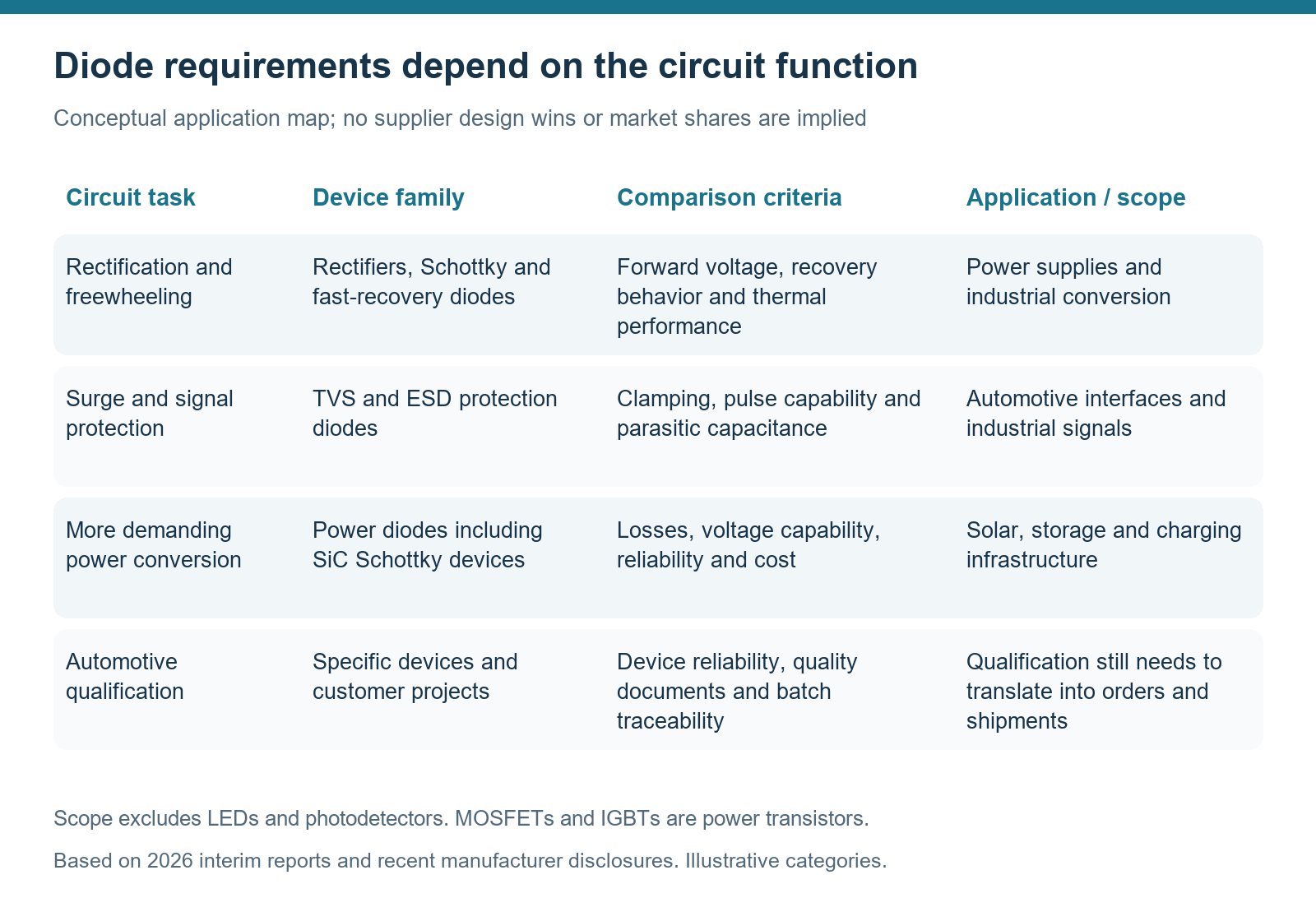
Figure 1. A conceptual map of circuit functions and evaluation criteria. Application examples do not establish a supplier's customer relationships or provide a basis for estimating market share.
Electric vehicles, solar, storage and computing power supplies create opportunities for power devices, but the circuit architecture determines which diodes are needed. Even within a power supply, a change in topology or switching device can change the rectification and freewheeling arrangement. Evidence that a specific diode has entered a customer design and continues to ship is therefore more informative than the growth of the end market alone.
2. China's supply base spans broad portfolios and specialized manufacturing
Recent disclosures support a view of ten Chinese suppliers with overlapping products and different manufacturing strengths. This is a selected group supported by available company materials, rather than a complete national directory or a market-share ranking.
Yangjie Technology combines rectifier and protection products with other power devices, supplying both dies and packaged components. Its competitive position depends partly on coordination across that portfolio and on customer adoption. Suzhou Good-Ark Electronics supplies diodes and bridges and provides semiconductor assembly and testing. Packaging processes and qualification matter to this business, while its consolidated accounts also include a substantial new-energy materials operation.
Among broader manufacturing platforms, China Resources Microelectronics (CR Micro) covers Schottky, fast-recovery and SiC diodes. Its diode and SiC MOSFET activities need separate assessment. Silan Microelectronics offers fast-recovery, Schottky, Zener, switching and TVS/ESD devices, with FRD dies also supplied for modules. That connection between discrete devices and modules provides a route into applications that would be missed by looking only at packaged diode catalogues.
Jiejie Microelectronics covers rectifier, fast-recovery, Schottky, protection and SiC diode activities. Its diode and protection product lines use an integrated device manufacturer, or IDM, model spanning the production chain. Galaxy Microelectronics combines small-signal, protection and power diodes with bridge-package development. WeEn Semiconductors covers rectifier, fast-recovery, Schottky and SiC products; the status of an individual generation or project should not be generalized to the entire portfolio.
Jiangsu Changjing Electronics (JSCJ) presents rectifier, Schottky, TVS/ESD, SiC, bridge and ultrafast-recovery families. Perfectway's recent listings cover several bridge series, although a catalogue publication date does not establish a mass-production date. Hubei Tech Semiconductors (Techsem) serves industrial applications with high-power rectifiers and power semiconductor modules. Its power levels, customers and service requirements differ from those of a small-signal specialist.
These differences make group revenue a poor basis for ranking diode suppliers. A consolidated figure may include other power devices, ICs or materials, while a count of catalogue entries says little about which products customers actually buy. Comparisons become more useful when they follow a particular application, product line and manufacturing operation.
3. Automotive and SiC projects are at different commercial stages
Some Chinese diode products already contribute to automotive supply chains. Silan's 2026 interim report states that IGBT and FRD dies for automotive traction applications have been sold in volume to several module packaging manufacturers in China and overseas. FRD denotes a fast-recovery diode. The disclosure establishes business at the die-to-module stage; it does not establish that Silan supplies a stand-alone diode directly to a vehicle manufacturer.
Good-Ark's Malaysian assembly and test operation, AICS, reports a different stage for its SMX series. The series passed qualification by a leading automotive-sector customer and entered small-batch production. Customer entry has progressed, but the eventual scale and profit contribution remain to be established.
Jiejie reports a breakthrough in SiC JBS diode-die development, while automotive SiC devices in molded packages and other products remain under development. A die-development result, a new package and customer volume purchases are separate milestones. Combining them into a claim that an entire high-end SiC portfolio is in mass production would go beyond the disclosure.

Figure 2. Unaltered Chinese source excerpt from Galaxy's 2026 interim report, page 25, project 9. The project concerns a high-performance GBJ package designed using thermal simulation. Its status column says “R&D stage.” The longer text describes objectives for thermal paths, resistance, surge capability and reliability, rather than verified achievements.
Galaxy's GBJ project also shows that product upgrading includes conventional silicon packaging. Thermal paths, internal resistance, package structure and reliability remain subjects of development in mature bridges. In a separate commercial example, CR Micro reports continuing SiC diode supply for solar and storage, charging infrastructure and appliances.
The product, supplying entity, customer type and shipment stage all matter. A company's automotive business does not make every diode in its catalogue automotive qualified. Equally, an unfinished development project does not negate shipments of its existing products.
4. Revenue growth and diode profitability require separate evidence
Good-Ark's first-half 2026 accounts illustrate the effect of business mix. Group revenue was approximately RMB 2.573 billion, up 29.10% year on year. Semiconductor revenue was about RMB 508 million, or 19.76% of the total. New-energy materials generated approximately RMB 2.038 billion, accounting for 79.22%.

Figure 3. Revenue composition for one company and reporting period. The semiconductor category includes multiple devices and assembly/testing activities; it is not diode-only revenue. Amounts are shown in RMB millions.
Calculated from the two reported revenue amounts, semiconductor revenue grew by approximately 10.22%, below the group's 29.10%. Consolidated growth cannot be attributed entirely to diode demand or product upgrading.

Figure 4. Unaltered Chinese source table from Good-Ark's 2026 interim report, page 12; amounts are in RMB. In the semiconductor row, revenue rises from RMB 461,280,329.63 to RMB 508,431,793.72, while its share falls from 23.15% to 19.76%. The rightmost “−3.39%” denotes an approximately 3.39 percentage-point decline in revenue share, not a fall in semiconductor revenue.
Yangjie's results have a different scope. In the first half of 2026, group revenue was approximately RMB 4.515 billion and net profit attributable to shareholders was about RMB 771 million, up 30.69% and 28.18%, respectively. Its semiconductor-device business reported approximately RMB 4.025 billion in revenue and a 35.07% gross margin.
That margin describes a broad device business. It is neither a rectifier-diode margin nor a directly comparable measure for another company's differently composed segment. It cannot, by itself, establish technical leadership in a particular diode category.
To attribute better profitability to product upgrading, the financial evidence needs to connect product mix with selling prices and costs. More demanding products may command better prices, but they may also require more qualification, testing and manufacturing expenditure. Yield and utilization influence how much of that spending each sale must absorb. Simultaneous growth in revenue and net profit does not establish which product improvements caused it.
5. Process experience and factory execution shape further progress
High-end competition extends beyond the choice of semiconductor material. Diodes Incorporated's September 2026 SBRFP automotive rectifier announcement, corrected at the end of that month, discusses forward voltage, reverse leakage, avalanche capability and packaging together with reliability and quality-documentation support. Although SBR technology uses a MOS manufacturing process, these products are rectifiers, not MOSFET switches.
The example shows the breadth of requirements surrounding a silicon rectifier. A competing device needs assessment at matched current, temperature and mounting conditions, followed by evaluation of board-level loss, temperature rise and reliability. A product-family label alone does not establish equivalent performance.
JSCJ's July 2026 presentation covers several diode categories and wafer products for photovoltaic bypass Schottky, TMBS, ESD and fast-recovery applications. This demonstrates breadth of supply. Performance under a specified operating condition still requires evidence for the relevant product.
Galaxy makes a more explicit comparison in its 2026 interim risk disclosure. It identifies gaps in its own process experience, product iteration and accumulated long-term reliability data for very high-power, very high-reliability and demanding automotive applications relative to companies including Infineon, onsemi and ROHM. This is Galaxy's assessment of its own position, not a ranking of China's entire diode industry.
The implication is that development work must be accompanied by validation and sustained use. Manufacturers need to feed production and field experience back into design, processes and quality management. The size of any remaining gap requires product-specific comparisons and customer validation results; an absence of public data does not establish an absence of capability.
Manufacturing integration is part of that work. Jiejie's diode and protection lines use a full-chain IDM model, while Techsem emphasizes integrated wafer, die, assembly and test capabilities. Integration can help coordinate production changes, but profitability still depends on qualified output, order mix and the efficiency of investment.
Construction milestones need similar care. Yangjie reports that the main structure of its No. 7 factory project for automotive power semiconductor module packaging had been topped out. This establishes building progress. Equipment installation, production-line readiness and customer-product introduction require further evidence before that project can be counted as additional shipments or diode profit.
China's diode suppliers are advancing through several routes: FRD dies in automotive modules, SiC diodes in power applications, smaller or improved protection-device packages, and continued thermal and process work on bridges. SiC diodes, SiC MOSFETs and GaN power switches serve different tasks and should not be grouped as “high-end diodes.” Improvements to established silicon products can also win worthwhile orders.
The commercial results will emerge project by project. Small batches must develop into continuing orders, new capacity must produce consistently, and improved products must recover their development and manufacturing costs. Those outcomes, reflected in identifiable revenue streams and margins, will provide firmer evidence of progress than a growing list of part numbers.