Protection parts don't protect a spec — they protect the chip behind them
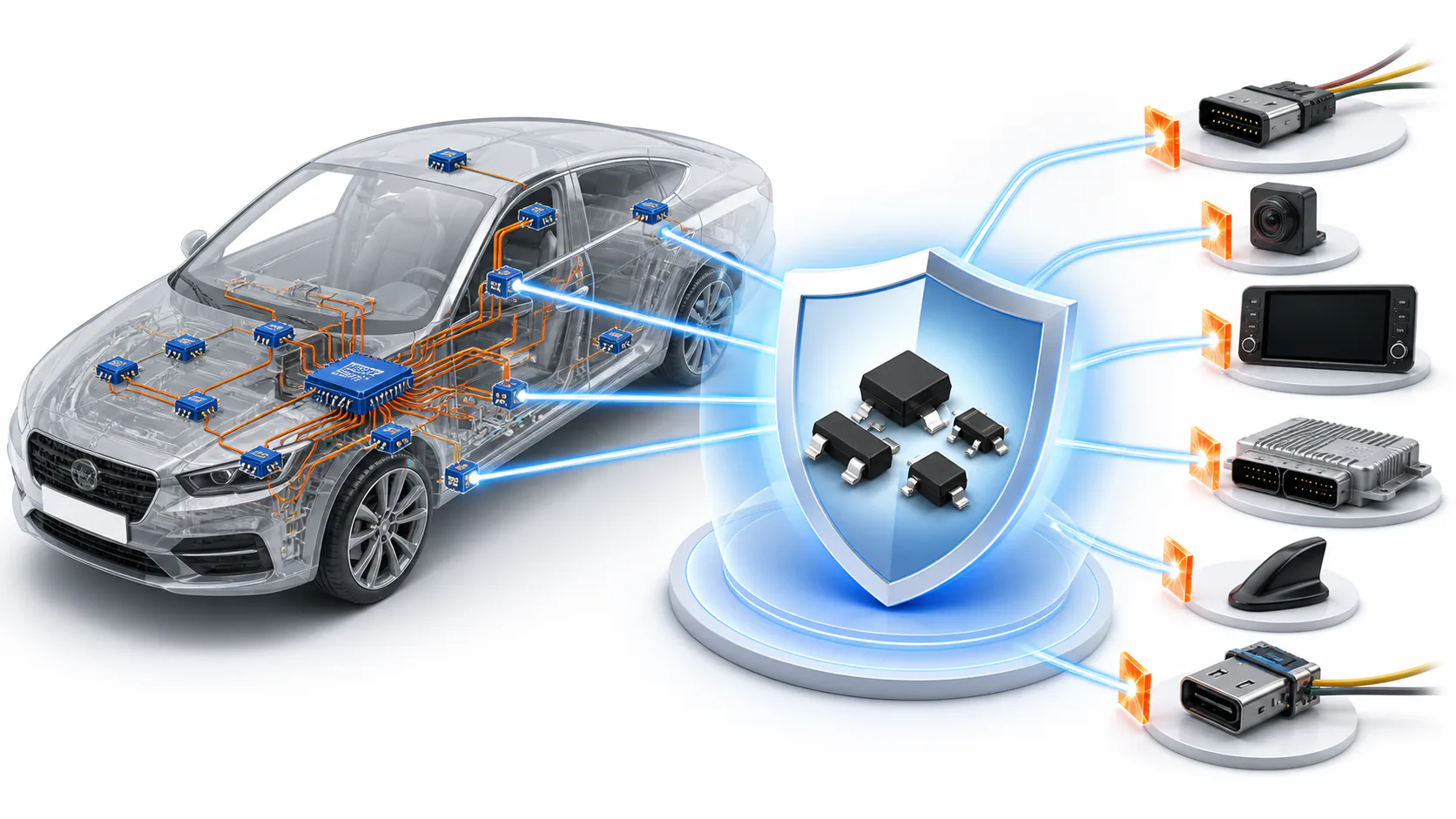
A TVS suppresses transient voltage; an ESD device shunts electrostatic discharge. In plain terms: when the board gets kicked by a voltage spike, these parts take the hit so the chip behind them doesn't. Connector hot-plug, chassis ESD, window-motor start/stop, harness coupling, a spike on the 12 V / 24 V rail — any of these can send a downstream IC into early retirement.
So second-sourcing a TVS/ESD part is not finding "same package, similar voltage, lower price." What actually matters: reverse standoff voltage, breakdown voltage, clamping voltage, peak pulse power, junction capacitance, leakage, and the automotive standards — AEC-Q101, IEC 61000-4-2, ISO 7637-2, ISO 16750-2.
Two parameters trip people up:
- Clamping voltage too high → the surge still punches through to the downstream IC.
- Junction capacitance too high → a high-speed line gets dragged slow.
A protection part is not "the more aggressive the better." On a power port it must survive the surge; on automotive Ethernet, SerDes or USB it must be light enough not to distort the signal.
The China-based bench — segmented by where it fits
The domestic supply base is no longer blank; it segments cleanly by application layer:
| Supplier | Where it fits | Representative capability (per public data) |
|---|---|---|
| JJW | Power-input, motor, body actuators | AEC-Q101 Rev-E auto TVS/ESD; DO-218 for 12 V/24 V, ISO 16750-2 load-dump P5a/5b, 4.6–8.0 kW pulse; >1.0 kW in SMB |
| DOWO | Solution-level: LIN, CAN, T-BOX, lighting, BMS | 48 V LIN protection (SD48C-Q, DWC4840NS-Q); LIN-bus TVS (TPSMBJ15A/24A, SMB/DO-214AA, 600 W, AEC-Q101) |
| Leiditech | Interface protection: CAN, auto-Ethernet, lighting | SMC24 for CAN ESD (24 V bidir, 25 pF, SOT-23, IEC 61000-4-2 L4, ±30 kV, AEC-Q101) |
The signal here: China-based protection is no longer just "a part number exists" — it now arrives organized by LIN / CAN / T-BOX / lighting / BMS use case, which is exactly how a Western buyer needs to source it.
The incumbents show the right way to classify
The established Western suppliers give the model to copy: they don't sell "a TVS," they sell protection by interface.
- Nexperia — auto ESD/TVS lines split by LIN, CAN(FD), FlexRay, automotive Ethernet, infotainment and SerDes, emphasizing low working capacitance.
- ST — auto ESD pages explicitly cover ADAS, V2X, CAN-FD, SerDes and Ethernet Base-T, stressing AEC-Q101 and system-level surge.
- Bourns — SM8S-Q / SM8SF-Q as the power/data-line transient benchmark (AEC-Q101; 6600 W / 7000 W peak; ISO 7637-2, ISO 16750-2).
The lesson for the buyer is blunt: don't second-source with the coarse bucket "a domestic TVS for an imported TVS." Source by interface and risk. Power input → power, clamping, load-dump. CAN/LIN → capacitance, EMC, bus waveform. Automotive Ethernet / SerDes → ultra-low capacitance, insertion loss, signal integrity. Motor / inductive loads → surge, freewheeling, thermal.
The counter-intuitive procurement rule
The cheaper the part, the less you can decide on price alone — because when it fails, what breaks is the expensive IC behind it and the reliability of the whole unit. A few cents saved that sends one ECU back for repair doesn't even cover the tape on the return shipment.
Engineering must confirm three things on any swap: (1) the test conditions match, (2) the protected target matches, (3) unit-level ESD / surge / EMC has been re-verified. A 24 V ESD part on LIN is not the same part on CAN-FD; a TVS on a 12 V input is not the same on a high-speed Ethernet line.
A practical, layered rollout:
- Consumer/industrial interfaces → can swap first.
- Low-speed body (LIN, lighting, window, seat, tailgate) → second-source qualification.
- CAN-FD, automotive Ethernet, SerDes, high-speed camera links → proceed with caution.
- HV power input, 48 V networks, strong-surge nodes → mandatory AEC-Q101, load-dump, thermal and customer validation.
Bottom line
TVS / ESD / protection parts are low-price, high-volume — but not low-barrier. They don't decide how smart a system is; they decide whether it survives ESD, surge, hot-plug, short circuit and inductive kickback. The mature second source isn't "the main chip went domestic" — it's a protection-alternative table sitting next to every interface a surge can reach.