
In 2026, the strongest signals in silicon capacitors are no longer simply higher published specifications. Samsung Electro-Mechanics has disclosed a long-term supply agreement, while Analog Devices completed its acquisition of Empower Semiconductor in July. Silicon capacitors are moving beyond a small category in the passive-component catalog and into competition around power delivery, advanced packaging and high-speed interconnects.
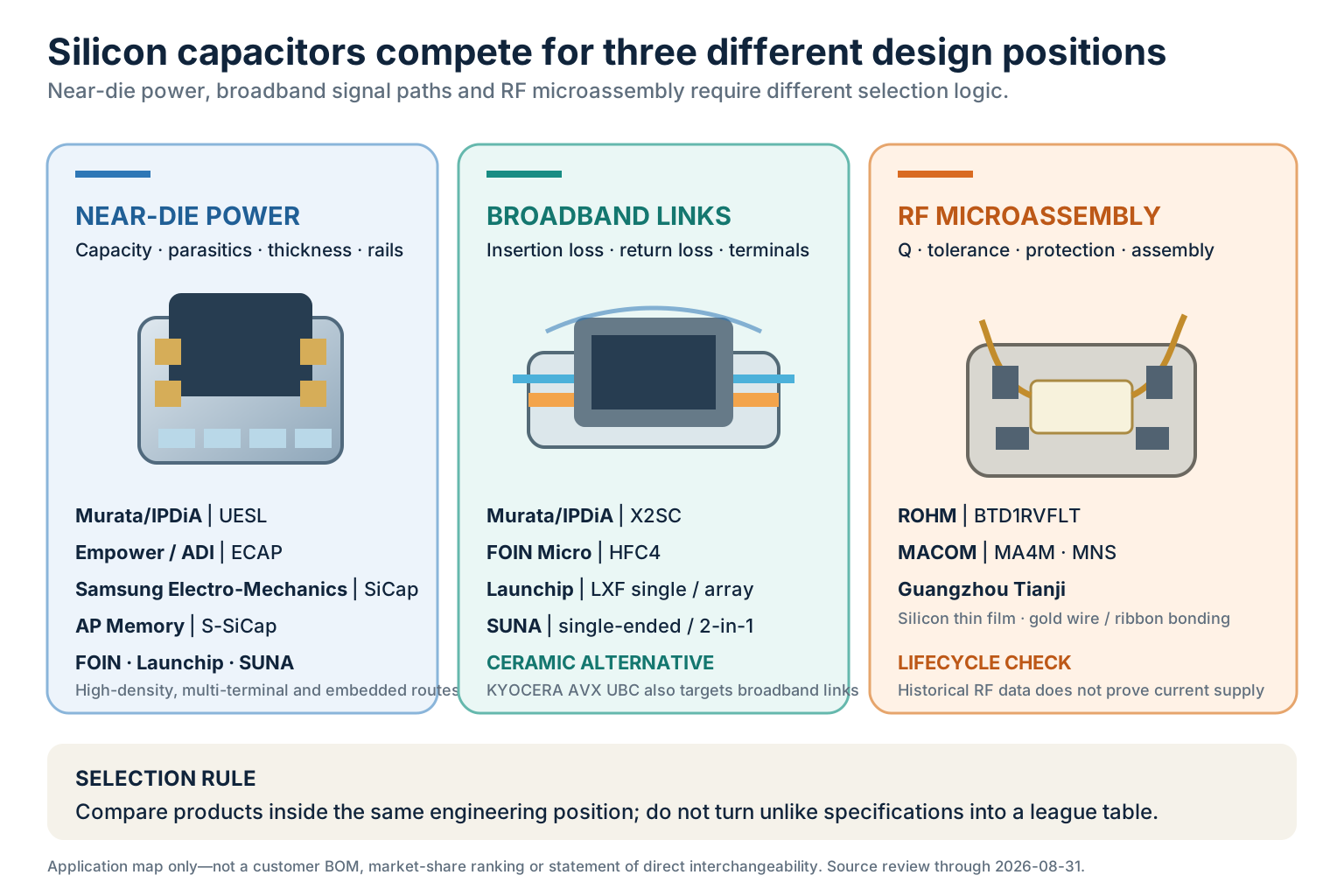
These suppliers should not be placed in one simplistic ranking. RF devices measured in hundreds of picofarads, broadband DC-blocking capacitors measured in tens of nanofarads and near-die decoupling products measured in microfarads perform different jobs. A more useful way to understand the market is to ask where each supplier intends to place the capacitor and in what form it enters the customer's design.
1. Near-die decoupling for AI: the contest has moved inside the package
Murata/IPDiA's UESL, Empower's ECAP and AP Memory's S-SiCap are useful comparisons, but they enter the system differently. Murata already offers an ultrathin product family for near-die decoupling. Empower provides single- and multi-power-domain configurations. Its May 2026 product guide describes the EC2005P as two 4.68 μF cells in a 2 × 2 mm package, for 9.36 μF of total nominal capacitance. Now that Empower is part of ADI, ECAP sits within a power-delivery portfolio that also includes integrated voltage regulation; its competitive set is no longer limited to other discrete capacitors.
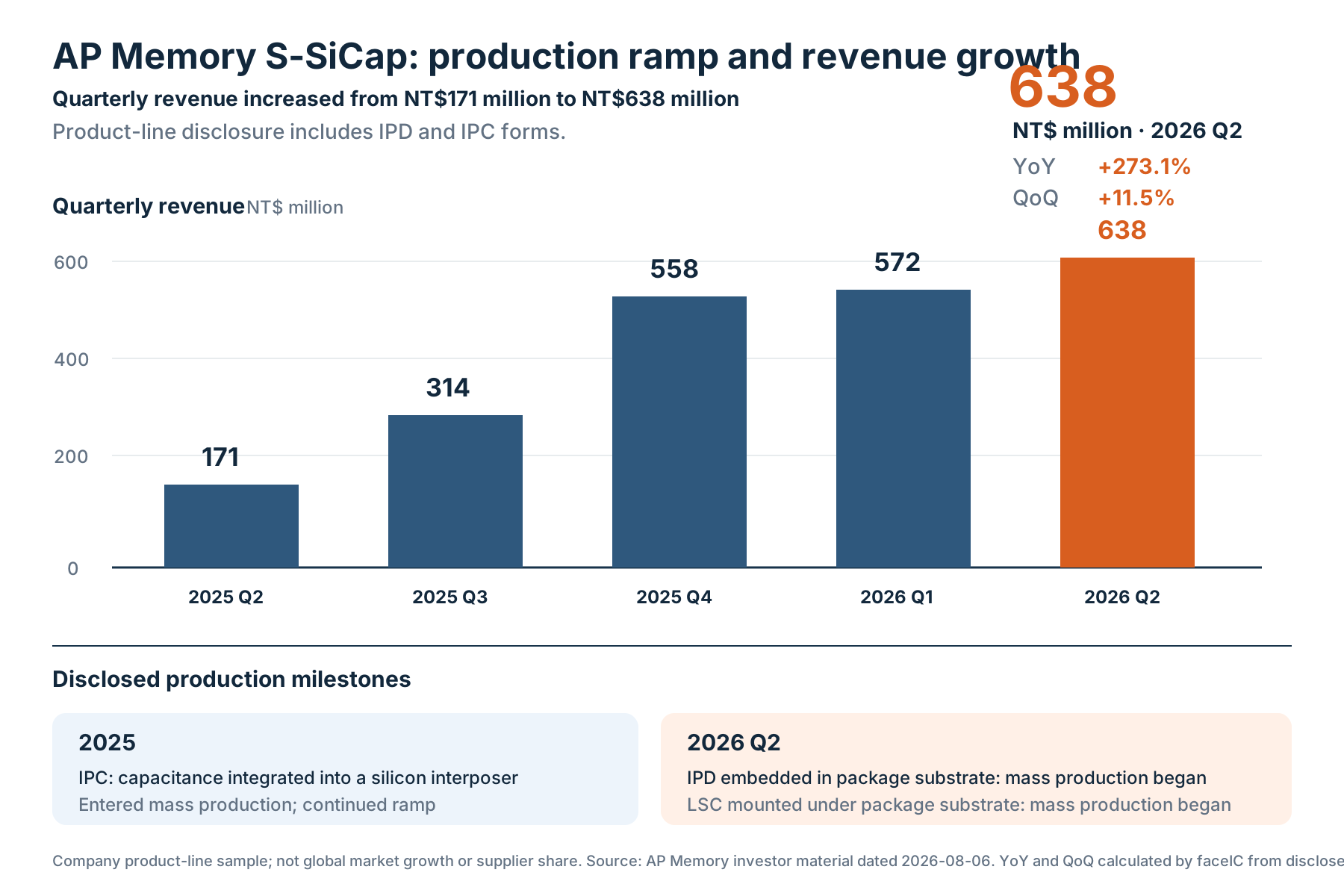
Taiwan-based AP Memory is moving closer to packaging processes. S-SiCap includes both discrete devices and an IPC route that integrates capacitance into a silicon interposer. Its latest investor material says IPC entered mass production in 2025, while substrate-embedded IPD and products mounted on the underside of a package substrate entered mass production in the second quarter of 2026. Samsung Electro-Mechanics has disclosed both LSC and embedded-product roadmaps. Its SCGCAP554M93JGNNWT is a 550 nF, four-power-domain device currently listed as available for sampling.
Suppliers based in mainland China are participating as well. FOIN Micro positions its HDC family for high-density decoupling. Launchip's LHC family spans 2-, 7-, 12- and 49-terminal configurations, with the 49-terminal device reaching 2 μF. SUNA also offers multi-terminal, high-density and embedded-mounting approaches. The useful comparison is effective capacitance under the target rail, mounting-loop inductance and package compatibility, not a ranking of promotional capacitance-density figures.
2. Broadband optical links: two 22 nF parts are not automatic substitutes
Broadband silicon capacitors occupy a different location: they pass high-speed signals while providing DC blocking, coupling or bypass functions. Murata's X2SC 939120422522-T5S and Launchip's LXF223SA1K0092 are both 22 nF, but their nominal body dimensions are approximately 0.60 × 0.30 mm and 0.42 × 0.22 mm, respectively. FOIN Micro's HFC4 family also includes a 22 nF 0402-format option. Equal capacitance does not remove differences in footprint, voltage, land pattern or high-frequency behavior.
SUNA's single-ended and differential broadband families illustrate another path. The supplier publishes insertion loss below 1 dB at 150 GHz for a single-ended line and below 1 dB at 110 GHz for its differential products; the latter use an integrated two-in-one structure. In a multichannel optical module, integration and terminal organization have engineering value of their own. Every product does not need to compete only on the highest stated frequency.
Nor does silicon have exclusive ownership of the broadband position. KYOCERA AVX takes a ceramic route with its UBC 550W family, also offering an 01005 form factor and typical insertion loss below 1 dB through 110 GHz. Optical-module selection therefore needs to consider the full frequency band, insertion and return loss, test conditions and mounting structure. Point specifications, simulation curves and catalog limits from different suppliers cannot be arranged into a simple performance ranking.
3. Established RF suppliers remain relevant—but an old vendor list is not enough
ROHM's BTD1RVFLT27N102 is a differentiated example: 1,000 pF, 3.6 V, 01005 and an integrated TVS. It emphasizes the combination of miniaturization and protection, rather than microfarad-level capacitance or a 110 GHz headline. These devices serve coupling and high-frequency functions in compact equipment; they are not selected against AI-package capacitors on the same basis.
MACOM's MA4M family uses a metal-nitride-silicon structure. The 30 pF MA4M3030, for example, targets microwave integrated circuits. Guangzhou Tianji's publicly filed material on silicon thin-film capacitors emphasizes gold surface electrodes and compatibility with gold-wire or gold-ribbon bonding. Both examples reinforce the same point: silicon capacitors do not all need to enter AI systems. Microwave microassembly, matching and tuning remain distinct markets.
Lifecycle status matters too. Skyworks included multiple SC-family part numbers in a May 2026 discontinuation notice. The last-order date passed on July 28, with final shipments scheduled through April 28, 2027; that does not mean all channel inventory disappears immediately. Vishay's HPC0402 has well-documented historical silicon-RF material, but an old data sheet does not prove current availability. For engineering and purchasing teams, "once offered" and "appropriate for a new design today" are different statements.
4. To measure commercialization, separate revenue, contracts and samples
AP Memory provides a concrete commercialization example. Quarterly S-SiCap revenue rose from NT$171 million in the second quarter of 2025 to NT$638 million in the second quarter of 2026. Using the disclosed figures, that is approximately 273.1% year-over-year growth and 11.5% sequential growth. The revenue line includes IPD and IPC forms, however, so it cannot be used to infer global silicon-capacitor growth or the size of the discrete-only market.
Samsung Electro-Mechanics' supply agreement is a different measure: approximately KRW 1.557 trillion to be fulfilled in 2027 and 2028. The customer is undisclosed. It should not be presented as revenue already recognized in 2026, nor tied directly to a specific sampling part on the company's website. ADI's acquisition of Empower includes integrated-voltage-regulator capabilities as well as silicon capacitors. Realized revenue, future supply contracts and whole-company acquisitions therefore represent commercialization, orders and capability integration, respectively; they cannot be added together as one market-size figure.
The pattern is clear. Silicon-capacitor competition is shifting from individual specifications toward a combination of device, package, model and sustained supply. Once a capacitor enters a substrate or interposer, validation includes materials, assembly, reliability and process collaboration—not electrical performance alone. The opportunity for China-based suppliers is correspondingly specific: build a verifiable and deliverable solution in a selected application, instead of using one headline specification to claim every market.
Conclusion: the dividing line is the layer of the design a supplier can enter
Murata's multi-family platform, the packaging routes taken by Samsung and AP Memory, Empower's position in power delivery, ROHM's integration of miniature protection, and the different portfolios of FOIN Micro, Launchip, SUNA and Guangzhou Tianji show that there is no single winning template.
High-speed signal-chain products, near-die power-delivery products and microwave-microassembly products should be evaluated separately. The most meaningful signal is which parts move from a specification sheet into validation, volume production and repeat delivery—not which supplier publishes a new maximum frequency or capacitance-density claim.
This article is based on public manufacturer information and materials supplied by vendors. It is intended for industry discussion only. Confirm specifications, availability and suitability against the latest manufacturer documents and project-level validation.